





Rivernotes
ASF Rivernotes 30 Oct 2020
asf
October 30, 2020

TOM MOFFATT ~ TMOFFATT@ASF.CA

MAINE
A Fall Run of Atlantic Salmon on the Penobscot River
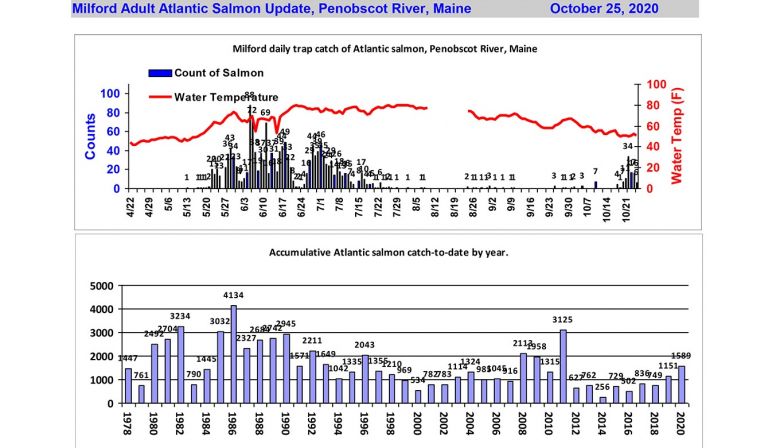
This is indeed a moment for celebration, as it raises the possibility in future of a distinct Fall Run of Atlantic salmon migrating up the Penobscot River. The river continues to have both a very large potential habitat for spawning salmon and the largest return. And this year we have the highest return since 2011.
Jason Valliere, Biologist with the Maine Department of Marine Resources, provides the latest information:
We finally got some rain, and Penobscot River flows have returned to normal conditions. Water temperature has dropped below 10C. Salmon are making their final push to spawning grounds.
We have had 127 new fish since the last update. Twenty have passed through the Orono fishway and 107 through Milford.
I wanted to add a special thanks to Brookfield for maintaining the video equipment and reviewing the video to update these counts, and allowing the fishway gates to be open for free uninterrupted passage.
Please remember that counts have not been adjusted for in-season recaptures based on PIT tag, radio tag, etc. The counts will be adjusted as data become available.
Narraguagus
In addition to the very good news on the Penobscot, there is yet another positive development on the Downeast Rivers.
Colby Bruchs, Maine DMR fisheries scientist, says:
We have two new captures, one female MSW salmon and one grilse have been captured since 19 Oct.. Elevated flows were short lived as discharge has declined to about 80 cubic feet per second. Water temperature remains about 10 C.
The adult trap is being removed for the season on Thurs., 29 Oct..
Atlantic salmon count through 27 October:
Season total: 108 Atlantic salmon, including 94 Multi-sea-winter fish and 14 grilse.
Kennebec Watershed – Sandy River
QUEBEC

Charles Cusson, ASF Director of Programs in Quebec, writes:
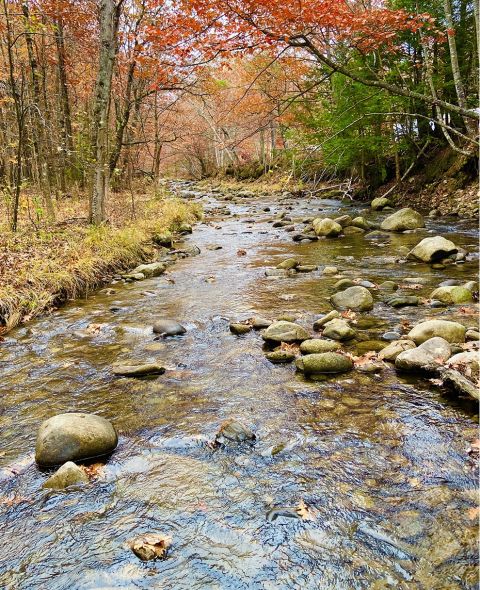
René Giroux, field operations manager for the Three Pabos Rivers, was walking along the rivers last week-end curious to see if spawning had begun. Mother Nature had brought some badly needed rain which helped the fish holding in the estuary since August to move up in the system. For years now, “Our rivers seem to be in an area that precipitation misses during our angling season, I wish we would have had this type of flow in June and July” laments Giroux.
René was able to capture some great scenes last weekend and has graciously agreed to share with us this week.
“As much uncertainty loomed back in May, we ended up having a very good season with no downturn in the number of anglers, there was a silver lining to the Covid-19 situation in the form of new anglers coming to fish our rivers”.

The Three Pabos Rivers (Source: Saumon Québec)
The name Pabos comes from the Native American word Pabog, meaning “still waters”. These three rivers, Petit Pabos, Grand Pabos North and Grand Pabos West, gradually descend from their source, the Gaspé highlands, in a winding course in a wild nature, then flow into the Gulf of St. Lawrence between the villages of Grande -Rivière and Pabos. They total 140 kilometers, 50 of which are open to salmon fishing. These splendid streams share cool and cold crystal-clear waters and a history of successful efforts to preserve and rebuild the Atlantic salmon population.
Over the centuries, these rivers have fed generations of indigenous people, enriched industrial fishing, and attracted sport fishermen, while runs of over 1,500 salmon were common. However, the species almost disappeared from these rivers at the end of the 20th century. This led to the closure of the Pabos to salmon farmers in 1984, followed by years of hard work to rebuild the salmon population, work supported by the Salmon Economic Development Plan, the community and the Three Pabos rivers restoration group.
The three Pabos rivers offer salmon anglers a total of 11 fishing zones, five of them with limited access and all accessible by footpath, and 91 pools. In addition to the Atlantic salmon, the Pabos rivers also have a healthy sea trout population with a weight varying from 1.4 to 2.7 kilograms.

This coming Sunday, Nov. 1, is the day most rivers hold their draws for the next season’s fishing. If you wish to enter a draw click on:
https://tirage.manisoft.ca/index_en.php
René Giroux, coordinateur de terrain pour les Trois Rivières Pabos, pendant une randonnée des rivières la fin de semaine dernière, s’est aperçu qu’il y avait beaucoup de saumon au rendez-vous. Dame Nature avait apporté de la pluie dont le besoin se faisait cruellement sentir, ce qui a aidé les saumons qui se trouvaient dans l’estuaire depuis le mois d’août à remonter dans les rivières. Depuis des années, « Nos rivières semblent être dans une zone où les précipitations nous ignorent pendant notre saison de pêche, j’aurais aimé que nous ayons ce type de débit en juin et juillet », se lamente Giroux.
René a pu capturer de superbes photos le week-end dernier et a gracieusement accepté de les partager avec nous cette semaine.
« Alors que beaucoup d’incertitude planait en mai, nous avons fini par avoir une très bonne saison sans que l’achalandage de pêcheurs connaisse une baisse, il y avait une lueur d’espoir dans la situation du Covid-19 sous la forme de nouveaux pêcheurs venant pêcher nos rivières ».
Le nom Pabos vient du mot amérindien Pabog, signifiant « eaux tranquilles ». Ces trois rivières, petit Pabos, grand Pabos Nord et grand Pabos Ouest, descendent progressivement de leur source, les hauts plateaux gaspésiens, en un parcours sinueux dans une nature sauvage, puis se jettent dans le golfe du Saint-Laurent entre les villages de Grande-Rivière et de Pabos. Elles totalisent 140 kilomètres, dont 50 sont ouverts à la pêche au saumon. Ces splendides cours d’eau ont en commun des eaux cristallines fraîches ou froides ainsi qu’une histoire marquée par des efforts couronnés de succès pour préserver et reconstituer la population de saumon atlantique.
Au cours des siècles, ces rivières ont nourri des générations d’autochtones, enrichi la pêche industrielle et attiré les pêcheurs sportifs, alors que les montaisons de plus de 1500 saumons étaient courantes. Or, l’espèce a presque disparu de ces cours d’eau à la fin du 20e siècle. Cela a conduit à la fermeture des Pabos aux saumoniers en 1984, puis à des années d’un travail acharné pour reconstituer la population de saumon, travail soutenu par le Plan de développement économique du saumon, la communauté et le Regroupement pour la restauration des trois rivières Pabos. Résultat : on trouve maintenant dans celles-ci des saumons de 2 à 15 kilogrammes.
Les trois rivières Pabos offrent aux saumoniers un total de 11 secteurs de pêche, 5 d’entre eux étant à accès contingenté et tous étant accessibles par sentier pédestre, et de 91 fosses. Outre le saumon atlantique, on trouve, dans les trois rivières Pabos, parmi les espèces les plus fréquentes, de la truite de mer au poids variant de 1,4 à 2,7 kilogrammes.
NEWFOUNDLAND
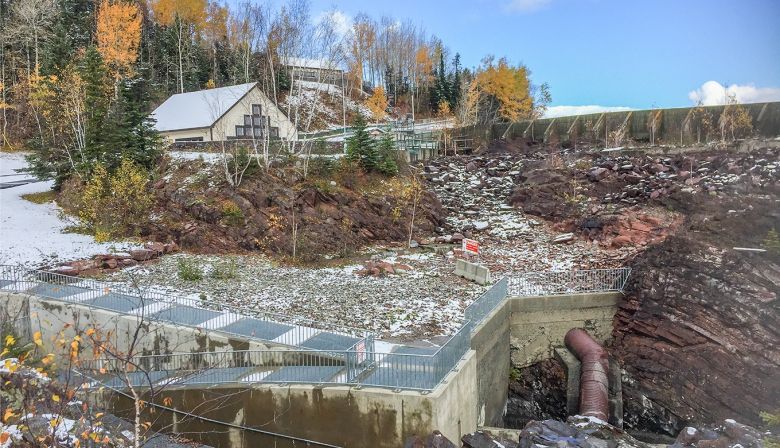
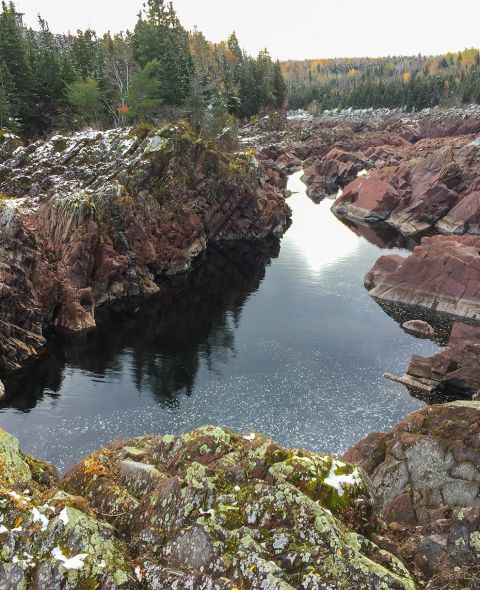
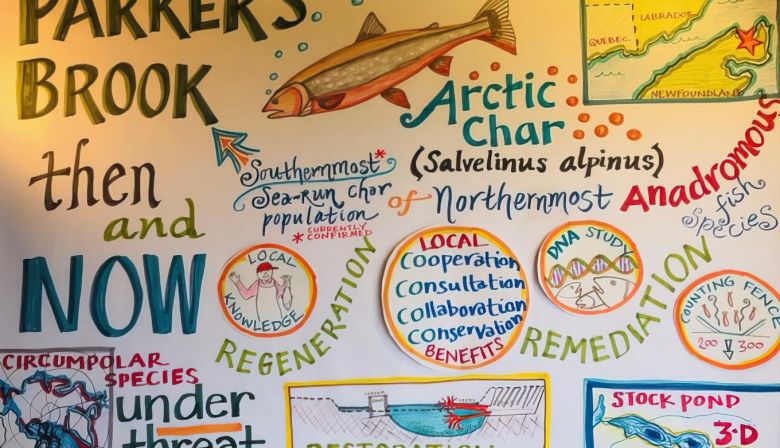
Chelsea Boaler, a PhD candidate and Specialist on Marine Ecosystems and Fisheries with WWF-Canada, writes about Parker’s Brook:
On Tuesday October 27, 2020, we had a successful webinar entitled, “Parker’s Brook: Then and Now.”
Parker’s Brook (also locally known as Western Brook) is a river that runs into Pistolet Bay on the Northern Peninsula of Newfoundland.
This event showcased past community-led work and research in the area, shifting threats and current community concerns, and present and future-planned monitoring and restoration work for this key ecosystem. The stream is home to the southernmost confirmed population of anadromous Arctic char.
The event was a multi-partner initiative including community members and cabin owners, DFO (Regional St. Anthony Office, and Science), Save Our Char Committee, and WWF-Canada (funded by Environment and Climate Change Canada). For more information, including copies of presentation material, please contact:
Chelsea Boaler at cboaler@wwfcanada.org.
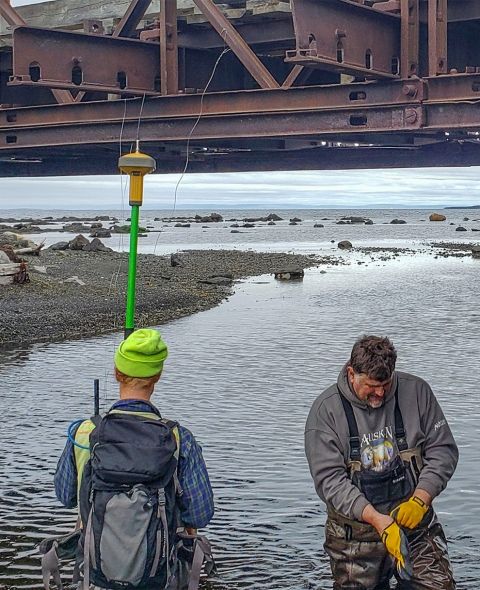

Humber
Don Ivany, ASF Director of Programs for Newfoundland and Labrador notes that generally river levels are high, and of course the salmon angling season has now been over for 2020 for two weeks.
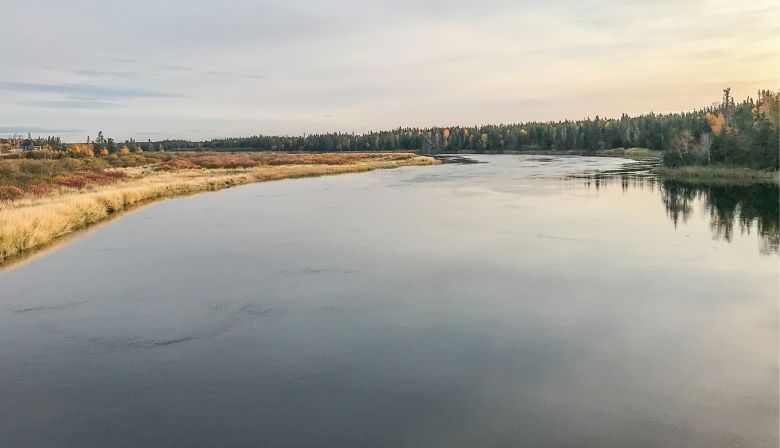
NOVA SCOTIA
Margaree
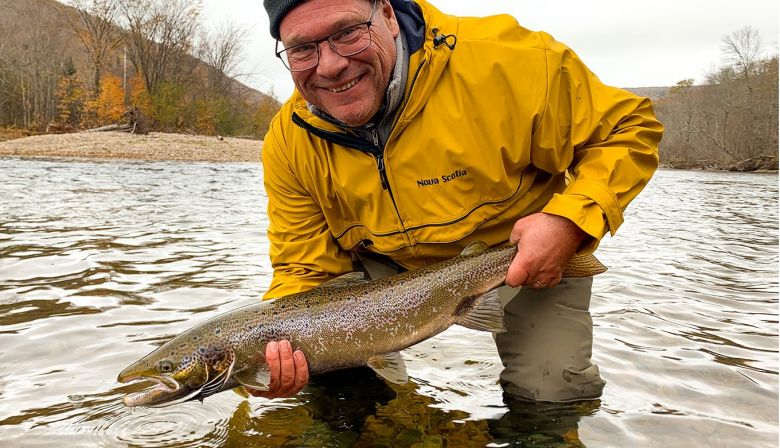
As Alex Breckenridge says, “The Season has been a Strange One”. Elevated temperatures and drought conditions put the salmon in jeopardy, but nevertheless they kept coming in from the sea. The rains came in October, and the water temperatures dropped. With the occasional higher flows, Atlantic salmon were able to move upstream, into the deep valley and beckoning spawning areas.
NEW BRUNSWICK
PRINCE EDWARD ISLAND
Fish are slow moving upstream because of the low water levels, although there are some grilse and msw holding in pools in the lower portion of the Morell. Keeping our fingers crossed for some decent rainfall.
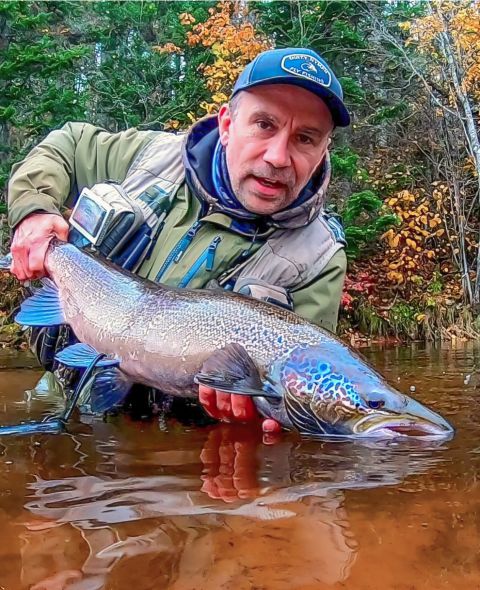
Taylor Main says:
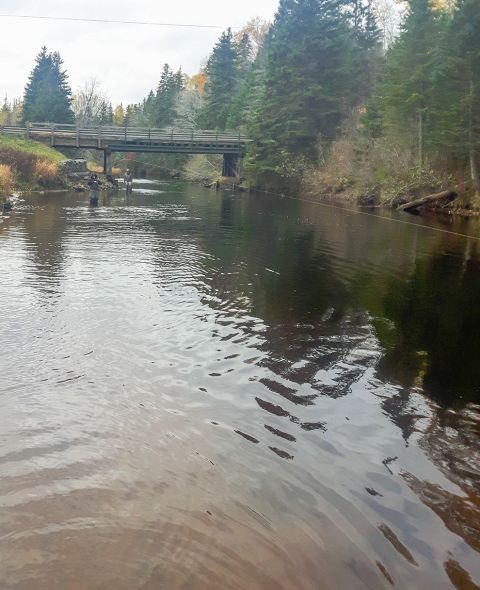
Over the past couple of days we’ve seen many more large salmon entering into the rivers. The fish are extremely spooky with the water this low. However, the odd one has been convinced to take a fly. Landing them on the other hand has proved difficult with all the soft takes.
On Wednesday I was with a group of five other anglers at a pool who had 4 MSW fish on rod and two other large hits but only managed to land a grilse over the course of the day. Aside from that it seems like there has been a decent number of grilse picked up throughout the season but fewer large salmon than in years past. The redd count data that will be collected over the next month should settle the score.
THE FINAL WORD – WILDNESS AND CIVILIZATION
But wild Atlantic salmon move silently in the oceans and streams around the North Atlantic Ocean, migrating their thousands of kilometres to and from distant feeding grounds, and seemingly showing up in our streams in better health, physical condition and numbers than could be imagined.
This is something to believe in. This is something to work towards improving and encouraging for next year, for their next generation, and for the decades ahead. When our own culture has the difficulties such as we have experienced this year, we need to have the thought that wild Atlantic salmon have that special “secret knowledge” that we can admire and that can encourage us all to do better in the year ahead.