





Uncategorized
Rivernotes April 9, 2026
pmonahan
April 8, 2026

Editor’s Note
Welcome to the first issue of Rivernotes for 2026! As the new editor of this venerable publication, I hope to build on the excellent work of last year’s editor, Adam Hodnett. I come to Rivernotes having spent the last 15 years editing the Orvis Fly Fishing blog and MidCurrent.com, and I look forward to bringing you news, information, river conditions, and fishing tips each week from Eastern Canada and Maine.
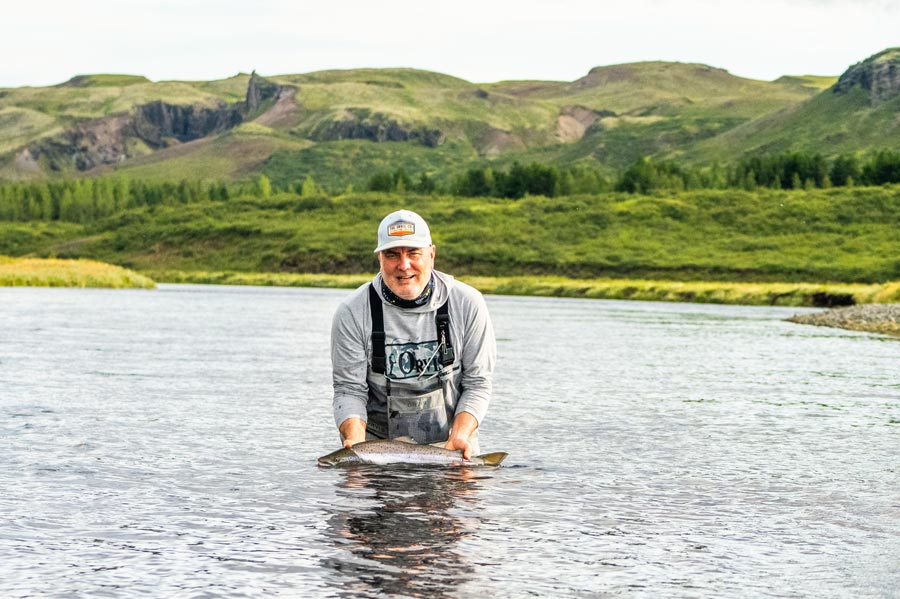
Phil Monahan with an Atlantic salmon from a coastal river in southern Iceland. Photo: Joel Ruby
I welcome your input, so if there are features or topics you’d like to see in Rivernotes—or if you’d like to submit a story, a photo, or other information—please let us know by using the Rivernotes submission form.
Kennebec Salmon Conservation in the New York Times
Last fall, ASF joined as the lead partner with The Nature Conservancy in a massive restoration project on Maine’s Kennebec River, with the goal of helping to get Atlantic salmon off the Endangered Species List in the U.S. The ambitious project includes the removal or modification of four dams, which would reconnect hundreds of miles of river, including prime spawning habitat, to the Gulf of Maine. Ultimately, salmon and other anadromous species will have access to streams that were cut off from the ocean more than a century ago.
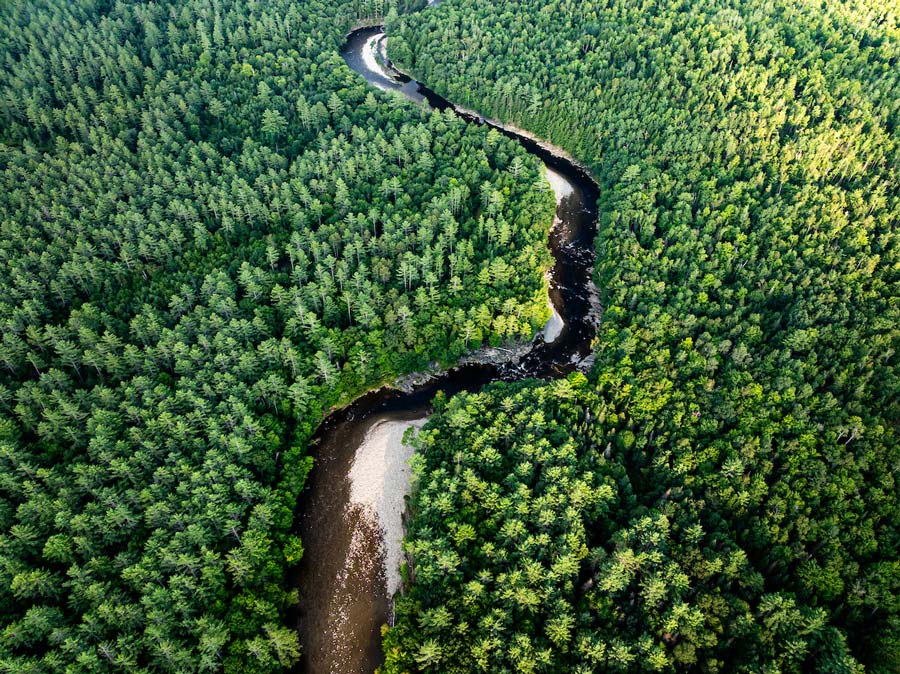
In a recent New York Times article entitled “The Fragile Hope for Salmon Recovery in Maine,” Murray Carpenter focuses on current work being done in the Sandy River watershed—a tributary of the Kennebec—as well as the potential benefits of the decade-long project to remove the barriers to fish migration.
The article quotes John Burrows, ASF’s vice president for U.S., who explains why tributaries like the Sandy are so vital for the long-term survival of the Kennebec’s salmon:
“It’s a climate-resilient landscape, high elevation and heavily forested,” Mr. Burrows said. “It’s an area that’s going to remain supportive of Atlantic salmon well into the future.”
Read the full story in the New York Times
Canadian Government Pledges Funds for Salmon Protection
Details of Mark Carney’s $81 million Atlantic Salmon announcement (while we cannot get too excited since the details are lacking), it’s huge news and he mentioned Atlantic Salmon!!!
Click here for more information on ASF.ca
UK Springer Season Update
by Andrew Goode, ASF Vice President of U.S Development
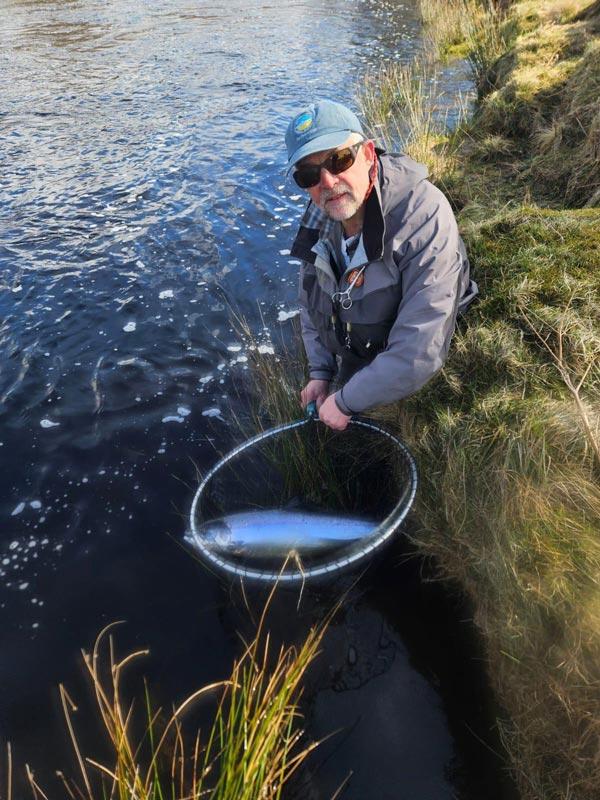
Photo by Brad Burns
The spring 2026 Atlantic-salmon season in the UK has started noticeably stronger than recent years, particularly in Scotland. These are the chrome-bright fish considered to be the finest fighting fish of the season. The season starts earlier than in North America, beginning in January on the major rivers and building through March. Brad Burns, a passionate US angler and frequent UK visitor describes the reason for the early season,
“In Scotland you are much farther north than we are in Maine or even in Atlantic Canada, but the tail end of the Gulf Stream and a northward current out of the Mediterranean combine to form the ‘North Atlantic drift.’ Prevailing winds are from the west off the sea. The weather isn’t typically freezing, even overnight, but it isn’t balmy, either. This is a land for wool and good foul-weather gear.”
Certainly, anglers need to pick their days in these early months of the season.
Both the Dee and Tay rivers reported catches well above the five-year average. Other rivers—such as the Tweed, Spey, and northern rivers—were all reporting better catches than last year, when low water levels were a widespread problem. Still, the early season is not a numbers game, and most anglers would be pleased with landing a couple of the springers in a week of fishing. But the early season maintains a certain reverence for anglers after a long winter.
These early numbers may indicate better at sea survival this past winter. Hopefully this trend will continue the rest of the 2026 season.
Video: Q&A with ASF VP of Research, Valérie Ouellet
Recently, ASF Communications Director Kristen Noel hosted a webinar with Valérie Ouellet, our Vice President of Research to answer some of the most common questions about Atlantic salmon migration, threats to North America’s wild populations, and best practices for handling fish, among others. It’s a fascinating hour-long discussion that is chock-full of information that will help you better understand the work we do at ASF and how you can be a part of protecting these iconic fish and their habitat.
Upcoming ASF Events
The next month offers some great opportunities to support ASF’s mission and play a role in protecting Atlantic salmon populations and the rivers that sustain them. Two important fundraising events and a fun trade show offer the opportunity to interact with other ASF members who share your passion for this iconic species.
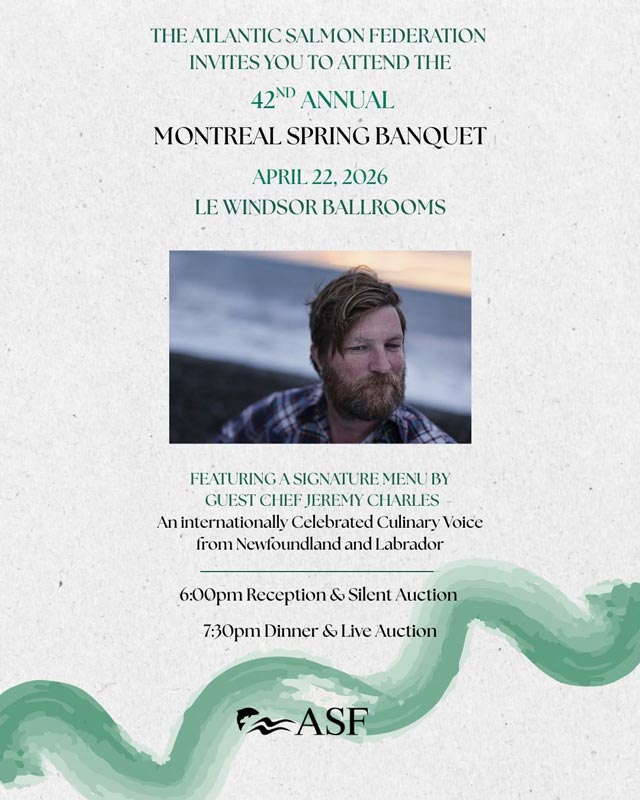
42nd Annual Montreal Spring Banquet, April 22: Join us at Le Windsor Ballrooms in Montréal for an evening celebrating great food, great company, and wild Atlantic salmon.
This year’s event will feature a signature menu by renowned chef Jeremy Charles. A chef, restaurateur, and author originally from Newfoundland and Labrador and now based in St. John’s, Jeremy has spent more than a decade championing the province’s food culture. His cooking highlights local and Indigenous ingredients, with a special focus on seafood and wild game. Jeremy is also the author of the acclaimed cookbook Wildness.
We hope you’ll join us for a memorable evening in support of Atlantic salmon conservation.
Click here to reserve your place
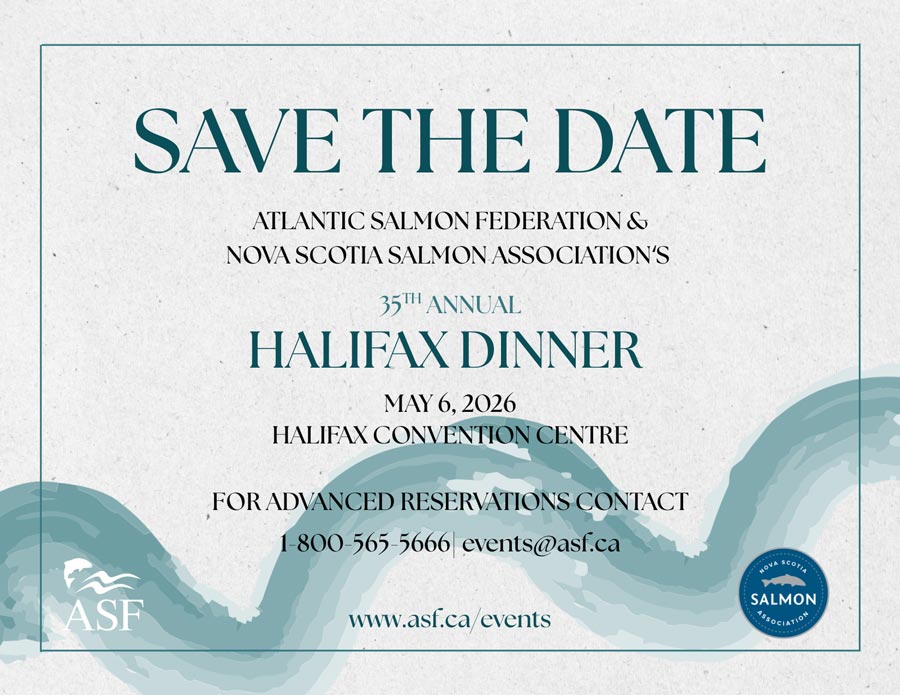
35th Annual Halifax Dinner, May 6: Don’t miss our 35th Annual Halifax Dinner, co-hosted with the Nova Scotia Salmon Association. This year we are thrilled to be honouring René Aucoin for his many valuable contributions to Atlantic-salmon conservation throughout Nova Scotia and the Maritimes. Join us for an unforgettable evening celebrating wild Atlantic salmon, and raising critical funds for the conservation and restoration of this sentinel species.
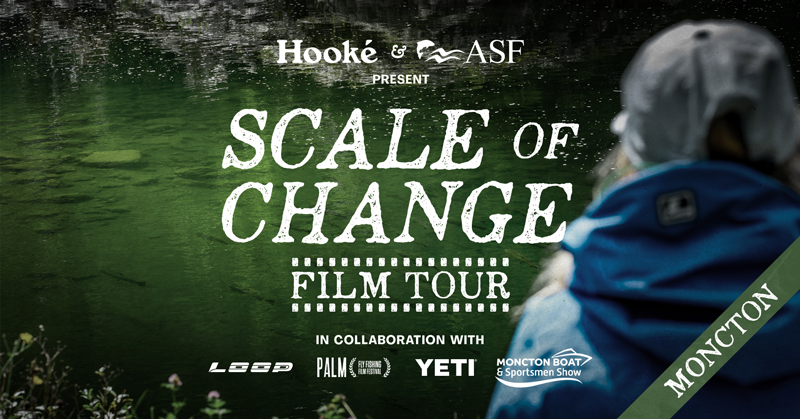
The 20th Anniversary Moncton Boat & Sportsmen Show, April 10-12: Come visit the ASF booth at the Moncton Boat & Sportsmen Show. Held at the Moncton Coliseum, the show brings together the region’s top boat dealers and offers a wide selection of outdoor products for anglers, hunters, and outdoor enthusiasts. ASF will be set up at Booth 466, so come by to say hi and to learn more about our current projects and goals.
We will also be co-hosting, along with Hooké, a showing of the Scale of Change Film Tour tomorrow evening. This collection of films is dedicated to protecting wild Atlantic salmon and the rivers they call home. Featuring powerful films from across Canada, the tour shines a light on the challenges facing this iconic species—while celebrating the people and communities working to protect it. (Click here for tickets.)
Click Here for More Information on the Show
Reflections from the Last of Out Lands Gathering
By Kyle Denny
Editor’s note: ASF Indigenous advisor sent in this report from a recent gathering of First Nation on Cape Breton. Kyle is a dedicated leader from the Eskasoni First Nation, fluent in Mi’kmaw, and deeply committed to Indigenous education, community development, and environmental stewardship. He currently serves as a board member of the Margaree Salmon Association. (Read an interview with Kyle.)
March 26, 2026 – Membertou, Unama’ki Highlands
When I first received the invitation to the Last of Out Lands Gathering, I sensed it would be more than just a meeting—it would be a journey back to the heart of what matters most: community, stewardship, and the enduring spirit of our rivers. Organized by the Unama’ki Institute of Natural Resources (UINR) and the Kwilmu’kw Maw-klusuaqn Negotiation Office (KMKNO), this gathering drew together Elders, youth, Knowledge Holders, and community members to reflect on our collective relationship with the Unama’ki Highlands—an area as spiritually significant as it is ecologically vital.
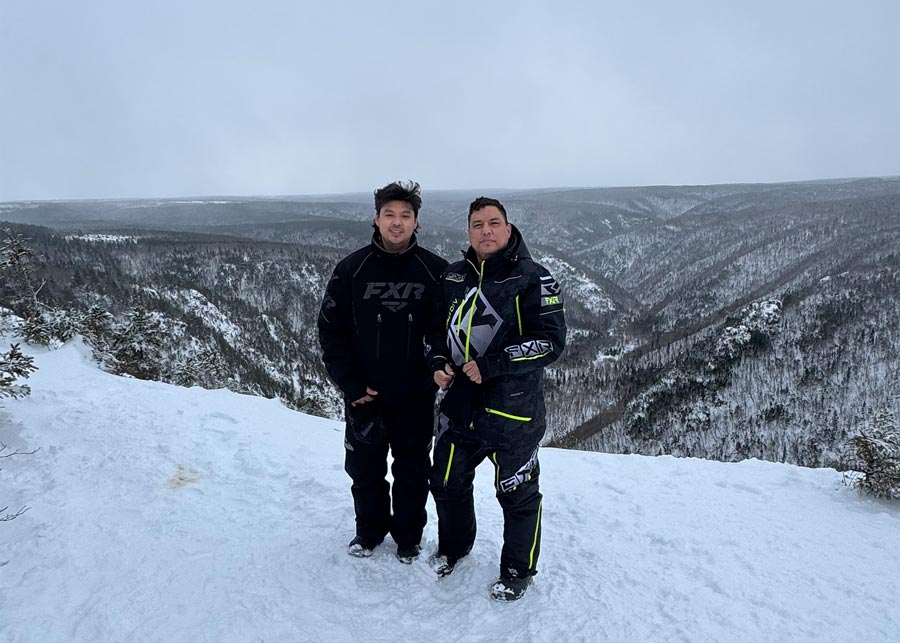
From the start, the stories shared by Elders reminded us of centuries-long connections to land and water. While the Atlantic salmon was often discussed as a symbol of renewal and responsibility, the conversations reached far beyond. People voiced concerns about the loss of Mi’kmaw medicines due to habitat change, declining moose populations, challenges in accessing Crown land, threats to bees, and the broader state of all natural resources. These issues were woven together, showing how the health of one element affects the others.
The workshops and group dialogues throughout the two days were dynamic and inclusive. We explored the complexities of land stewardship, governance models, and ecosystem-based management. Whether in small breakout groups or larger open-sharing sessions, every voice was valued. I was struck by how seamlessly traditional teachings were woven with contemporary perspectives—how the Mi’kmaq worldview of interconnectedness provides a blueprint for sustainable action.
One particularly meaningful moment for me came when I spoke up during one of the open discussions. I shared conversations I’d had with fellow salmon anglers—passionate individuals who, like me, are deeply connected to the rivers and the salmon that inhabit them. Our concern wasn’t just about salmon numbers or restoration efforts, but about the visible changes across the Highlands. I admitted to the group that while I could talk at length about river restoration or the status of salmon runs, I had zero concrete information on just how much damage tree harvesting has done in the Highlands. The uncertainty troubled me deeply.
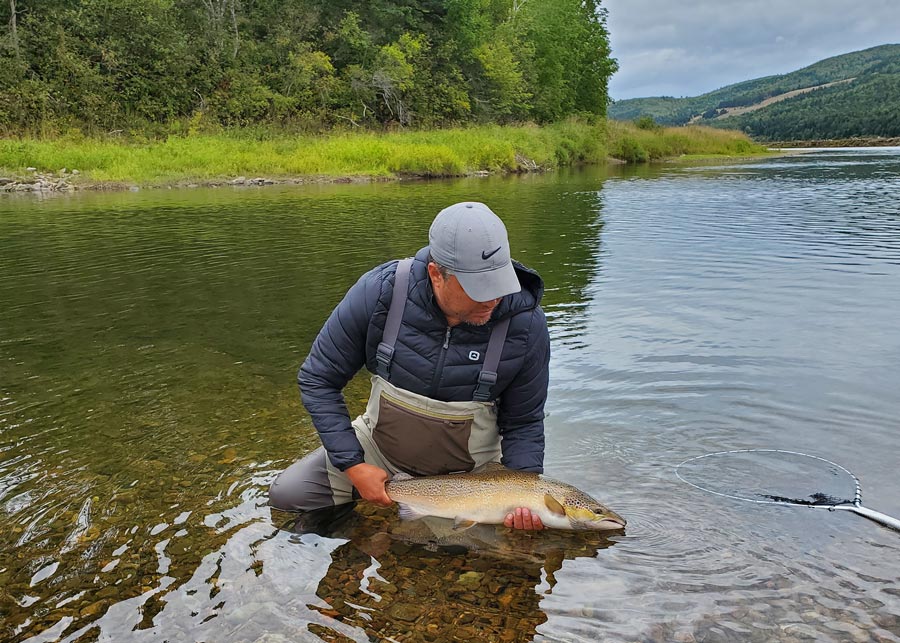
I urged the gathering to consider forming working groups and mobilizing community efforts to address this pressing issue. Only by coming together—pooling knowledge, resources, and perspectives—could we truly understand the impact of deforestation and develop solutions that honour both the land and its people.
Youth participation brought fresh perspectives and a willingness to tackle difficult questions, reinforcing hope for future stewardship. As we closed the gathering, it was clear that the protection and accessibility of all natural resources—not just salmon—remained central to our shared vision. We reaffirmed our commitment to co-develop governance grounded in Mi’kmaq values, respectful of tradition and future generations. Leaving Membertou, I felt renewed, confident that by working together, we could ensure that forests, rivers, medicines, animals, and all forms of life in the Cape Breton Highlands would remain protected and thriving for years to come.
Join ASF on a Hosted Trip on the St. Paul’s Salmon Fishing Club
Since 1964, The St Paul’s Salmon Fishing Club—nestled on the St. Paul’s River on the Lower North Shore of Quebec—has been providing clients both some of the world’s best Atlantic-salmon fly fishing. The Lodge operates on a 100% catch-and-release policy, with exclusive river rights to more than 30 miles of pristine river, and access to 35+ salmon pools. (Click here for information about the lodge and the fishing.)
Join ASF for an exclusive hosted trip to this beautiful, productive river from July 25th to August 1st. The trip includes:
- 7 days of guided fishing,
- Private lodging,
- Flights to the lodge from Deer Lake, NL
This opportunity is limited to 7 anglers, and the cost is $6,900 (USD).
For more information, contact Andy Goode at agoode@asfmaine.org