




Rivernotes
Rivernotes May 7, 2026
Phil Monahan
May 7, 2026
Editor's Note
by Phil Monahan, ASF Managing Editor
Welcome to Rivernotes, our weekly roundup of news and information from around the world of Atlantic salmon—Québec, Atlantic Canada, and Maine.
Around the Maritimes, anglers and researchers alike have been dealing with high, cold water. While fly fishers in Nova Scotia have managed to catch brook trout fairly consistently despite the conditions, according to the folks at MacPhersons Fly & Tackle in Liverpool, things in New Brunswick have been a bit tougher. Jack Bourque of Jack's Fly Shop in Bathurst told me that it hasn't been safe to wade in many places. Let's hope that this is a harbinger of good water levels all summer.
A Cape Breton Conundrum
A gorgeous feature by Jimmie Pedersen in Catch Magazine tells the story of how a brief bump in flow and color on the Chéticamp made all the difference during last year's low water.
"We took that three-inch rise and headed into the canyon. As the water rose, it turned that distinct, dark tannin…a deep, tea-colored red that makes spotting Atlantic Salmon a game of shadows and intuition. To a photographer, that orange-hued clarity is a dream; to an angler, it’s a signal that the fish might finally move. We had the water to ourselves because we were the only ones willing to gamble on a drizzle, and frankly, the only ones lucky enough to be close by to catch it."
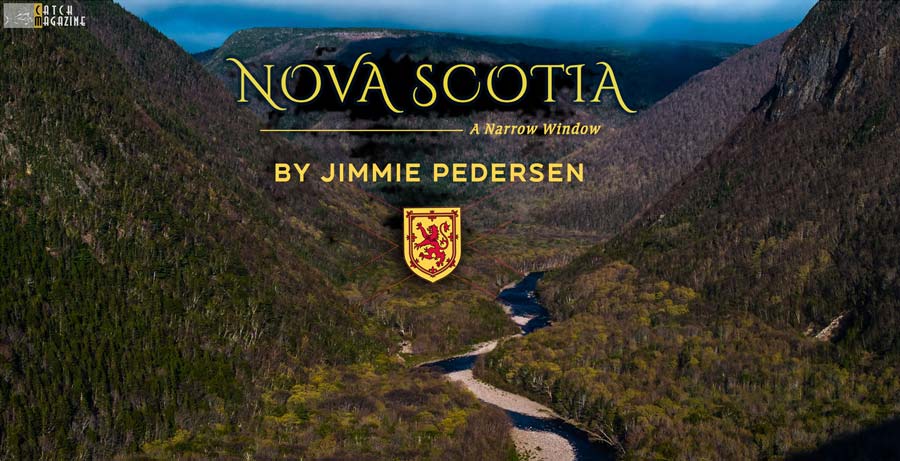
The photos are stunning—reminders of why we must continue to work to save wild rivers and the fish that rely on them.
Listen to the Saving Salmon Podcast
At the end of last year, ASF launched eight episodes of The Saving Salmon Podcast, which investigates river systems from Maine to Greenland and the wild salmon that depend on them for survival. If you haven't listened yet, now is a great time to catch up.
Hosted by award-winning CBC journalist Bob Keating and ASF Communications Director Kristen Noel, the episodes are not only full of great information, but they also transport you to the front lines of the fight—from Burgeo to the Penobscot.
Nova Scotia
Nova Scotia Program Director Matt Russell updates us on fishing conditions, as well as smolt-counting efforts on two rivers.
Streamer Season
Fishing conditions continue to improve with rising water temperatures, and river levels remain high. Following the recent heavy rains across the province, and with more rain in the forecast, it’s streamer time!
Polyleaders and weighted flies will be the keys to fruitful trout outings. Woolly Buggers of all sizes and colours are great options, as are Conehead Zonkers. For those who prefer more classic patterns, the trusty Muddler Minnow rarely disappoints.
Science and Research
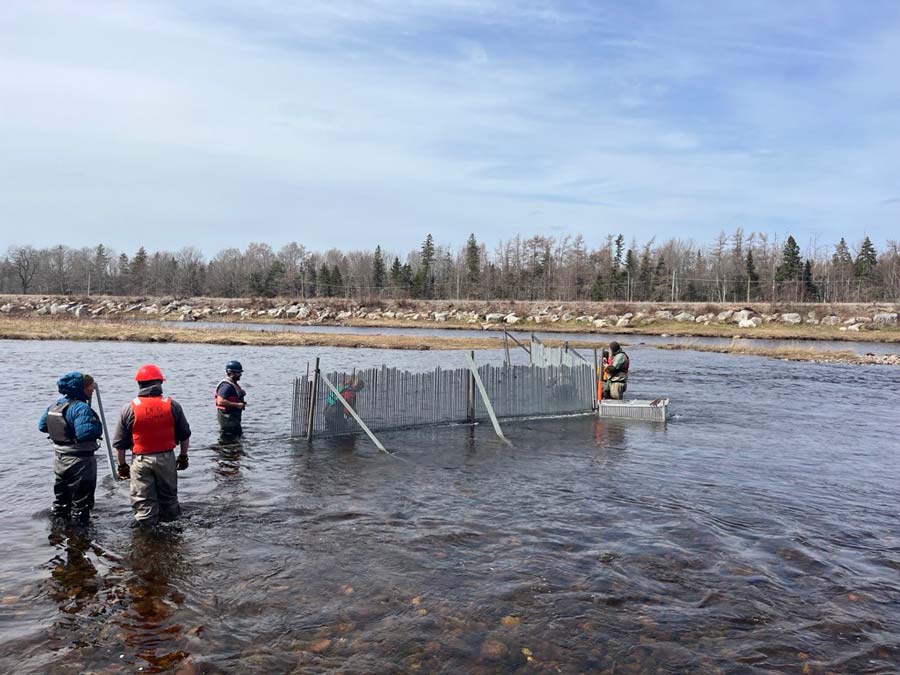
Smolt assessments across the province are in full swing, featuring our three wheels in the St. Mary’s as well as a recently installed counting fence on the West Branch of the St. Mary’s. ASF staff and partners are on the river, ready to get as many smolt tagged as possible for our modernized population assessment.
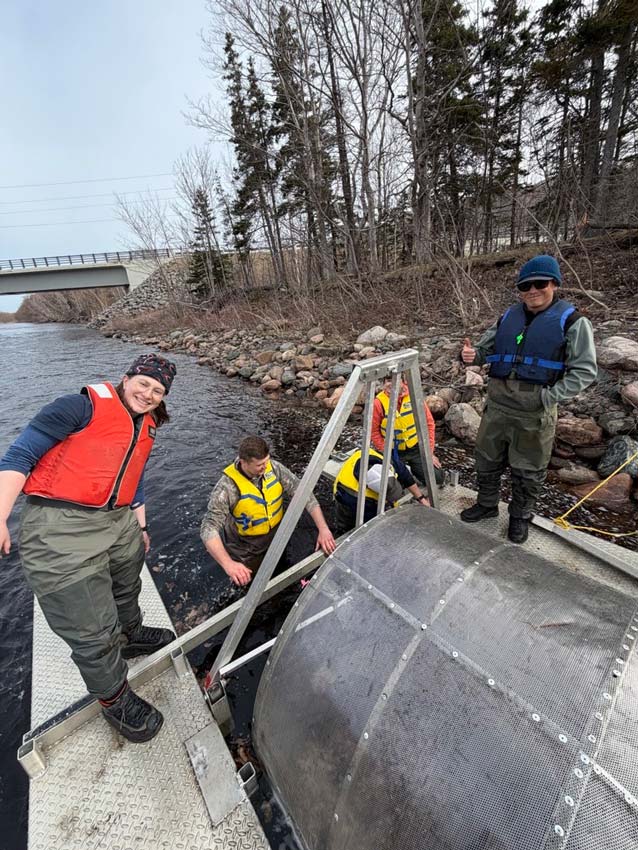
Last week, ASF staff assisted the Chéticamp River Salmon Association (our Wild Salmon Watersheds partner) with the installation of a smolt wheel on the Chéticamp. More information about this installation and project can be found in the update from Wild Salmon Watersheds (below).
Halifax Dinner
This week, ASF and Nova Scotia Salmon Association (NSSA) hosted our 35th annual Halifax Dinner at the Halifax Convention Centre. This year, we honoured Réné Aucoin of the Chéticamp River Salmon Association for his decades of leadership and commitment to salmon conservation across the province.
There will be more to come from the Halifax Dinner in next week’s Rivernotes.
Québec
Caroline Coté, directrice du programme pour le Québec, revient sur une importante activité de financement pour une rivière de la Haute-Côte-Nord.
30ᵉ souper-bénéfice de la CGRSE: une rivière qui change
À Essipit, la salle était pleine pour le 30ᵉ souper-bénéfice de la rivière des Escoumins. Environ 150 personnes s’étaient rassemblées pour soutenir la rivière. C’est un rendez-vous annuel qui sert autant à financer les opérations qu’à prendre le pouls du territoire.
Les fonds recueillis permettent d’assurer le fonctionnement de la rivière (salaires, entretien, suivi) mais aussi de réaliser des travaux de restauration en amont, dans le cadre du plan de conservation mené avec la FQSA, me disait Pierre-Olivier Fortin.
Autour de la table, les conversations reviennent naturellement à la pêche. Maurice, Lévis, France et Christine cumulent plus d’un siècle d’expérience sur les Escoumins. Pour eux, ça ne fait pas vraiment de doute : il y a moins de saumons qu’avant, et certains de l’été dernier semblaient plus fatigués. Et tous s’entendent pour dire que «sans les pêcheurs, on perd des yeux sur la rivière.»
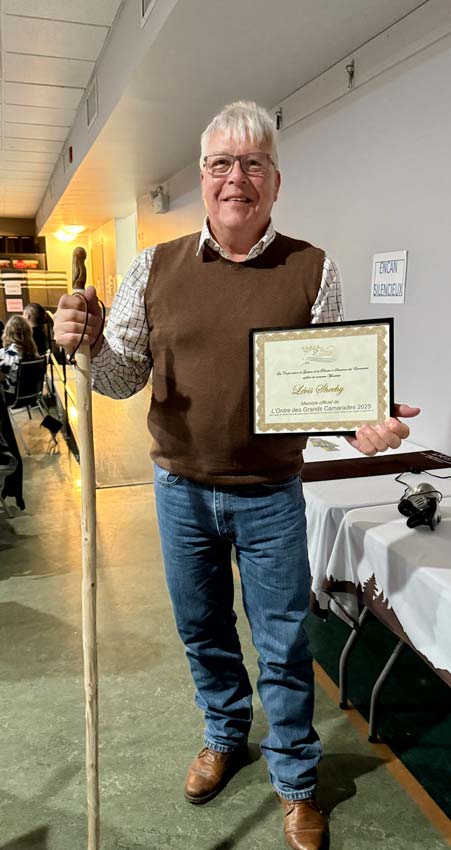
Photo: Caroline Coté
La discussion dérive aussi vers la truite de mer, qui semble moins abondante qu’avant, mais toujours aussi appréciée. Maurice résume:
«Les bancs de truites, ça va, ça vient. Quand ils passent, faut être attentif et marcher avec une extrême délicatesse, sinon elles fuient pour ne plus revenir de la journée !»
Guide depuis trente ans, Maurice lit les fosses comme personne. Il distingue les grosses truites des petits saumons à leur simple mouvement dans les eaux foncées typiques de la Haute-Côte-Nord. Et, ajoute-t-il en souriant, les pêcheurs les plus chanceux ne sont pas toujours les plus expérimentés : «Souvent, les nouveaux sont plus à l’écoute.»
La saison de la truite de mer a ouvert à la mi-avril. Lévis s’est essayé le jour même du souper. Les eaux sont encore glaciales, la neige persiste en forêt, et les lacs d’amont ne sont pas encore calés. Les truites n’étaient pas au rendez-vous . . . encore trop tôt, selon les habitués.
En les écoutant, on sent que la rivière est en pleine transition.
Moment marquant de la soirée: l’Ordre des Grands Camarades 2025 a été remis à Lévis Sheehy, en reconnaissance de plus de dix années d’engagement sur la rivière, d’une éthique de remise à l’eau exemplaire et de sa participation active à la communauté.
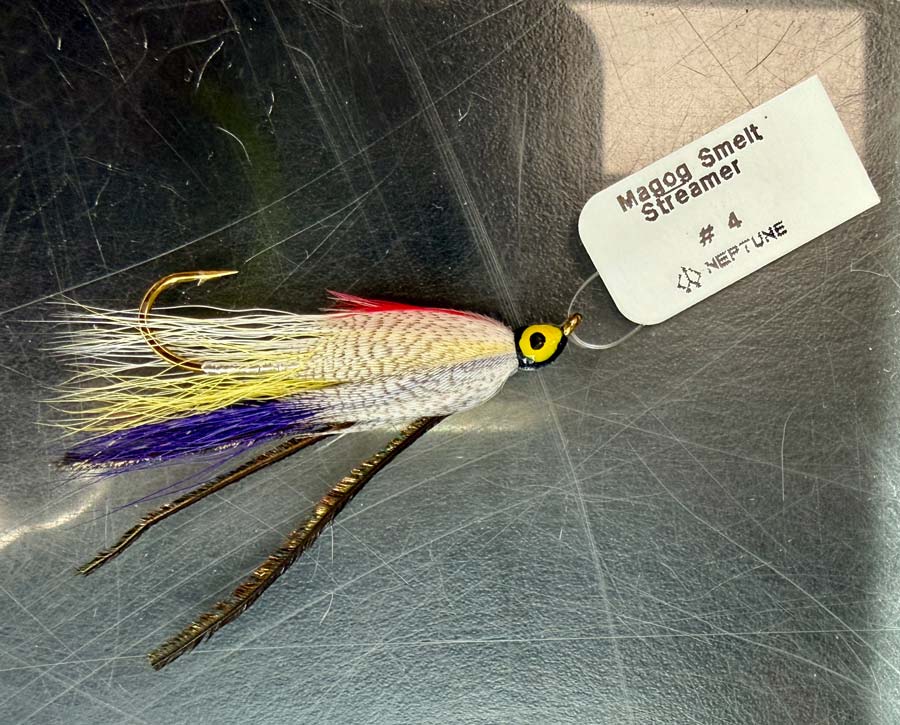
En début de saison, pas de surprise: la Magog Smelt reste une valeur sûre pour la truite de mer, selon les gens du coin.
Québec (English)
Québec Program Director Caroline Coté recaps an important fundraiser for an Upper North Shore river.
A River in Transition
In Essipit—an Innu First Nation community located on the Haute-Côte-Nord—about 150 people gathered on May 2 for the 30th fundraising dinner for the Escoumins River, hosted by the Corporation de Gestion de la Rivière à Saumons des Escoumins (CGRSE). It’s an annual event that supports the river, while also taking the pulse of the territory. A highlight of the evening was Lévis Sheehy being named to the 2025 Order of the Grand Companions, recognizing more than a decade of commitment to the river, strong catch-and-release ethics, and active involvement in the local community.
According to Pierre-Olivier Fortin of Fédération québécoise pour le saumon atlantique (FQSA), the funds raised help ensure the river’s day-to-day operations (salaries, maintenance, and monitoring) and also support upstream restoration work as part of the conservation plan led by the FQSA.
Around the table, conversations naturally turned to fishing. Maurice, Lévis, France, and Christine together have more than a century of experience on the Escoumins. For them, there’s little doubt: there are fewer salmon than before, and some fish last summer looked more tired. “Without anglers, we lose eyes on the river,” they all agreed.
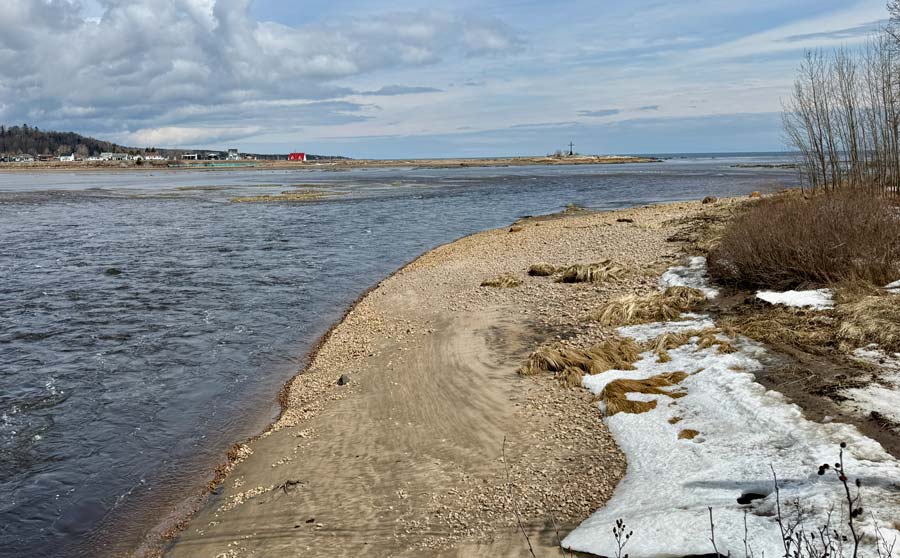
The conversation also shifted to sea trout, which seem less abundant than before, but still just as valued. Maurice summed it up: “Schools come and go. When they pass through, you have to be attentive and move with extreme delicacy; otherwise they spook and won’t come back for the rest of the day.”
A guide for thirty years, Maurice reads the pools like no one else. He can tell large sea trout from small salmon just by their movements in the dark waters typical of the North Shore. And, he added with a smile, the most successful anglers aren’t always the most experienced: “Often, the newcomers are the ones who listen.”
Sea-trout season opened in mid-April, and Lévis tried his luck the same day as the dinner. However, the water is still icy, snow remains in the forest, and upstream lakes have not yet cleared, so the trout were not there yet. According to regulars, it’s still too early, but a reliable fly choice for the early season is a Magog Smelt.
Listening to these anglers, you can feel that the river is in transition.
Newfoundland and Labrador
Newfoundland and Labrador Program Director Kim Thompson points out an error in this year's Anglers' Guide and highlights an important honour for a river hero.
Newfoundland anglers are counting down the days, as the recreational salmon angling season is less than a month away and 2026 licences issued by the Department of Forestry, Agriculture and Lands, Wildlife Division are available at selected retailers across the province. Also now available is the printed Newfoundland and Labrador Anglers’ Guide for 2026-2027, which contains an error that rippled the waters last week. On page 1 in the Management Measures section, it reads: “Catch and release angling is not permitted on non-scheduled waters.” DFO issued a correction, which noted that the online text and PDF versions of the guide have been updated to remove this statement. Printed guides will not be updated, as they have already been distributed.
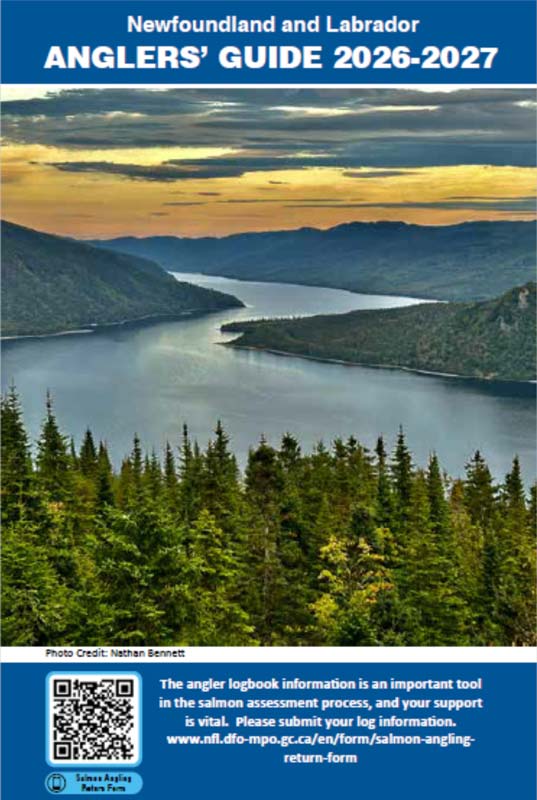
Notices to anglers are available online in the Fishery Notices section of the DFO Newfoundland and Labrador Region webpage.
If you would like to have all these DFO notices sent directly to you by email, please contact: NLPRI@dfo-mpo.gc.ca.
SAEN Spring Dinner and Auction: Toby McDonald Honored
Congratulations to the Salmonid Association of Eastern Newfoundland (SAEN) on another fun-filled, highly successful Spring Dinner and Auction, with more than 90 people attending to support salmon-conversation initiatives. One of the highlights of this event is the Dorothy Burton Conservation Award, which was established in her memory in 2018. Dorothy (along with her husband, Vince) operated numerous lodges in Labrador, was a trusted and respected voice in the family business, and was an early advocate for catch-and-release—long before it was popular.
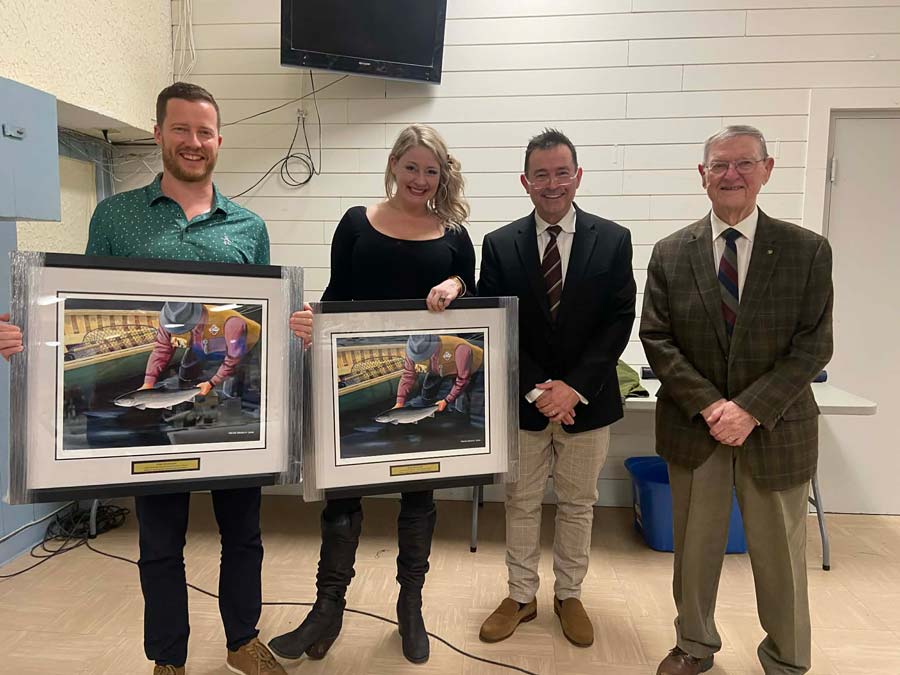
This year’s recipient is Toby McDonald, an avid angler and coach of the Brad Gushue 2006 Olympic gold medal curling team, who passed away in January of last year. The most constant and remarkable aspect of Toby’s approach to salmon fishing was his love for the environment and his respect for salmon. He didn’t have to teach this; he embodied it. Catch-and-release was an integral part of Toby’s fishing ethos.
Dorothy’s son, Rob, and Vince presented the award to Toby’s son Michael and daughter Sarah, who accepted it on behalf of their late father.
New Brunswick
In this week’s update, our New Brunswick Program Director David Roth reports from the early days of the field season on the Miramichi, where efforts are underway alongside partners to collect as many smolts as possible for the trap-and-transport program. As is often the case in fieldwork, those efforts have already been shaped by changing conditions on the river.
Following last week’s successful deployment of smolt wheels—in collaboration with the Miramichi Salmon Association, Anqotum Resource Management, and the Canadian Rivers Institute—the operation initially progressed smoothly. The first fish were captured, and the wheels were running as planned. However, heavy rainfall toward the end of the week led to a rapid rise in water levels, bringing with it a significant increase in debris.
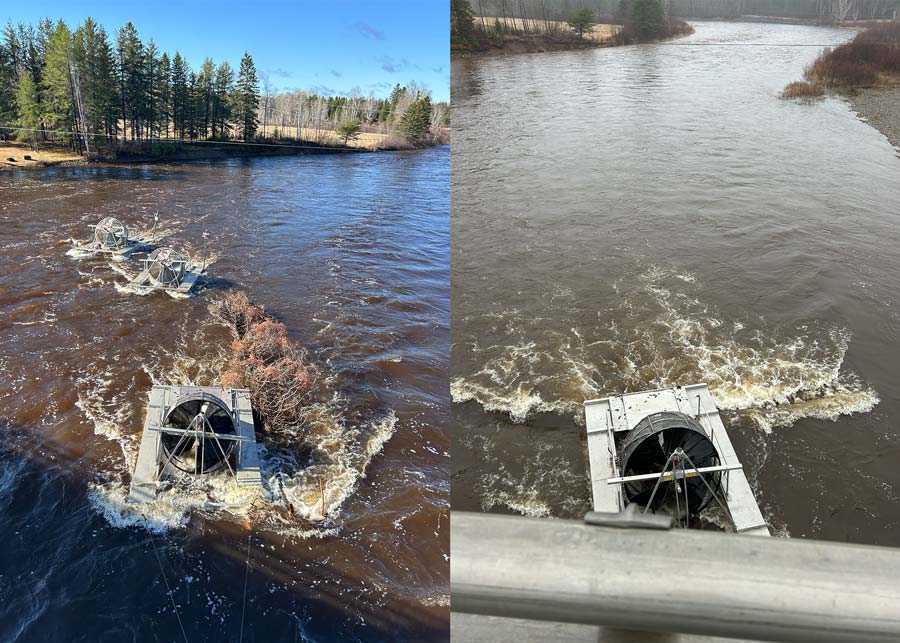
Although the wheels had not been actively fishing in anticipation of these conditions, they remained in place, and it required considerable effort to secure and clear them once the downpour had ended. At the Northwest Miramichi collection sites, large trees and debris became lodged beneath the pontoons of the wheels, halting operations and placing increased strain on anchor systems.
After a 48-hour pause to give the river time to slow down, the team returned to the site for a full day of coordinated work, removing debris and restoring the infrastructure. Operations are now back on track. In parallel, the operation on our Southwest Miramichi site continued without any incidents, showing how local variations in weather events can make a big difference within the same watershed.
These same conditions—high discharge, heavy debris loads, and increased turbidity—also impacted angling across the river, slowing fishing activity in the final days of kelt season, which will soon begin its traditional wind-down in anticipation of the first bright salmon to appear in the river.
Maine
Colby W. B. Bruchs, a Fisheries Scientist with Maine Department of Marine Resources, says that smolt-trap operations are going well.
We've enjoyed steady trap operation, with captures at both sites each day. So far, 120 smolt have been trapped at Little Falls, and 77 at Route 9. We received much needed rain, and water temperature remains seasonably cold, around 9C.
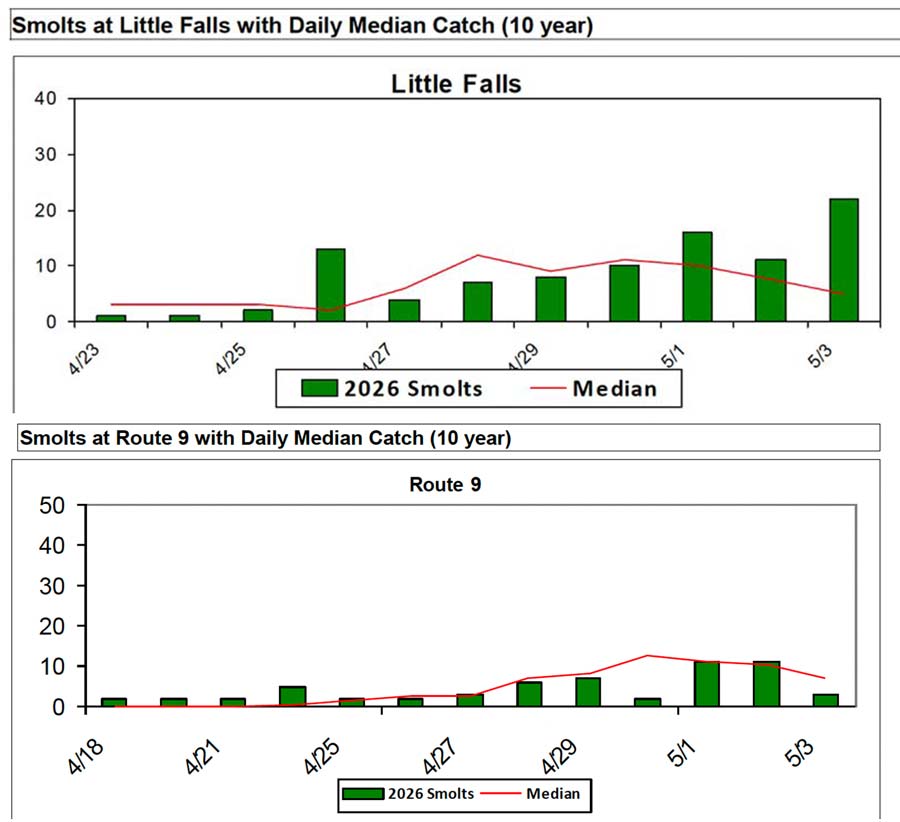
Jason Valliere, a marine scientist with the Maine Department of Marine Resources, also reported that cold weather and rain have led to a slow start at the Penobscot fish passage: no salmon yet and just over 5,000 river herring. That said, he expects things will turn around quickly.
Wild Salmon Watersheds
Jordan Condon, Science Coordinator for Wild Salmon Watersheds, updates us on smolt-wheel deployments in Nova Scotia, New Brunswick, and Newfoundland and Labrador.
Field season has kicked off for ASF’s Wild Salmon Watersheds (WSW) program. The first smolt wheel was deployed on the Chéticamp River in Cape Breton, Nova Scotia. Thanks to a hard-working crew, the wheel was up and operational after the first day.
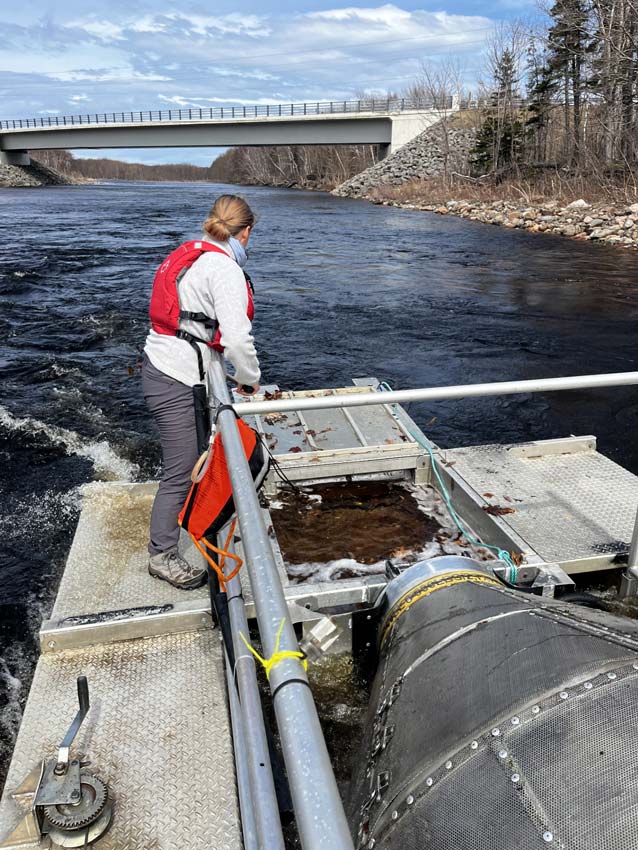
So far, four smolts were captured on Saturday, but water temperatures have cooled down to 3 degrees (Celcius) with the recent snow melt. Given increased rain and snowmelt, the wheel has been lifted until conditions return to safe operating levels.
I’d like to say a big thank you to the Chéticamp River Salmon Association, Parks Canada, and ASF staff Matt Russel and Kate Gingles for their hard work that made this deployment a success.
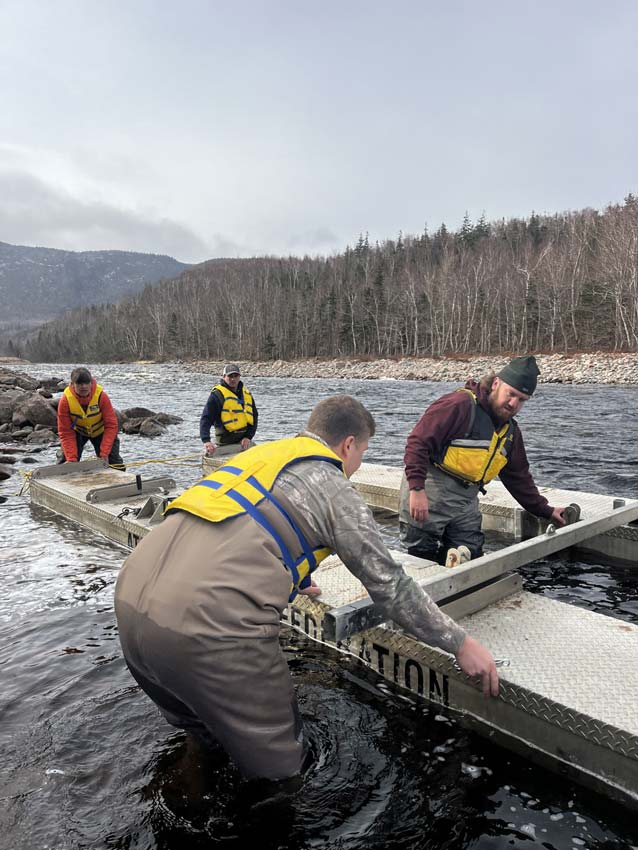
The next smolt-wheel deployments will be on the Terra Nova and Nepisiguit rivers. Site preparation is underway, but river conditions have delayed deployments. Both rivers are experiencing higher flows than in recent years, which is inconvenient for operating smolt wheels, but it's quite refreshing to see more typical spring flow conditions.
Stay tuned for next week’s Rivernotes, when we will have updates on our smolt-wheel deployments and the season’s first smolt catches.
Upcoming Events
May 8-10: Downhome Expo, Glacier Arena in Mount Pearl. ASF's booth number is 48, so be sure to drop by.
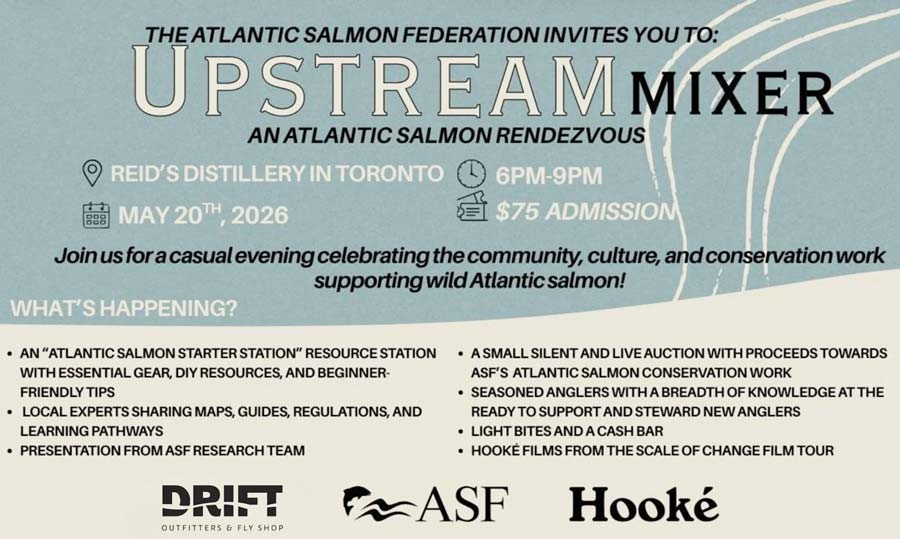
May 20: Toronto Upstream Mixer, An Atlantic Salmon Rendezvous. Join us for a casual evening to welcome a new wave of stewards to the community, culture, and conservation work that supports wild Atlantic salmon. Together with seasoned Atlantic salmon Anglers and Conservationists, we invite you to join us in demystifying Atlantic salmon angling.
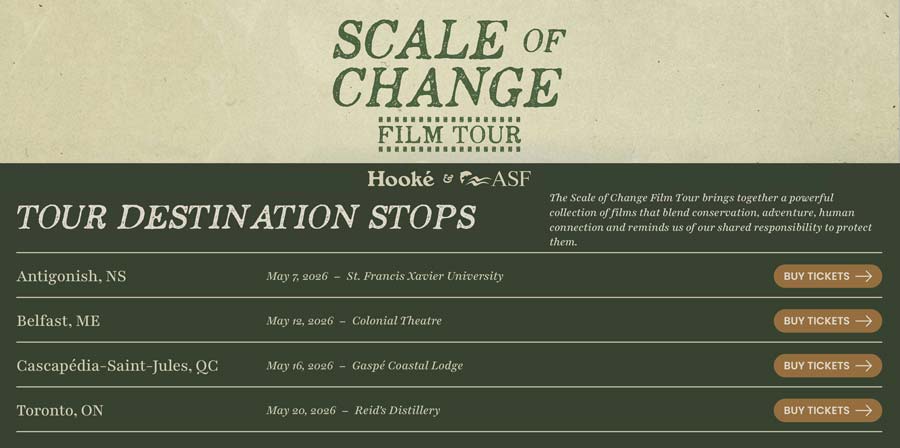
Upcoming Scale of Change Tour Stops