





Rivernotes
RiverNotes 1 September 2022
asf
January 5, 2026

COMPILED BY DEIRDRE GREEN (DGREEN@ASF.CA)
EDITOR’S NOTE
As Autumn approaches, please remember to tag @asf_salmon on social media in your conservation efforts and angling adventures. We love hearing from our members, so when you have a story to share, please email us at rivernotes@asf.ca.
Thank you for your continued support and enthusiasm for Atlantic salmon conservation.
QUEBEC
Cliquez ici pour voir les tableaux…
Veuillez prendre note que la remise à l’eau des saumons est obligatoire sur certaines rivières à partir du 1er septembre.
Les conditions d’eau plus chaude étant la norme en ce moment, veuillez svp réduire au minimum la durée du combat si vous piquez un saumon et veuillez les garder le poisson dans l’eau pendant tout le processus de la remise à l’eau. Il n’y a pas de temps prédéfini pour relâcher un poisson, il vous indiquera quand il est prêt à partir.
Rappel aux saumoniers pêchant les rivières du Québec, prenez le temps de rapporter vos prises et remise à l’eau afin d’avoir des statistiques précises et que les gestionnaires de rivière puissent calculer le succès de pêche avec précision. Tight Lines!
Les données utilisées dans ce rapport proviennent de divers sites web, des médias sociaux et de source gouvernementale québécois. Les informations peuvent changer sans avis au préalable en ce qui concerne les comparatifs des saisons précédentes.

Charles Cusson, Director of Quebec Programs, shares:
As we begin the last month of the 2022 season, low water conditions were a major factor affecting angling success during the month of August on many rivers.
The attached tables display statistics up to and including late August 2022, and for the previous four seasons for comparison.
Click here to view tables…
We would like to remind anglers fishing Quebec rivers to make the time to report your releases. This contributes to us having the most accurate angling statistics and allows the river managers to accurately calculate angling success.
With warmer water conditions being the norm, please keep the amount of time your fish is on the line to a minimum (if you can hook up) and please keep them in the water during the entire release process. There is no pre-set amount of time prescribed to revive a fish, it will tell you when it is ready to go.
Please be aware, mandatory live release of salmon is in effect on many rivers as of September 1st. Tight Lines!
Note: The data used for Quebec RiverNotes has been sourced from various river websites, social media and Quebec government sources. Information may change without prior notification respecting past year’s comparative figures.

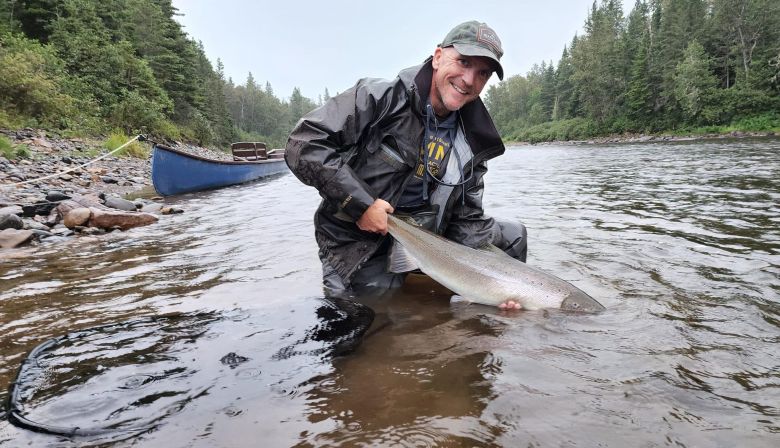
Mathieu Leonard and partner, Marie-Renée recently visited the Petite Cascapédia and Bonaventure rivers. Mathieu highlights:
Despite the low water levels of this mid-season, the Petite Cascapédia and Bonaventure remain cold as they are mountain sourced. We wrapped up our summer season with a trip to these two rivers and were fortunate to connect with some beautiful fish.
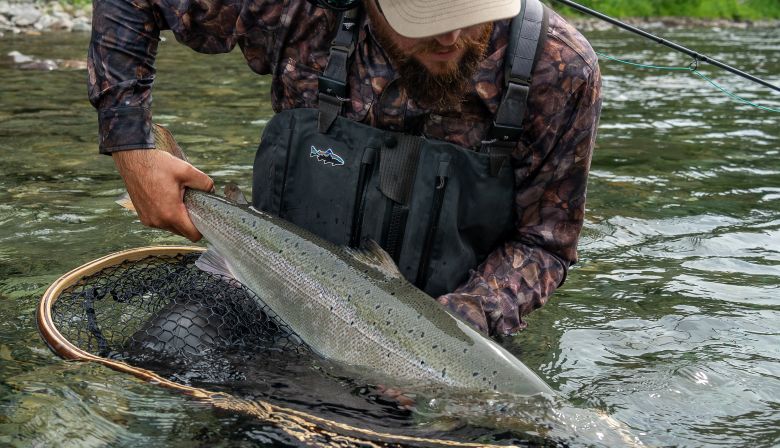
Marie-Renée got some action on the Petite Cascapédia, to the benefit of Logan (pictured below) who was ready for the netting job. A special moment landing and releasing this Atlantic together as a family. The fall colours of the fish are coming to life as their morphology slowly changes with the colder temperatures taking over the Gaspé Peninsula.
Follow Mathieu Leonard on Instagram @premiere_drop

NEWFOUNDLAND & LABRADOR
Unfortunately, light rain showers this past week did little, if anything, to increase water levels throughout NL. And while night-time temperatures are slowly starting to cool, the continuation of hot weather during the day has kept water temperatures warm. As a result, angling conditions have been poor throughout over the past week (with a few exceptions in Northern Labrador) and as a result, fishing has been slow. This has led DFO to restrict more rivers on the island to early morning fishing only.
See the latest DFO River Openings and Closures for NL.
There is good news in the forecast, with rainfall expected for much of next week. Hopefully this will improve conditions so that anglers may close out the regular season on a positive note. In the meantime, the fall angling season on the main stems of the ‘Big Three Rivers’ — the Humber, Gander, and Exploits, will continue until October 7th for release fishing only
Lastly, the latest DFO Fishway Counts for Newfoundland and Labrador (up to Aug 28, 2022) are now available.
See the latest DFO Fishway Counts for NL.
As you will note from the table, this will be the last count for the season for a few rivers identified by the following symbol: **.
Regional Round-Up
Southwestern NL – A couple of days of light rain last week rose water levels slightly on a few rivers in this area including Southwest River and Harry’s Rivers, but due to continued hot and dry weather that followed the levels quickly dropped again. As such, angling conditions remain poor in this area of the province and fishing is still very slow.
Western NL – While water levels are still fairly good for angling on the lower Humber, water temperature on this section of the river is now an issue, with temperatures averaging around 18 degrees daily. As a result, fishing is currently very slow in this area, with only an odd fish hooked. Meanwhile, conditions are worse on the upper Humber where the water level is very low and day-time water temperature averages between 20-22 degrees Celsius.
Main River (Sops Arm) saw a slight bump in water level last week, but it quickly dropped and is low again. Water temperatures on Main River have dropped from an average of 21.0 degrees Celsius daily to 15.5 degrees daily. There are few fish being seen in the lower sections of the river, as most fish have now reached the headwaters.
Labrador – Long-time guide, Lester Butt, reports that there was a good sign of fish on the Forteau River last week, as there has been all summer. An odd fish is still being hooked despite fair angling conditions. Rob French, owner of the Bigland Salmon Lodge on the Pinware River, reports that there was hardly any fish on the lower section of this river last week and the river was low and warm.
Further North, Tony Chubbs, with the Labrador Hunting and Fishing Association, provided the following update from the Kenamu River near Goose Bay:
“11th of August – Lowest water seen. Air temp 23-26C and water temp 16C. Fishing best this season. 3 Rods. Hooked our limits (2 large). Over 30 fish seen.
19th of August – Rained all day. Air Temp 18-20C. Water up about six inches from our previous trip on 11 August. Water temperature cool and estimated at 15C. We have been getting some thunderstorms and rain. Good fish activity. 6 fish hooked between three rods. About 15 fish seen. Most fish hooked are jacks.
22nd of August – Water up again another couple of inches with thunder showers during the day. Air temp 24C in afternoon. Estimated water temperature at 14C. Four rods fishing and 7 fish hooked, with about 20 fish (1 large) seen. Mostly grilse jacks.
We have not seen any other anglers fishing our section of the river this year.”
Central NL – All rivers here remain very low with warm water temperatures. As of August 31st, DFO restricted angling on the Terra Nova to morning fishing only due to low water levels and warm water temperatures.
Angler, Trevor King, reports there is still a good show of fish on the Lower Gander, but the water is very low and warm, and fish just aren’t interested. Matthew Morgan notes fishing has also slowed on the Exploits River, but an odd fish is still being hooked there.
Avalon Peninsula – Water levels are low and water temperatures warm on most rivers, yet the odd fish is still being hooked here and there.
In the Field
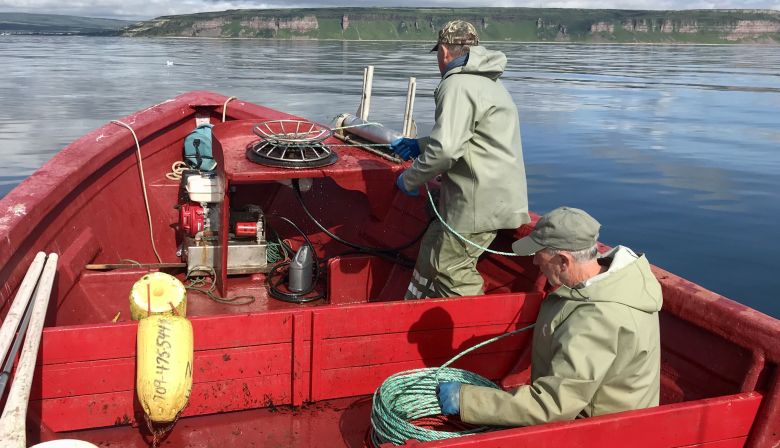
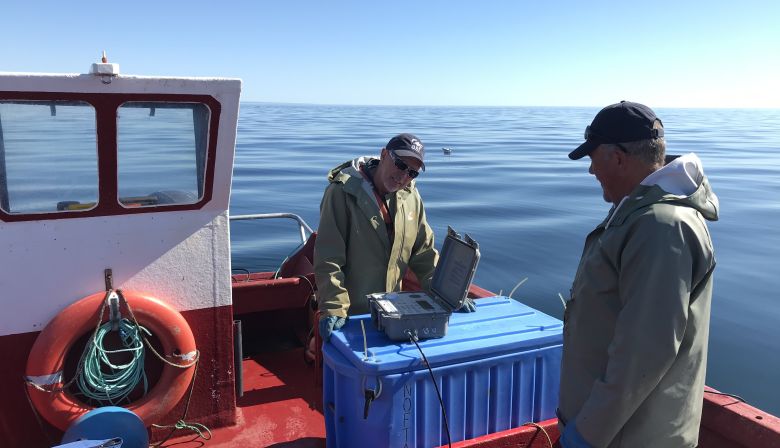
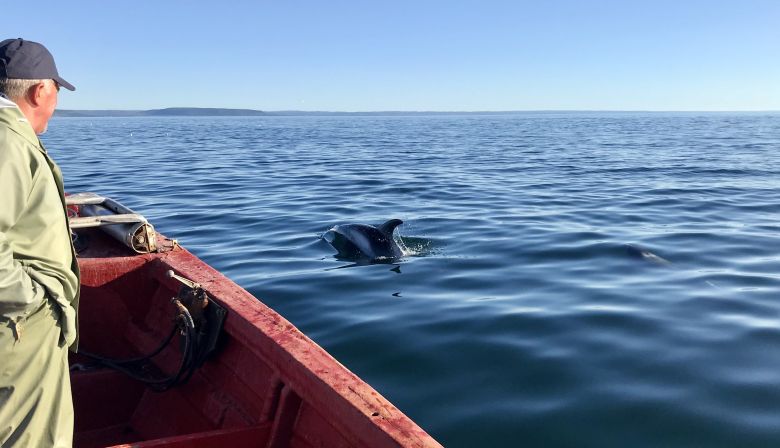
From August 15-18 we worked in the Northern Peninsula taking up and resetting some of our tracking gear within the Strait of Belle Isle. The following images were captured during this work.


NOVA SCOTIA
SAVE THE DATE!
IN THE FIELD
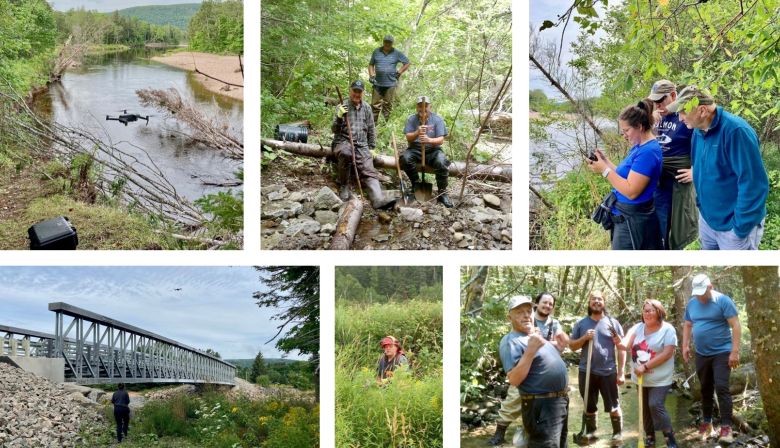
Live feed of thermal variations allowed us to highlight cold water refugia on roughly 38 kilometers of river. Kathryn is working with other rivers involved in the Nova Scotia Salmon Associations (NSSA) Gulf Priority Rivers Project however, we are hopeful to have her back in the future to survey the Southwest branch of the Margaree river, up to Lake Ainsley. After Kathryn has “stitched together” the information from this thermal imaging drone work, we will have valuable data that can be used to help us plan for future habitat remediation.
The Nova Scotia Salmon Association (NSSA) recently released their monthly newsletter.
Click HERE to read the August 2022 newsletter.
You can join the NSSA for free at nssalmon.ca/join today!
HAVE YOUR SAY!
You may also wish to visit the Healthy Bays Network website for a comprehensive list of survey questions and sample responses.
With fish farm expansions unfolding throughout Atlantic Canada, it is critical that we share our concerns with government today. Please visit the links supplied, educate yourself and share the deadline of September 6th amongst your network.
NEW BRUNSWICK
The numbers seen here are in stark contrast to improved counts within other regions. Many have noted the parallel to an increased presence of striped bass within the watershed and echoing this, ASF’s smolt tracking has shown significant striped bass predation in recent years.
2022 | Northwest Miramichi
2011 | Northwest Miramichi
2022 | Dungarvon
2011 | Dungarvon
DFO has released the latest trap numbers for our review.
Earlier this week, DNR shared an updated barrier report for Jacquet River that shows the number of salmon reaching the fence have doubled over last year.
IN THE FIELD
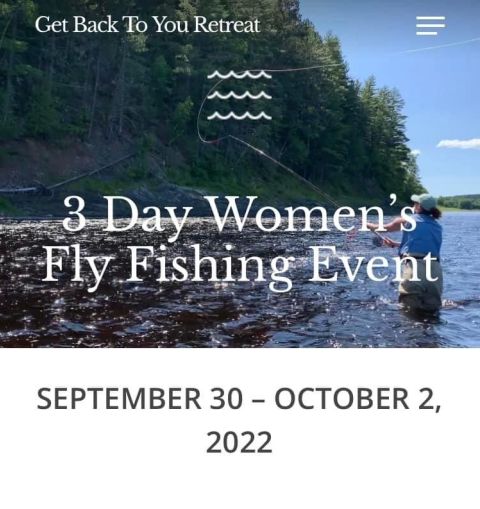
WOMEN’S FISHING RETREAT
MAINE
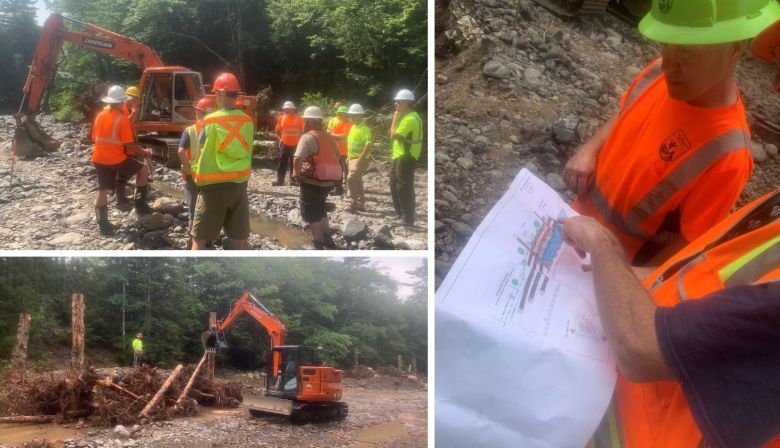
Exciting activities are occurring upriver on the Narraguagus. We began our annual juvenile abundance assessment and parr brood stock collection effort via backpack electrofishing. We also performed fish relocation at Project SHARE’s Route 9 Habitat Restoration site. Nearly 600 large parr were relocated prior to construction of Engineered Log Jams (ELJs).
The project aims to improve degraded rearing habitat by reducing over-widening through construction of ELJ’s and a new floodplain, providing deeper pools for summer and overwinter refuge, and creating geomorphic conditions that promote mobilization and sorting of sediments to benefit all life stages of Atlantic salmon.
If you find yourself along Route 9 this fall, the site is easily observed off the East Beddington Lake Road — just a couple hundred yards south of Route 9.
Congratulations to Project SHARE and their restoration partners for completing this project. A first of it’s kind in designated critical habitat in Maine!
DMR’s Jennifer Noll shared the following salmon updates on August 26th:
Temperatures have still been warm on the mainstem Kennebec throughout most of this past week, averaging around 22°C. Some rain has come through the region bringing the flow level in Sidney, ME to over 6,000cfs, then back down to around 5,730 cfs for the rest of the week. The discharge level is now between the 75% and maximum historic discharge levels (based on 36 years of data). (USGS current conditions).
The fish lift has been fully operating over most of the past week. No Atlantic salmon were captured since the last report.
Craig King provided an update on stock enhancement/beach seine projects from Kennebec and beyond:
As August slips away from us, on the 26th we started our 4th round of beach seining in the tidal portion of the greater Kennebec drainage. This week we finished our 4th round of seining above the head of tide. As in years past, the most recent catches have been significantly reduced, with very few to no river herring or shad at any of the sites due to their determined migration towards the salt water.
Some much needed rain brought the Kennebec flows up, which allowed us to navigate the upper sections with the jet boats which was a welcomed opportunity. Also this week some fishway checks in the Sebasticook drainage resulted in a juvenile sample from Sebasticook lake in Newport. Fifty juvenile alewives were sampled, their average lengths and weights were 90mm and 6 g.