



Rivernotes
Rivernotes April 30, 2026
Phil Monahan
April 30, 2026
Editor's Note
by Phil Monahan, ASF Managing Editor
Welcome to Rivernotes, our weekly roundup of news and information from around the world of Atlantic salmon—Québec, Atlantic Canada, and Maine.
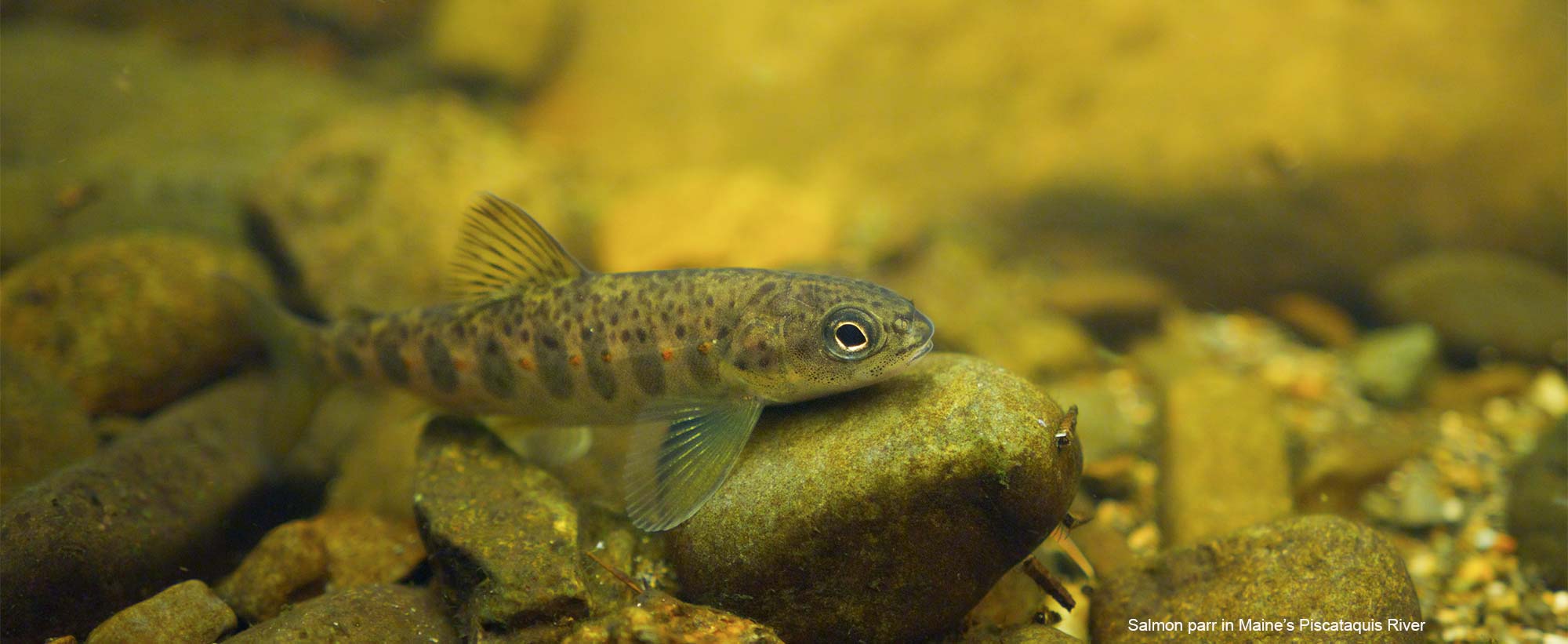
Reminder: The row of buttons you see above that beautiful salmon parr will help you find exactly what you're looking for. Simply click a button and be whisked directly to the section you want to read first.
This week, we've got evidence that fishing is starting to heat up in New Brunswick and Nova Scotia, while updates from the rest of the region offer insights into events, research projects, and predictions for the season.
New Online Magazine from Loop Tackle
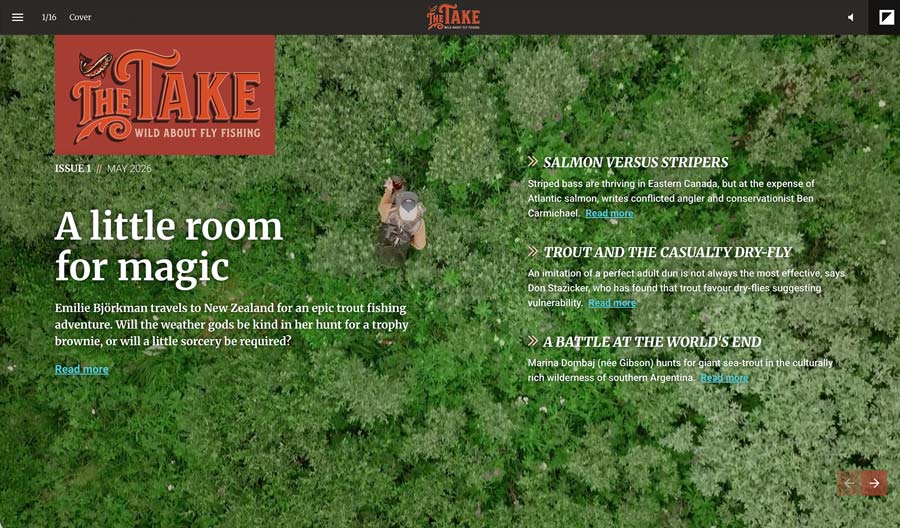
Last week, the first issue of The Take—“a new, interactive, free-to-view global magazine born of a shared obsession with fly-fishing and brought to you by the passionate makers, ambassadors and followers of Loop Tackle”—was published online. Of particular interest to Rivernotes readers is “Salmon versus stripers,” an article by ASF US Council member Ben Carmichael about the effects of striped-bass overpopulation in the Miramichi and its estuary.
[T]he striper[s] became the flash point for a few questions best paraphrased as: Who belongs and who is unwelcome? Who deserves the right to call a place theirs? And, perhaps most importantly, who gets to decide?
Subscription to The Take is free.
Video: Dry Flies for Atlantic salmon
Getting a salmon to take a dry fly is a major accomplishment, and well-known angler Simon Gawesworth walks us through some effective techniques for targeting salmon using dead-drifted dry flies on Labrador's Pinware River.
He discusses how to identify and fish specific water structures known as "windows" to improve visibility and presentation. Other topics include fly selection and strategies for making adjustments to suit unique conditions.
Newfoundland and Labrador
ASF's Wild Salmon Watersheds Coordinator, Kris Hunter, tells us about a great educational program to help students learn about salmon and conservation. (Photos by Jake Dicks and Dru Kennedy)
Lego Robotics Program Teaches Student about Salmon, Thriving Rivers, and Strong Communities
Alongside Freshwater Alexander Bays Ecosystem Corporation (FABEC), our Wild Salmon Watersheds partner in NL, and in collaboration with the Clarenville High School EcoSTEM team, ASF sponsored two Lego Robotics competitions for schools in the Clarenville and Marystown areas last week. An education initiative dedicated to empowering students through Science, Technology, Engineering, and Mathematics learning, EcoSTEM partners with schools to create interactive, hands-on STEM programs. Both events were wildly successful, with hundreds of kids, parents, and teachers engaged in fun and challenging activities that taught them about salmon and conservation. This was the culmination of months of planning.
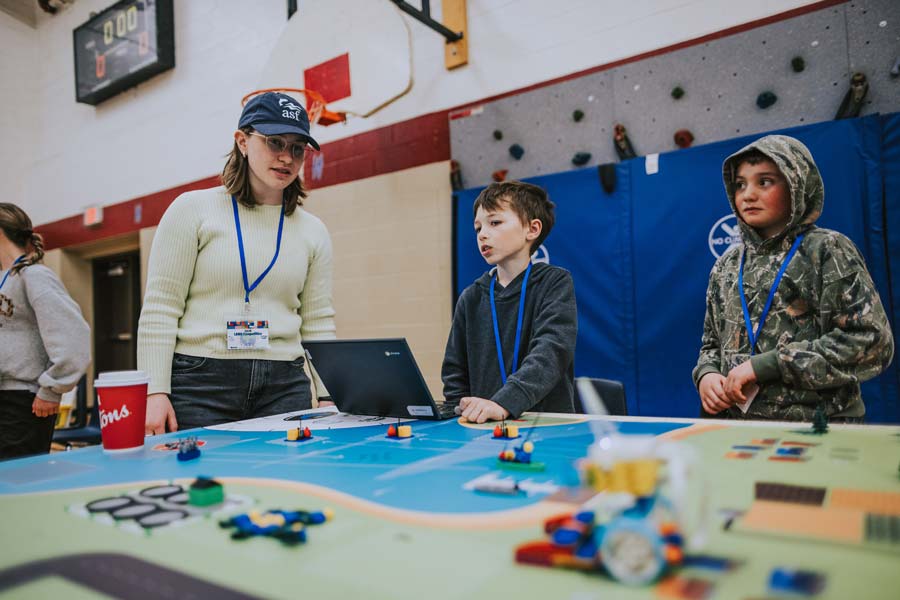
Last September, the EcoSTEM team from Clarenville, a fantastic group of high-school students, participated in our WSW Network meeting in Glovertown and then approached us about working more closely. A key part of WSW is about fostering stewardship, so we saw this as an excellent opportunity to engage with youth. Together we planned the conservation tasks for the event, engaged with schools, and designed the maps and the props. Last week the ASF team—Kim Thompson, Kate Gingles, and I—joined Sean Jackson from FABEC, and teachers and students from the EcoSTEM team to put it into action. During the events, the kids learned about different salmon conservation tasks that they had to accomplish, why they are important, and how they relate to what groups like ASF and FABEC do every day.
The tasks included removing a dam, deploying acoustic receivers, removing an open net pen and moving it to land, deploying an electrofishing team and a smolt wheel, replacing a problematic culvert with a single-span bridge, and bringing together community members and resources. The kids then spent the next couple of hours building and programming their Lego robots to complete these tasks. We then invited parents, grandparents, and members of the community in to watch and cheer on the teams. During the competition, each team was given two three-minute rounds to complete as many tasks as possible.
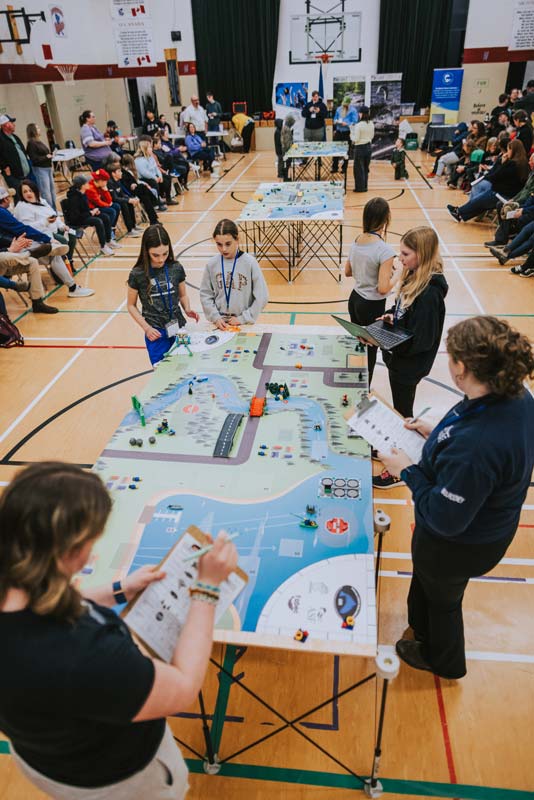
It was a long day, but the kids (and we) had an absolute blast and learned a lot about engineering, programming, and of course salmon conservation and conservation programs. Numerous people told us how much they learned about salmon because of the event.
Now that we have this established engagement activity, we are really looking forward to bringing it to other schools and communities.
Upcoming Newfoundland & Labrador Events
April 30 (tonight!)—International Fly Fishing Film Festival (IF4), Bruneau Centre for Research and Innovation, St. John’s.
May 2—Salmonid Association of Eastern Newfoundland (SAEN) Spring Dinner and Auction, Knights of Columbus, St. John’s. Tickets can be obtained through any SAEN board member, through the SAEN office (info@saen.org or 709-722-9300), or in person at 50 Pippy Place. The SAEN office will be open Friday morning.
May 8-10—Downhome Expo, Glacier Arena in Mount Pearl. ASF booth number is 48. Be sure to drop by.
Québec
Caroline Coté, directrice du programme pour le Québec, a assisté à la projection d’un nouveau documentaire qui suit l’équipe canadienne de pêche à la mouche aux Championnats du monde.
Bâtir le courant: une soirée chez Hooké à Québec
Jeudi soir, le 23 avril, j'ai pris la route vers la boutique Hooké, sur le boulevard Sainte-Anne à Québec. La salle était pleine, une vingtaine de personnes venues rencontrer Sabrina Barnes, membre de l'équipe féminine canadienne de pêche à la mouche aux Championnats mondiaux de 2025, et découvrir en primeur Bâtir le courant — Empowering Waters, le documentaire qu'elle a coréalisé avec le vidéaste Pierre-Luc Bernier.
Le film (23 minutes) suit les sept Canadiennes qui ont représenté le pays à Idaho Falls en juillet dernier, lors de la 4ᵉ édition des Mondiaux féminins. Sept pêcheuses venues de la Colombie-Britannique, de l'Alberta et du Québec, réunies pour une semaine de pratique dans les eaux de l'Idaho, du Montana et de l'Ohio avant d'affronter six autres nations. Le Canada a terminé 4ᵉ.
Avant d'appuyer sur play, Sabrina nous a glissé quelque chose qui a changé ma façon de regarder le film : le vrai cœur de l'histoire, c'est la cérémonie d'ouverture. Sept femmes, trois provinces, un drapeau, et pour plusieurs d'entre elles, la première fois qu'elles se rencontraient en personne. À partir de là, on ne regarde plus la compétition de la même manière. Bâtir le courant, ce n'est pas un film sur qui a gagné. C'est un film sur comment elles sont arrivées là.
Au Québec, Sabrina n'a plus besoin de présentations. Certifiée instructrice par Fly Fishers International à 17 ans (oui, 17), elle fonde à 20 ans sa propre école, ReelTrip, où elle enseigne le lancer à une main et à la canne Spey, du débutant à l'expert. Guide de pêche, elle a aussi accompagné des pêcheurs sur quelques-unes des plus belles rivières à saumon du Québec. Médaillée d'argent individuelle aux Championnats nationaux féminins en 2023 et en 2024, elle se qualifie pour l'équipe canadienne aux Mondiaux de 2025. Elle collabore aussi à plusieurs magazines spécialisés.
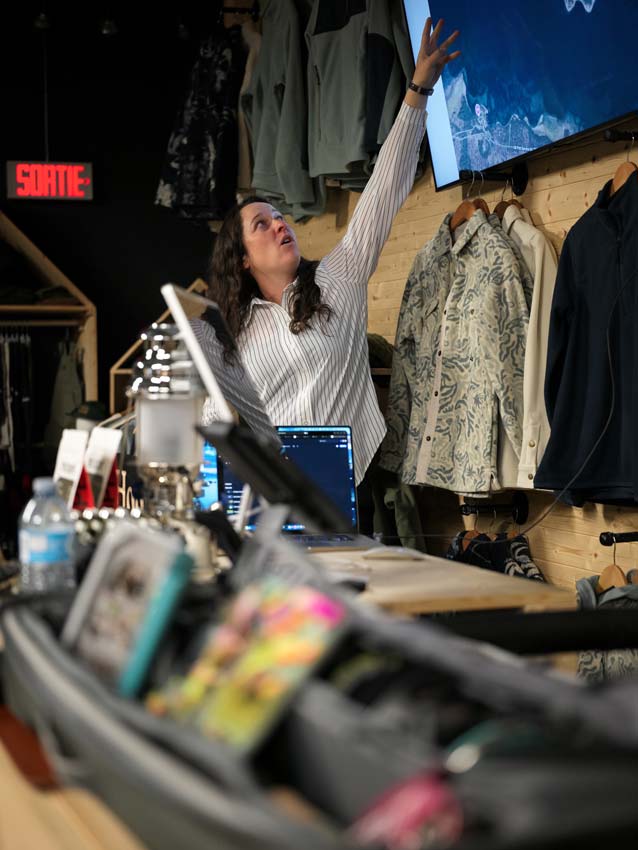
Bâtir le courant est le premier documentaire canadien consacré à la compétition de pêche à la mouche, et le tout premier au monde à suivre une équipe féminine. Le volet féminin des Mondiaux n'existe que depuis 2022, autant dire que l'histoire est encore en train de s'écrire, et qu'on a la chance de la voir prendre forme.
Sabrina et Pierre-Luc cherchent maintenant un diffuseur. D'ici là, le film remonte le courant à sa façon, de soirée en soirée. Montréal, Trois-Rivières, Toronto et Québec ont déjà eu droit à leur projection. Cliquez ici pour les mises à jour.
Québec (English)
Québec Program Director Caroline Coté attended a screening of a new documentary that follows the Canadian Women's Fly Fishing Team to the World Championships.
Building the Current: An Evening at Hooké in Quebec City
Last Thursday evening, about twenty people packed the Hooké shop in Quebec City to meet Sabrina Barnes, a member of Fly Fishing Canada's Women's Team at the 2025 World Championship, and to catch an early screening of Bâtir le courant — Empowering Waters, the documentary she co-directed with videographer Pierre-Luc Bernier.
The 23-minute film follows the seven Canadian women who represented the country in Idaho Falls last July, at the 4th annual FIPS-Mouche World Ladies Fly Fishing Championship. Seven anglers from British Columbia, Alberta, and Quebec came together for a week of practice on the waters of Idaho, Montana, and Ohio before facing six other nations. Canada finished 4th.
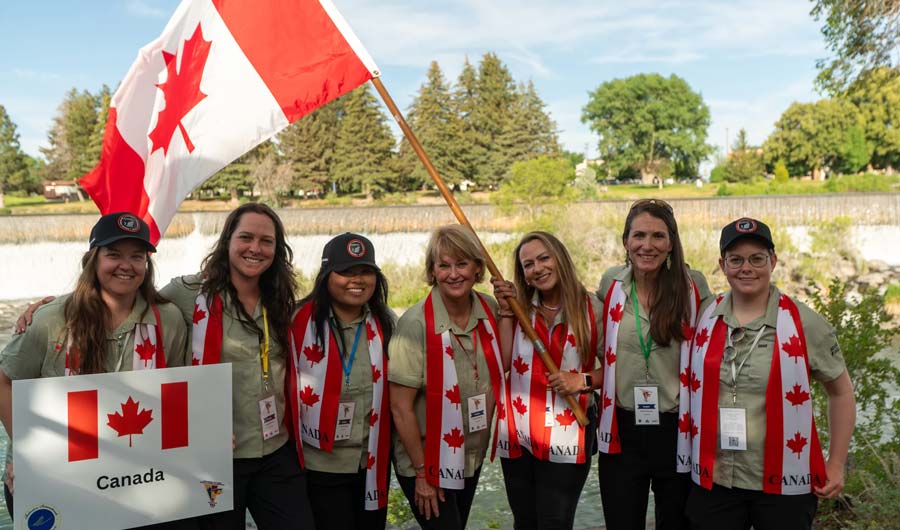
Before hitting play, Sabrina told us something that changed how I watched the whole film: the real heart of the story is the opening ceremony. Seven women, three provinces, one flag—and for several of them, their first time meeting in person. From there, you stop watching it as a competition. Bâtir le courant isn't a film about who won. It's a film about how they got there.
In Quebec, Sabrina doesn't really need an introduction. Certified as an instructor by Fly Fishers International at 17 years old, she founded her own school, ReelTrip, at 20, where she teaches single-hand and Spey casting from beginner to expert. She's also a fishing guide who has led anglers on some of Quebec's finest salmon rivers. Individual silver medalist at the Canadian Women's National Championships in 2023 and 2024, she qualified for the Canadian team at the 2025 Worlds. She also writes for several specialized magazines.
Bâtir le courant is the first Canadian documentary devoted to competitive fly fishing, and the very first in the world to follow a women's team. The women's category at the Worlds has only existed since 2022, which is to say the story is still being written, and we're lucky to be watching it take shape.
Sabrina and Pierre-Luc are now looking for a broadcaster. Until then, the film is making its way upstream, one evening at a time. Montreal, Trois-Rivières, Toronto, and Quebec City have hosted screenings so far. Click here for updates.
Prince Edward Island
Jordan Condon, Wild Salmon Watersheds Science Coordinator, gives an update on how the trout season is shaping up.
The snowpack has almost completely left the landscape on Prince Edward Island, gifting anglers favorable water levels to begin their angling season. After what seemed to be more of a “normal” winter, Islanders hope for a replenished aquifer and stable water levels leading into the summer season. So far, angling reports vary: some individuals have had a fantastic start to the season—with healthy reports of brook trout caught in the salt water—while others haven’t caught as many but are enjoying being back on the water.
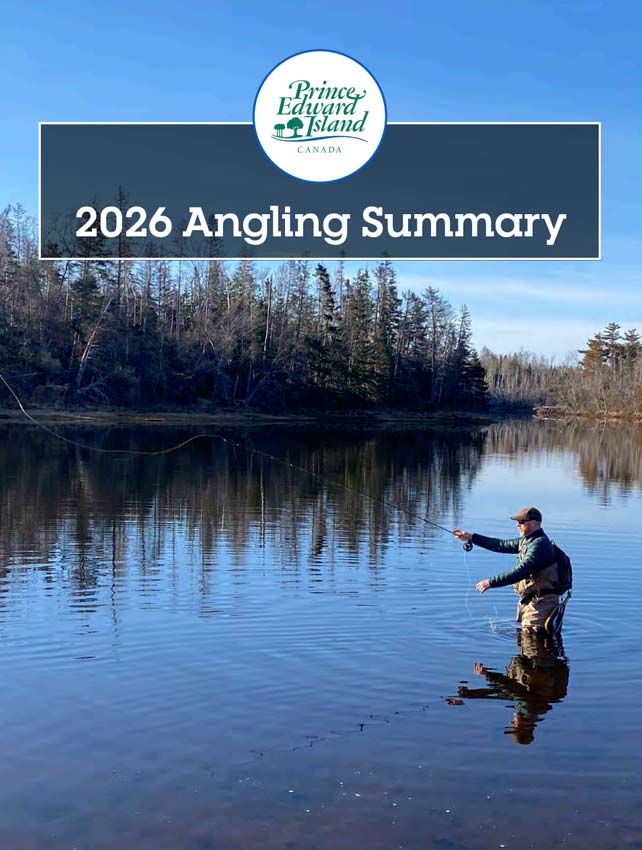
A common conversation topic among PEI anglers is concern about the low rainbow-smelt returns. One thing that should help is the establishment of a no-dip-netting zone on the West River around the Crosby’s Dam section, a milestone for rainbow-smelt conservation. This is the first year these measures were put in place, and the goal is to remove the dip-net fishery pressure in an area where the smelts gather due to velocity constraints. Closing this section to dip netting will allow more smelt to successfully navigate upriver to spawn and play their vital role in the food web for other species.
Nova Scotia
Nova Scotia Program Director Matt Russell is anticipating dry-fly season and previews some big events in the province next week.
Trout Season
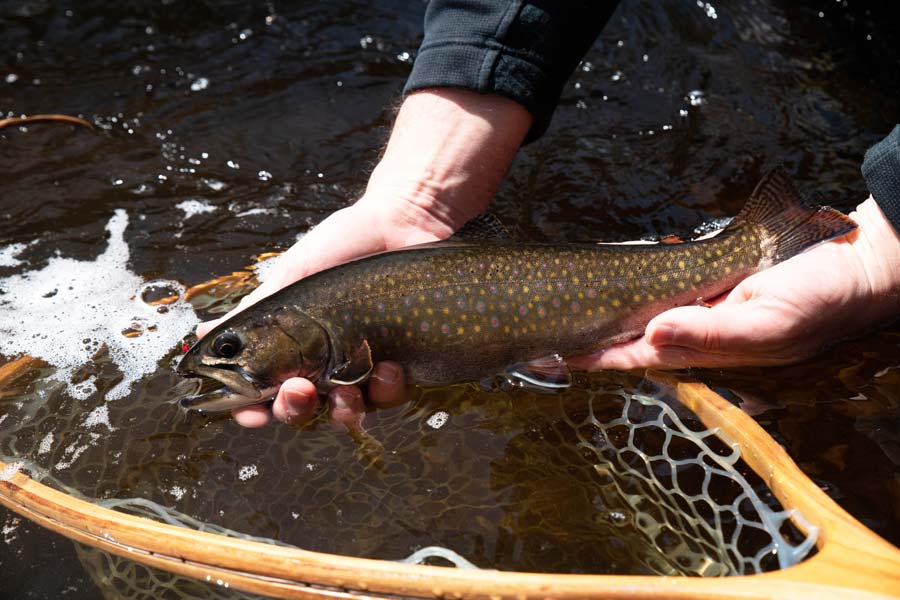
While salmon season is still a month away, consistent rain and mild temperatures for the next few weeks mean that trout season is in full swing. Water temperatures across the province are quickly approaching that magic 10° mark when the coveted dry-fly season really takes off. Ideal flies for this time of year in NS include many classics, like the Black Quill and Hendrickson, and on those extra warm days, a size 10-14 Royal Coachman is a personal favourite.
Smolt Wheels
We are happy to report that as of April 27 our team, in partnership with St. Mary's River Association (SMRA) and DFO, have tagged our first smolt on the St. Mary’s River. As mentioned in last week’s Rivernotes, this smolt is the first of hopefully over 1,000 we will tag this year.
Today, ASF staff will be joining the Cheticamp Rivers Salmon Association to install a smolt wheel on the Cheticamp River as part of our Wild Salmon Watersheds Program.
Halifax Dinner
Next week is a big one for ASF’s Nova Scotia operations: On May 6, ASF and NSSA will host our 35th Annual Halifax Dinner, and there are ASF Board of directors’ meetings May 5–7. For more information about the Halifax Dinner or to purchase tickets please contact events@asf.ca.
Scale of Change Showing
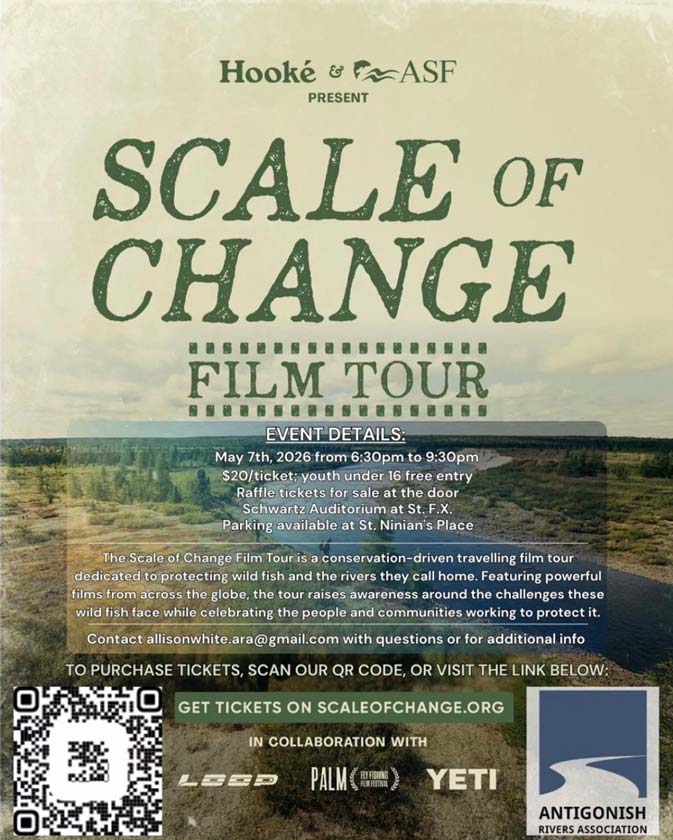
On May 7 the Scale of Change Film Tour will be headed to Antigonish. Hosted by the Antigonish Rivers Association, the event will take place from 6:30–9:30 at the Schwartz Auditorium on St. Francis Xavier University campus. Click here for more information and to purchase tickets.
New Brunswick
New Brunswick Program Director David Roth shares updates on smolt-wheel deployment and highlights positive salmon-fishing results during the recent spell of good weather.
Earlier this week, I joined partners from the Miramichi Salmon Association, Anqotum Resource Management, and the Canadian Rivers Institute at Wayerton Bridge to install three smolt wheels on the Northwest Miramichi River. Additional wheels are scheduled to be deployed later this week on the Dungarvon River and the Southwest Miramichi River. Next week, the installation on the Nepisiquit River will follow suit.
These traps will support several important research and conservation initiatives. The team is also waiting for water levels to drop further before installing nets that will significantly expand collection efforts compared with previous seasons.
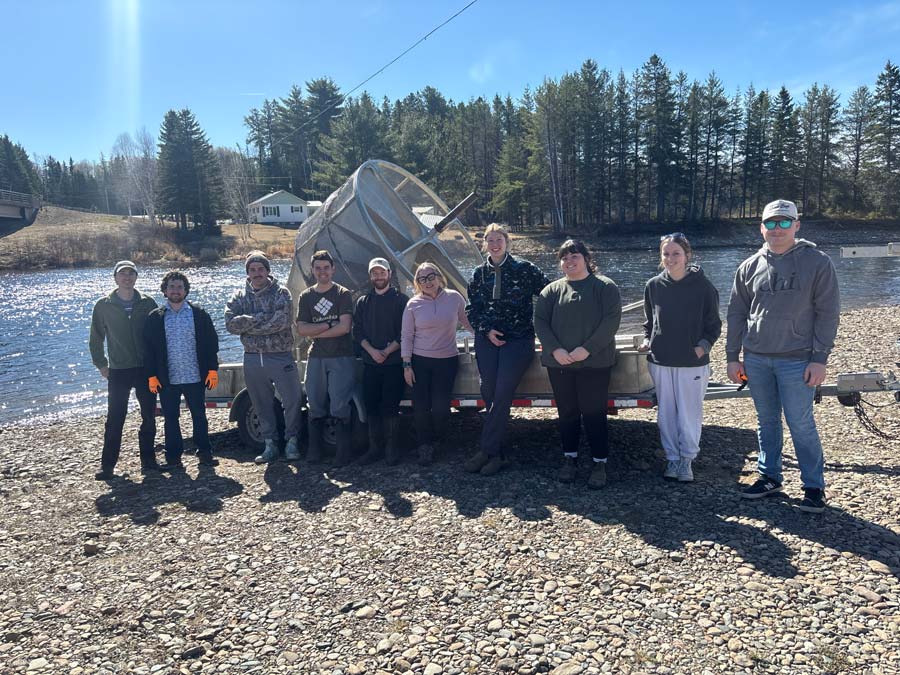
On the Northwest and Southwest Miramichi, collected smolts will once again be transported downriver to help improve survival during their outmigration to sea. Building on lessons learned over the past two years, the team has refined its methods to further enhance fish survival. One of the most significant changes this season is the use of a boat equipped with flow-through tanks, allowing a constant exchange of river water during transport. This helps smolts continue to imprint on their home river, reducing the risk of straying when they return as adults. More on the project can be found here.
In parallel, the Miramichi Salmon Association will conduct its annual smolt estimates. The wheel on the Dungarvon River will be used to collect DNA samples to evaluate the success of previous fry-stocking efforts performed on the river by the Miramichi Salmon Association in collaboration with the University of New Brunswick.
Fishing Report
On the angling front, reports from across the river suggest fishing improved considerably over the past week. Warmer temperatures and clearer water appear to be driving the increase in success.
Catch reports continue to reflect the strong grilse presence seen during last year’s bright-salmon season. This is consistent with counts from last season on the Miramichi, which suggested a ratio of roughly 1 salmon to 5 grilse. That said, several anglers were rewarded this week with beautiful multi-sea-winter salmon.
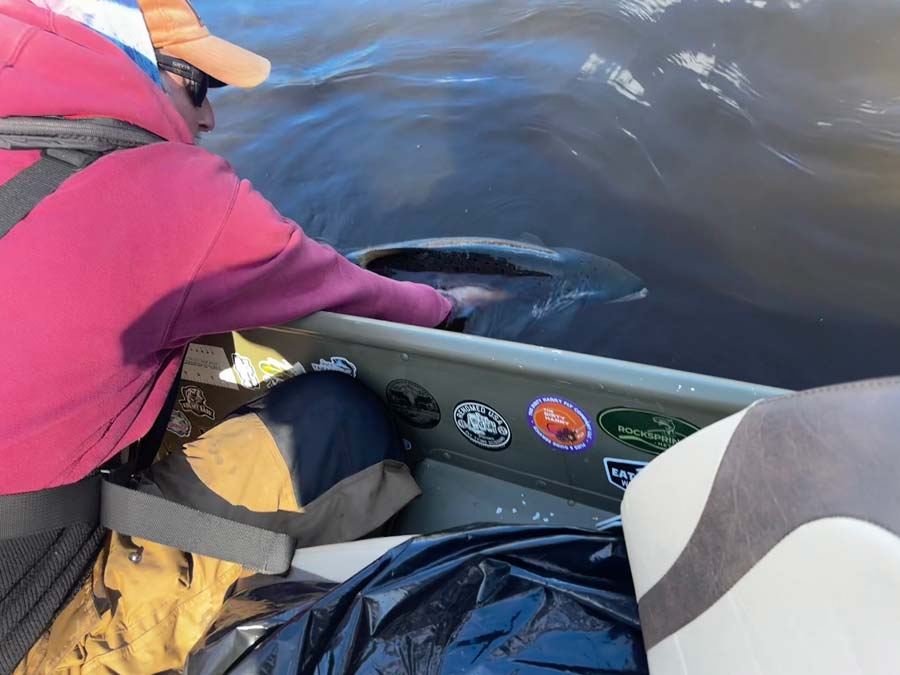
We also heard from the Wolastoqey Nation New Brunswick about efforts to save the Mactaquac Biodiversity Facility.
Wolastoqey Nation launches petition to save Mactaquac hatchery
This decision raises significant environmental and cultural concerns, including the risk of extinction of Polamuwok in the Wolastoq if no viable alternatives are in place. If DFO can make this decision, which risks the extinction of Wolastoq salmon, they could pull away from any other river system when things get tough.
WNNB is circulating a petition to the Minister and the House of Commons, which can be found at www.wolastoqsalmon.ca. Please consider signing and reach out to your MP or MLA about this important issue.
Maine
ASF Maine Habitat Restoration Project Manager Jeff Reardon shared his experiences at an annual fish fry.
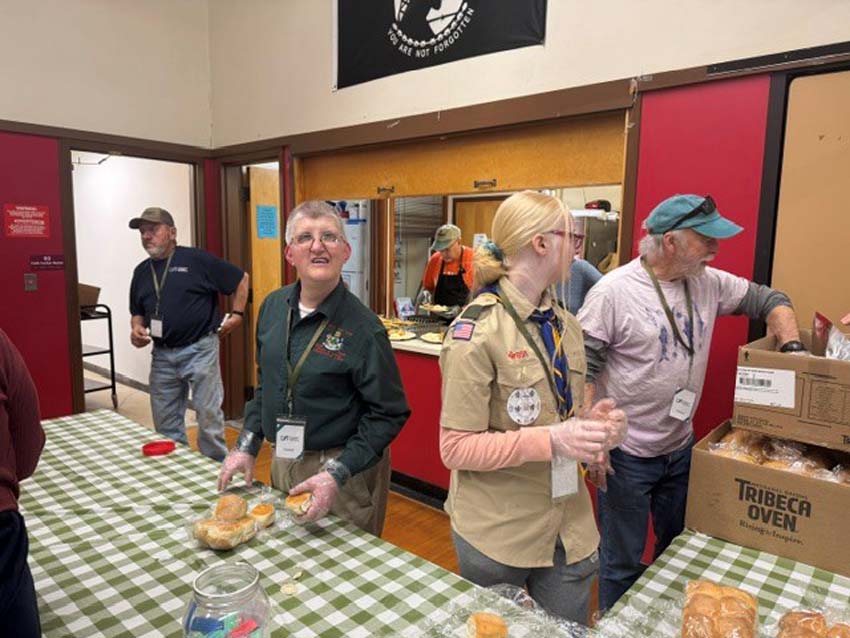
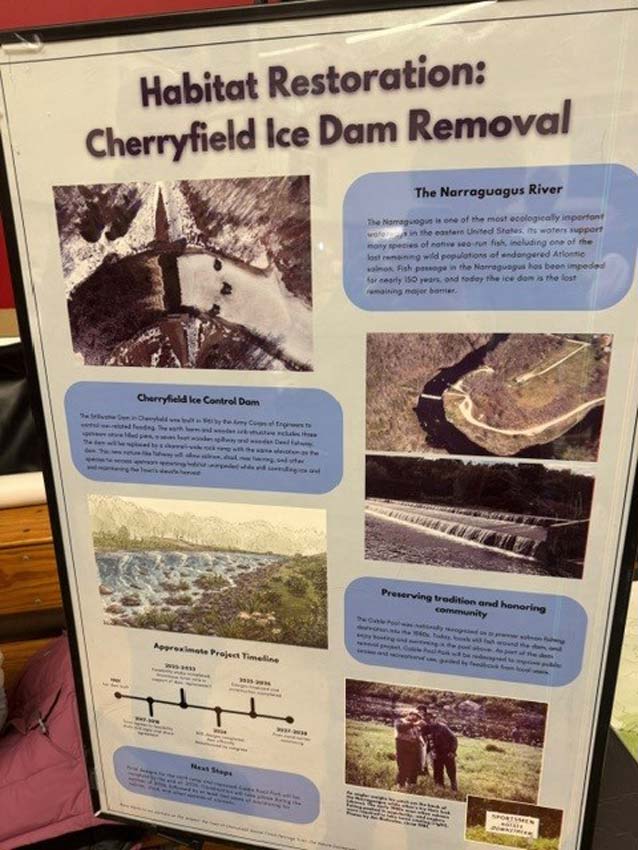
On Saturday, April 25, the Downeast Salmon Federation (DSF) celebrated its 24th annual smelt fry—and my first. The Smelt Fry is a spring event held every year to celebrate Maine’s abundance of sea-run fish. DSF operates one of the last commercial smelt fisheries in Maine at the head of tide on the Pleasant River in Columbia Falls, just downstream of a dam they removed in 1999 to improve sea-run fish access to the river. These fisheries will be further aided by DSF's plans to take out the Cherryfield Dam on the mainstem of the Narraguagus River. ASF, a project partner, will be Downeast regularly this summer during the construction of a new nature-like fishway at the Cherryfield site.
My invitation was reinforced at a Maine Council ASF meeting on April 18, where Maine Council President Gerry Ziegars, former DSF President Alan “Chubba” Kane, and longtime DSF and Maine Council officer Don Sprangers regaled me with tales of this spring’s smelt netting, where they harvested over 400 pounds—enough for the Smelt Fry plus some surplus for smoking—in two nights.
The weather gods provided the nicest day of the spring—sun, no wind, and temps in the mid 60s. When my wife and I pulled into Columbia Falls an hour before the advertised start of the event, the town was already hopping, and by 11 the beer tent was open, tours were underway in DSF’s conservation hatchery and smelt harvest shack, and sales were brisk at the smoked fish food truck selling smoked smelts, smoked mackerel, and smoked alewives.
The fried smelt lunch was delicious, served by the local Scout troop and DSF member and long-time state legislator Will Tuell, with wild Maine blueberry shortcake for dessert.
From the gathering cormorants, gulls, and ospreys over the marsh in Pleasant Bay below the falls, the spring alewife run was just starting, and daffodils were just starting to bloom as we drove home. Maine’s endangered Atlantic salmon can’t be far behind them!
Colby W. B. Bruchs, a Fisheries Scientist with Maine Department of Marine Resources, sent in an update on smolt-collection activities.
The 2026 smolt season is underway! We deployed four rotary screw traps (RSTs) at two sites on the Narraguagus River, continuing smolt assessments for a 29th year.
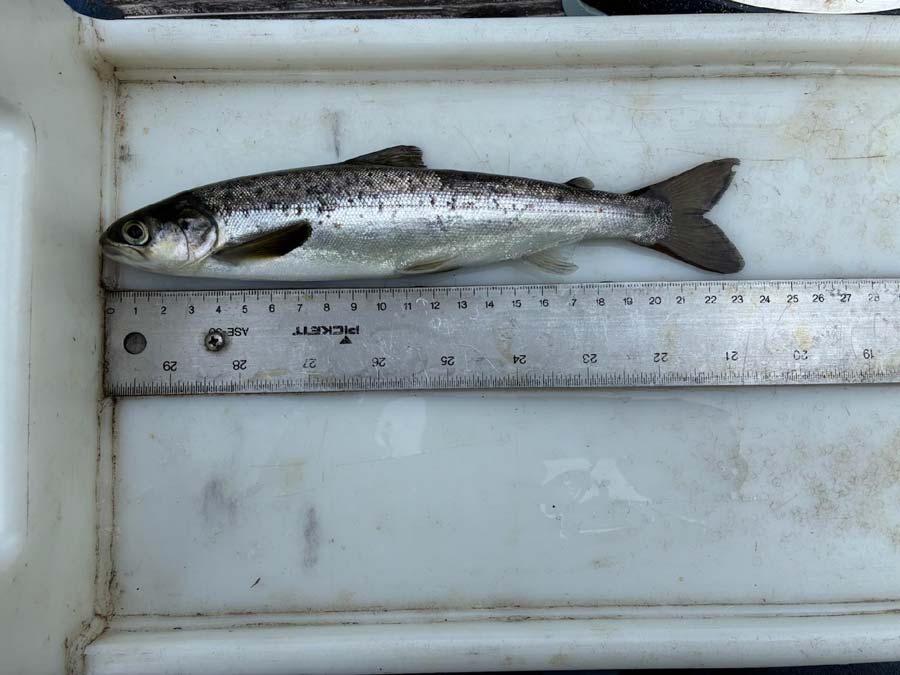
Two traps are deployed in the lower river at Little Falls to continue long-term population monitoring. In partnership with Project SHARE, two traps are deployed in the upper river at Route 9 to evaluate smolt production response to ongoing habitat restoration activities.
RST operations began on 14 April. Although water temperature is cold, smolts have been captured at each site—19 smolt at Little Falls; 22 smolt and 2 parr at SnoMobile Bridge.
Research and Environment
Ellen Mansfield, of ASF's Research and Environment team shared stories of teams preparing for a season of collecting and analyzing data from rivers around the region.
Reading the Signs of Spring Returns
After several of the worst return years on record, 2025 told two different stories. Grilse runs showed clear improvement, with some rivers seeing the best early-season fishing in years. Large, multi-sea-winter salmon told a different story, with returns on many rivers remaining historically poor, which is likely the echo of a weak 2024 grilse run.
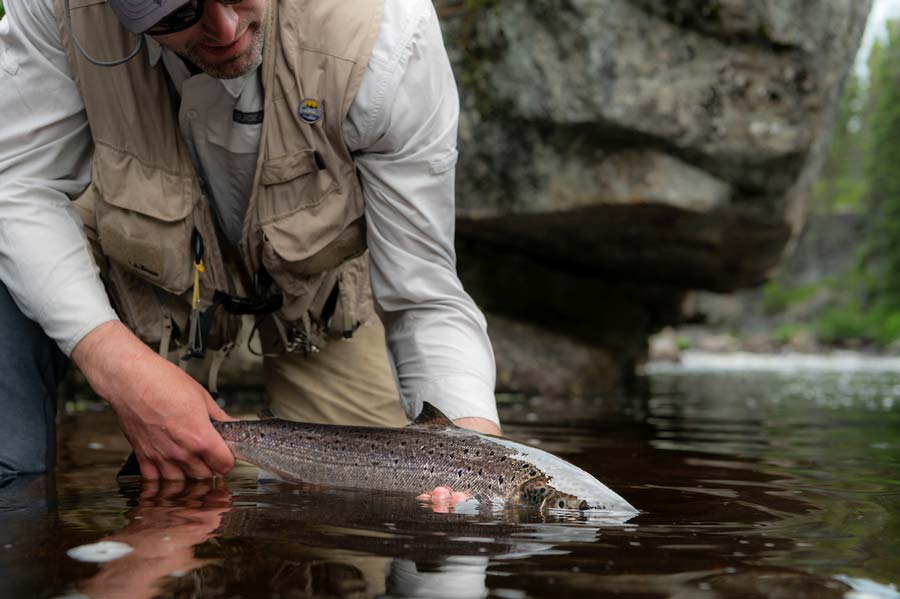
This pattern comes down to how long salmon stay at sea before maturing. Grilse and large salmon originate from the same cohort of smolt, with some returning after one winter at sea, while others remain out for a second or potentially third year. As a result, strong grilse returns in one year may relate to stronger large salmon returns the next. This relationship underpins the life-cycle models used by international scientists to forecast North Atlantic salmon abundance. If it holds, 2025’s grilse improvement should translate into more large fish returning this season.
The distinction between returns and survival is key to evaluating the largest constraint on salmon recovery, says ASF researcher Jason Daniels, and the research team is working to do just that. A new smolt-monitoring program aims to track individual fish from rivers into the ocean and back, generating the survival data needed to refine forecasts and link conservation actions to measurable outcomes. The 2025 season suggests that the science is directionally sound. And this shift from returns to survival moves uncertainty from the ocean back into the reach of management.
Low Water, High Stakes
The rivers that Atlantic salmon call home are starting this season in a water deficit, a situation that the research team is keeping a close eye on. Across Maine, river and stream levels are mostly low. On the Canadian side, the picture is similar: while March brought near-normal precipitation to much of the Maritimes, some localized dryness limited recovery in parts of New Brunswick and Nova Scotia. Most salmon regions are still carrying moisture deficits from a severe 2025 drought season. Even with more snowpack in headwater regions than in previous years, the snowpack was still historically low—which means that the spring freshet that typically recharges groundwater and pushes smolts seaward arrived thin.
For salmon, low flows mean concentrated fish, elevated temperatures as summer approaches, and reduced access to cold-water refuges. The timing compounds the pressure on smolt already navigating their narrow migration window.
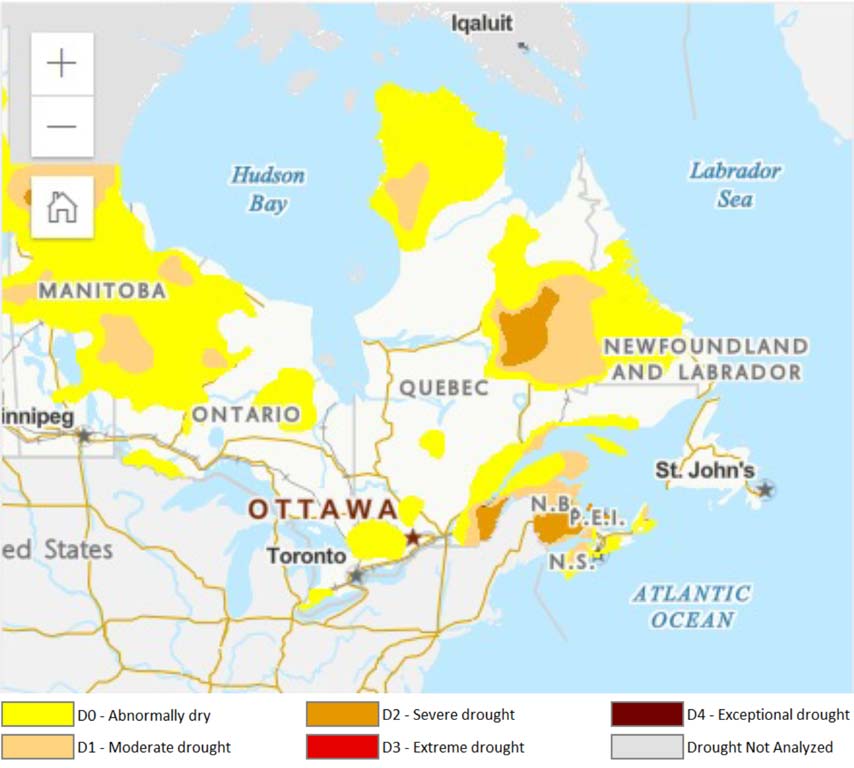
There is room for cautious hope. Hydrological deficits can be alleviated by a wet spring and summer, and our rivers have shown resilience before. But recovery isn't passive; it depends in part on what we take from the system and what we put back.
Every water withdrawal, every riparian buffer cleared, every impervious surface added to a watershed pushes rivers closer to the edge during dry years. Collectively, the inverse is also true: maintaining streamside vegetation, reducing consumptive withdrawals during low-flow periods, and supporting groundwater recharge programs all matter. Salmon don't ask much of us.
Mostly, they ask that we leave enough water in the river. As we get excited for sunny warm days, let’s still hope nature will bring a lot of rain in the upcoming weeks!
Development
Upcoming ASF Events
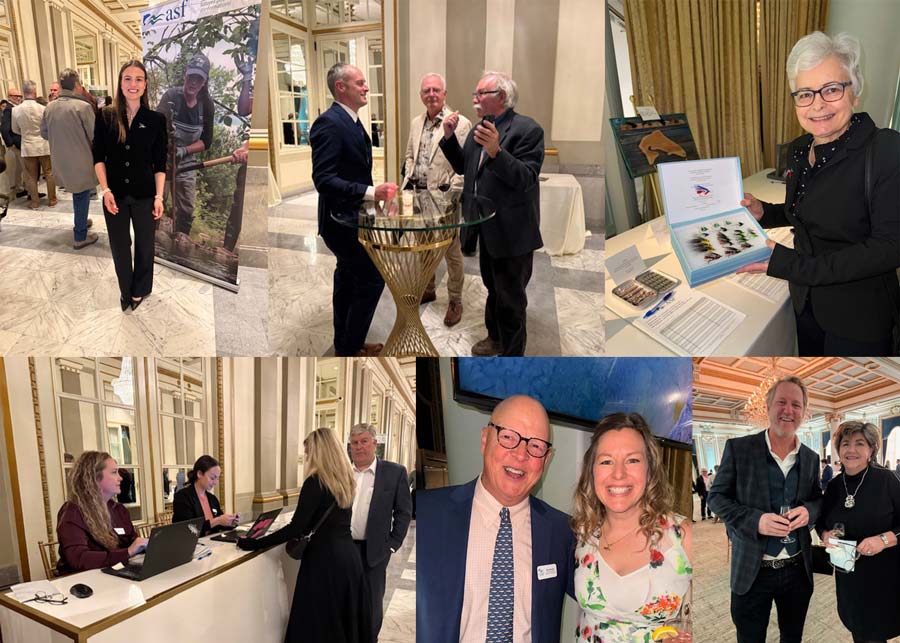
May 6: 35th Annual Halifax Dinner. Co-hosted with the Nova Scotia Salmon Association, Annual Halifax Dinner will honour René Aucoin, president of the Chéticamp River Association, for his many valuable contributions to Atlantic salmon conservation throughout Nova Scotia and the Maritimes.
May 20: Toronto Upstream Mixer, An Atlantic Salmon Rendezvous. Join us for a casual evening to welcome a new wave of stewards to the community, culture, and conservation work that supports wild Atlantic salmon. Together with seasoned Atlantic salmon Anglers and Conservationists, we invite you to join us in demystifying Atlantic salmon angling.
Tomorrow's Protection Begins Today
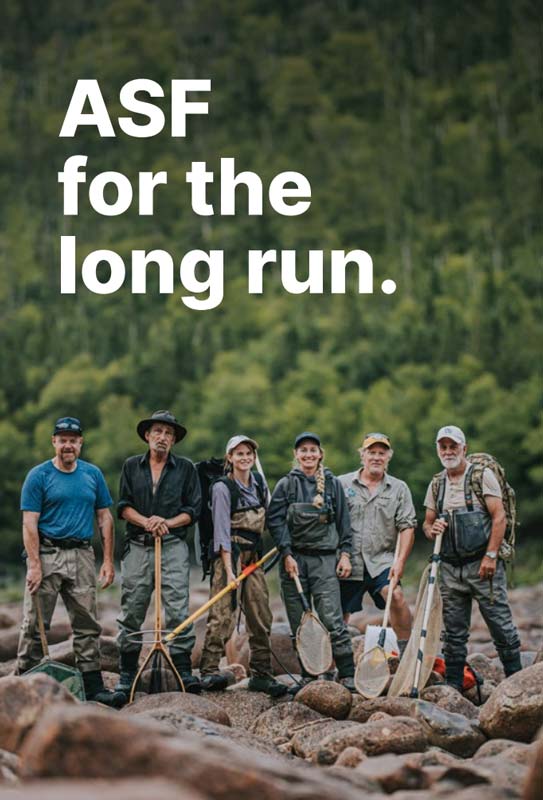
Many of us feel a compelling need to leave a lasting impact on our friends and family, as well as the world in which we live.
At ASF, we focus on remarkable fish in delicate ecosystems that demand the coldest and cleanest water. Legacy gifts help make a difference. There are easy ways to make an impactful gift that not only helps our conservation and research efforts, but also helps you, your estate, and your heirs.
To learn more about how you can help, please visit our Planned Giving Website.
We will be pleased to assist you and your advisors in planning a legacy gift that both serves your financial needs and contributes to the health of wild salmon.
And if you're 65 or older, ASF has secured a 20% match on any endowment gift or legacy gift made to ASF in 2026. This means that a $100,000 planned gift commitment for tomorrow would result in a $20,000 gift today from our anonymous matching foundation.
For more information, please contact:
Bill Bullock, Vice President, Development
Vice-présidente, développement ÉU
(802) 375-3320 | bbullock@asfmaine.org