





Rivernotes
Rivernotes May 14, 2026
Phil Monahan
May 14, 2026
Editor's Note
by Phil Monahan, ASF Managing Editor
Welcome to Rivernotes, our weekly roundup of news and information from around the world of Atlantic salmon—Québec, Atlantic Canada, and Maine.
Fishing reports from across the region describe tough conditions, but a few fine catches. And, according to angler Brad Burns, things should only improve:
“The Miramichi and its tributaries, such as the Cains, are gradually trending down in height. The river is still cold, and brookies are everywhere and interested in large streamers. Any of the normal favorites like the Mickey Finn will do, but so will Soft Hackles, fur strips, and the ever-effective Green Machine.
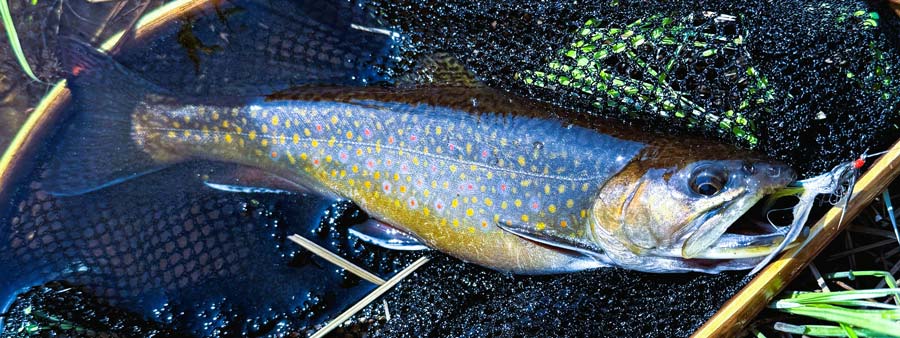
Next week is forecast to provide some warmth and there will be some hatches taking place. It will definitely not be too early for dry flies to work. It is hard to beat bombers and other high floating attractors, such as Stimulators and Wulffs.
Country Haven tells me that the Rapids are producing some very good fishing for larger trout, and there are kelts being caught here and there for those trying for them. We’re still a week away from any realistic chance of a Miramichi bright salmon, but that’s not a very long wait.“
Guide Patrick Poirier in Cape Breton reports:
"Rivers have been very high, with reports of snowpack still remaining in the highlands, which has limited fishing opportunities. Even with conditions as they are, there have been reports of some nice brown trout and a few speckled trout. These heavy flows will allow most kelt to exit the river with minimal interference, and good water offers hope of a great start to the salmon angling season."
The Future is Bright
The Miramichi Salmon Association is once again offering its First Bright Miramichi Salmon of the Year Award.
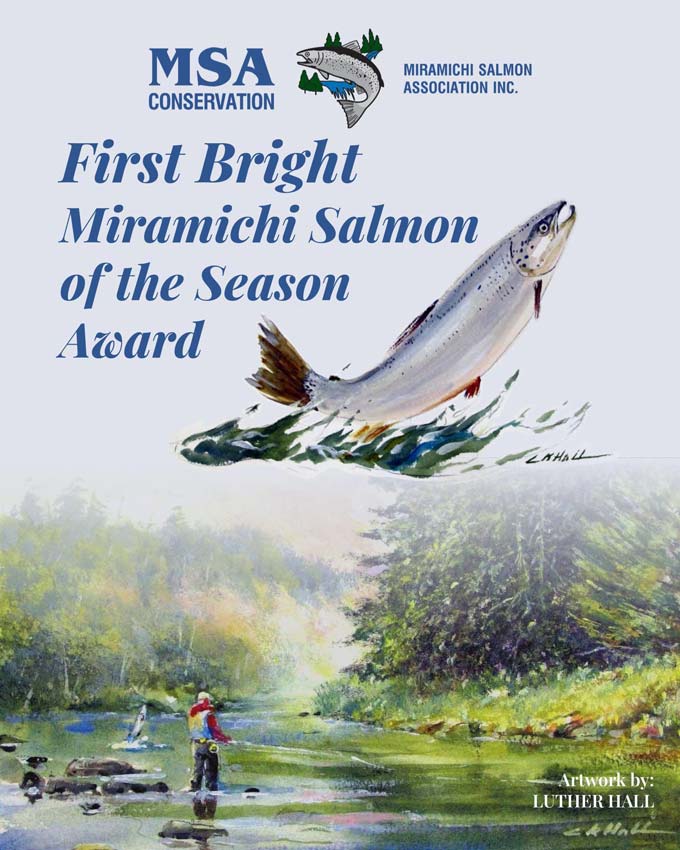
To encourage early-season fishing—and to recognize those who persevere through challenging conditions—the first bright salmon landed in 2026 will be honoured with a special commemorative certificate featuring original artwork by Luther Hall.
How to Enter
If you land what you believe is the first bright salmon of the season:
- Take a photo of yourself with the fish (or ask a buddy to help)
- Email it to: events@miramichisalmon.ca
- Include your name, town, and the branch of the river where the fish was caught
- A rough estimate of the fish length is welcome but not required.
Québec
La directrice du programme Québec, Caroline Côté, partage ses expériences tirées d’une récente tournée d’écoute.
Notes de tournée : la Côte-Nord, une question, et un rendez-vous en juillet
Au cours des dernières semaines, j'ai parcouru plus de 2 300 kilomètres sur la Côte-Nord. L'objectif était simple : me présenter dans mes nouvelles fonctions, renouer avec des partenaires de longue date et en rencontrer de nouveaux : gestionnaires de rivières, pourvoyeurs, ZECs, partenaires innus et organismes de bassins versants qui veillent, souvent dans l'ombre, sur le saumon atlantique.
Les rivières sont encore froides, la neige persiste en forêt, plusieurs lacs sont toujours gelés. La saison ne commence qu'en juin, mais les gens, eux, sont déjà à l'œuvre.
Le voyage a commencé aux Escoumins, là où j'avais raconté le souper-bénéfice de la CGRSE il y a deux semaines. Le lendemain, c'est au quai des Pilotes que je me suis arrêtée : on m'avait glissé que la morue avait commencé à mordre au bout du quai. Je suis allée vérifier. Rien ce jour-là, mais c'est ça aussi, prendre le pouls d'un territoire.
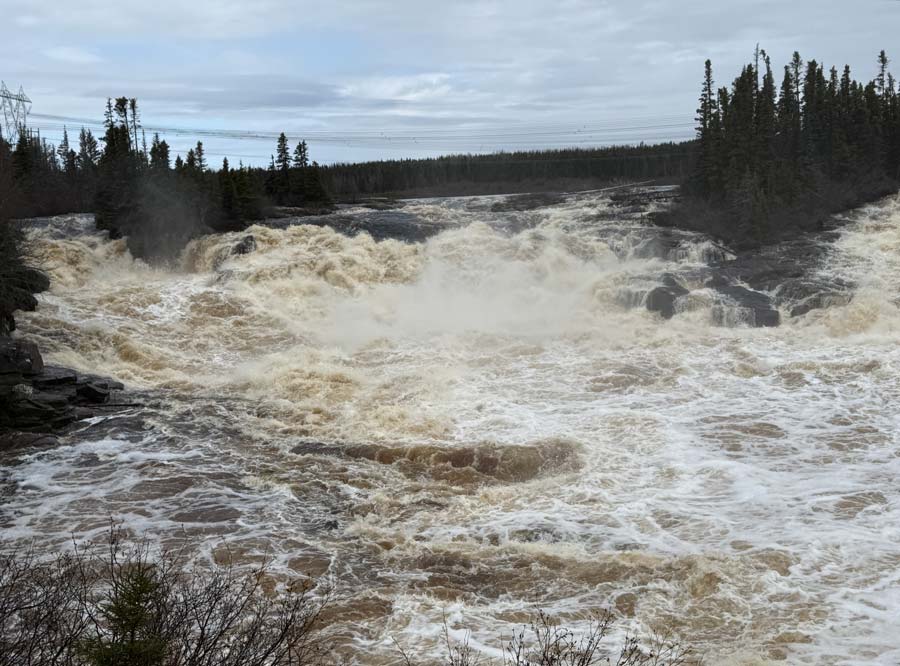
Plus tard dans la semaine, en décrivant les conditions printanières dans mon réseau : les eaux hautes, encore froides, teintées de tannins par la fonte j'ai reçu cette réponse d'un allié des rivières à saumons : « Love that tea-colored water. Raging spring! » Là où certains voient des conditions difficiles, d'autres voient la promesse d'une belle saison.
En Minganie, Gérard, agent territorial à Nutashkuan depuis près de trente ans, m'a partagé sa vision du travail : la sensibilisation à la conservation ne peut pas s'imposer de l'extérieur, elle doit venir des communautés, avec douceur. Il m'a aussi parlé du saumon comme d'une métaphore : les chutes à franchir, l'eau qu'il faut attendre, le moment où il faut persévérer plutôt que d'abandonner. C'est une image qui résume bien ce que j'ai vu sur la route : rester attentif, patient et persévérant.
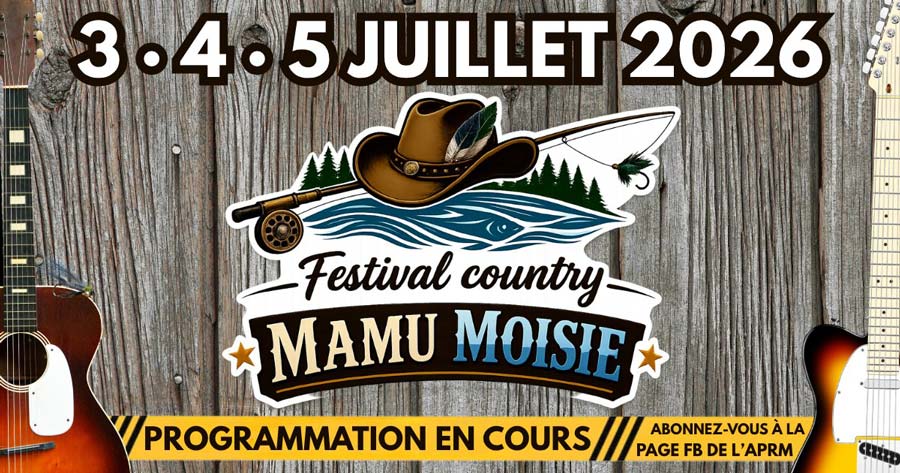
Et à mon retour au bercail à Québec, j'ai réservé une plage horaire pour qu'on en discute encore. Sur la rivière Moisie, la Rivière Moisie Protection Association (APRM) et l'Agence Mamu Innu Kaikusseth (AMIK) lancent la première édition du festival country Mamu Moisie, les 3, 4 et 5 juillet, sur la plage du camping de la ZEC. Tous les profits seront réinvestis dans la conservation de la rivière.
On vous attend là-bas. Et d'ici là, si vous avez des commentaires, des questions ou des suggestions de billets, n'hésitez pas à m'écrire: ccote@asf.ca.
Québec (English)
Québec Program Director Caroline Côté shares experiences from a recent listening tour.
Notes from the Road
Over the past weeks, I drove more than 2,300 kilometres across Québec's North Shore. The goal was simple: introduce myself in my new role, reconnect with longtime partners, and meet new ones—river managers, outfitters, ZECs, Innu partners, and watershed organizations who watch over Atlantic salmon, often quietly.
The rivers were still cold, snow lingered in the forest, and many lakes remained frozen. The season won't really begin until June, but the people who care for these watersheds are already at work.
The trip started in Les Escoumins, where I had been to the CGRSE fundraiser two weeks earlier. The next day, I stopped by the Pilots' Wharf because someone had mentioned that cod had started biting at the end of the dock. I went to check. Nothing that day, but that's part of taking the pulse of a territory.
Later that week, while describing the spring conditions in my network, I got this reply from an ally of salmon rivers: "Love that tea-colored water. Raging spring!" Where some see difficult conditions, others see the promise of a good season.
In Minganie, Gérard, a territorial agent in Nutashkuan for nearly 30 years, shared his philosophy that conservation awareness cannot be imposed from outside; it has to come from within the community, gently. He also spoke about salmon as a metaphor for our work: the falls to climb, the water you have to wait for, the moment when you persevere instead of giving up.
Celebrating the Moisie
On the Moisie River, the Rivière Moisie Protection Association (APRM) and Agence Mamu Innu Kaikussesht (AMIK) are launching the first edition of the Mamu Moisie country festival on July 3, 4, and 5, on the beach of the ZEC campground. All profits will be reinvested in the conservation of the river.
We hope to see you there. In the meantime, if you have comments, questions, or suggestions for future posts, please email me at ccote@asf.ca.
Newfoundland and Labrador
Newfoundland and Labrador Program Director Kim Thompson celebrates the opening of trout season and updates us on smolt-wheel efforts on the Terra Nova River.
The recreational Atlantic salmon season is not open until June, but anglers can still get out on the water with the start of the 2026 summer trout season for Zone 1 (insular Newfoundland) on May 15 until September 7.
DFO reminds anglers that details on the regulations pertaining to bag limits, river classification, closed areas, and special management areas are contained in the Angler's Guide 2026–2027, which is available online here.
High-Water Challenges
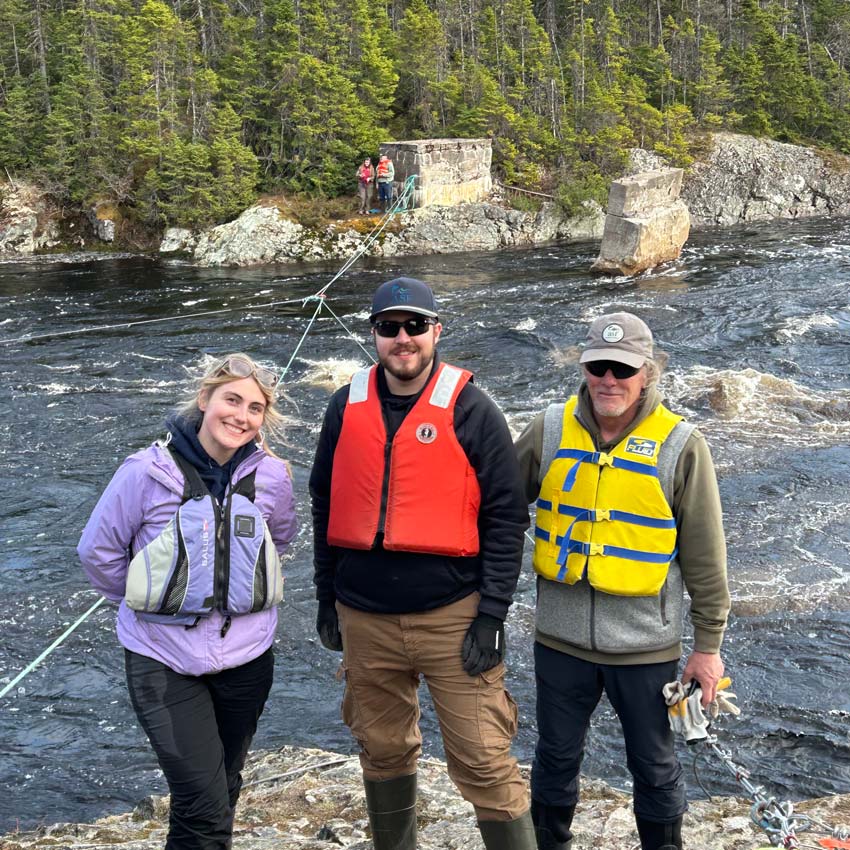
As in other provinces, it has been a high-flow spring. Water levels on the Terra Nova River have been abnormally high, making it challenging for the annual deployment of the smolt wheel.
Thanks to the efforts of the FABEC members who, along with ASF's Jon Carr, were able to safely deploy the wheel this past Saturday evening. Just one smolt was caught on the first night.
[Check out the short video below, which shows ASF's Jon Carr climbing inside the wheel for repairs, and then deploying it a second time.—Ed.]
However, the turbulent waters got the upper hand, and the wheel suffered damage, which required it to be brought ashore for repairs. In short order, the team were able to secure the supplies to make repairs and redeploy the wheel.
Nevertheless, with heavy rain forecast over the next couple of days, the river continues to rise—with flow rates more than double what they were at the same time last year. For the safety of team members and the equipment, the smolt wheel will be tied up along shore until water levels recede. Hopefully Mother Nature will be kinder to the field team in the coming days.
Downhome Expo
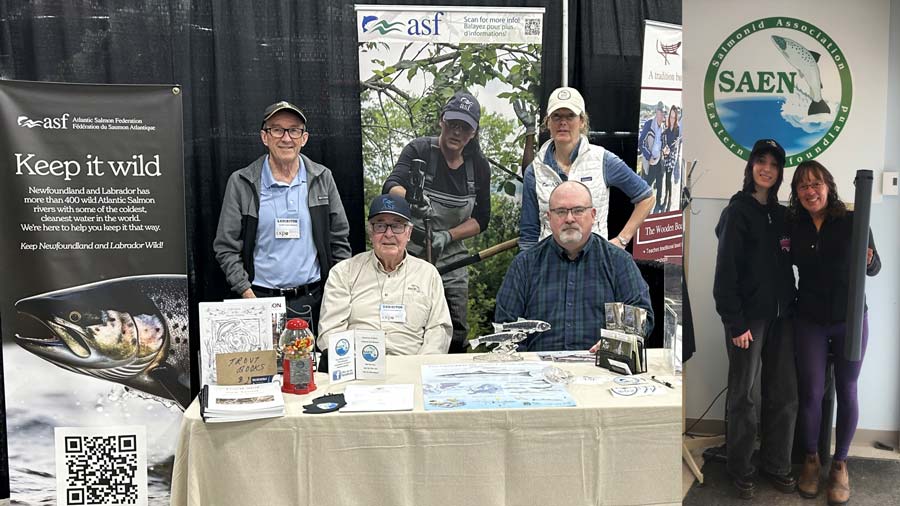
Many thanks to the Salmonid Association of Eastern Newfoundland (SAEN) members who, in collaboration with ASF, spent Mother's Day weekend at the Downhome Expo, promoting awareness of wild Atlantic salmon and conservation initiatives. A special thanks to Ian Gall, who shared his personal collection of flies with those who stopped by for a chat.
New Brunswick
New Brunswick Program Director David Roth offers a short update on the Miramichi and new invasive species regulations.
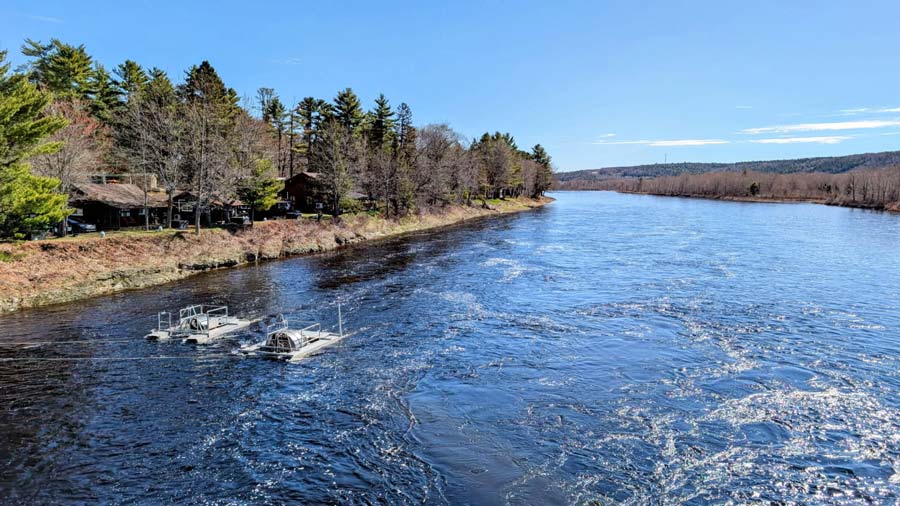
With the smolt-collection sites on the Miramichi River now operating at full capacity, the team has been putting in long days to ensure that everything continues to run smoothly throughout the peak of the migration.
Despite the busy field schedule, I had the chance to speak with several anglers over the past week and heard encouraging reports from the end of the kelt season. Many anglers reported unusually high catches of sea-run brook trout early in the season, including a notable number of large fish. These observations continue a trend that many anglers have noted over the last two years, when they've been seeing increasing numbers of trout compared to previous seasons.
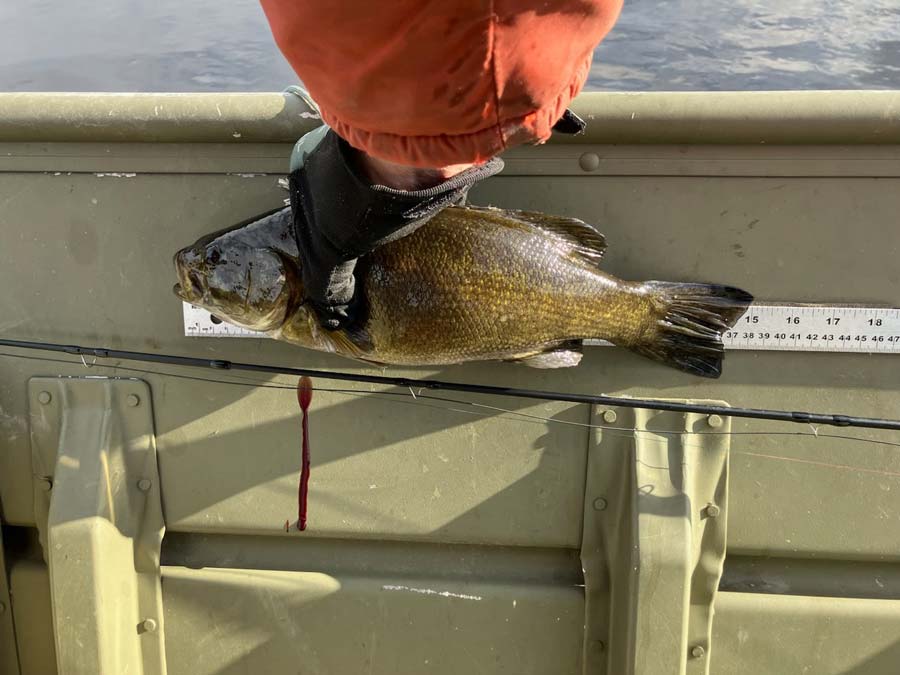
Unfortunately, anglers on the Miramichi River are also continuing to report catches of invasive smallmouth bass, including large mature individuals capable of reproducing. ASF would like to remind anglers of the new mandatory retention regulations for several invasive fish species introduced this season by the New Brunswick Department of Natural Resources and Energy Development. We encourage everyone to familiarize themselves with the updated rules and the species included under the regulations. More information can be found on the Mandatory retention of invasive species page on the department’s website.
Maine
Jon Viti, Piscataquis River Project Manager, shares an important milestone in the long process to remove a dam on the Piscataquis.
On Friday, May 1, our team working on the removal of the Mayo Mill Dam—which spans the Piscataquis River in Dover Foxcroft, Maine—submitted the Federal Energy Regulatory Commission (FERC) Application for Surrender which is the culmination of more than three years of outreach, engineering, writing, and planning. This document is hundreds of pages and represents my work and the work of former ASF employee Maranda Nemeth (who is now the grant manager for this project with NOAA). It will release jurisdiction of the dam from the federal government and allow us to proceed with removal.
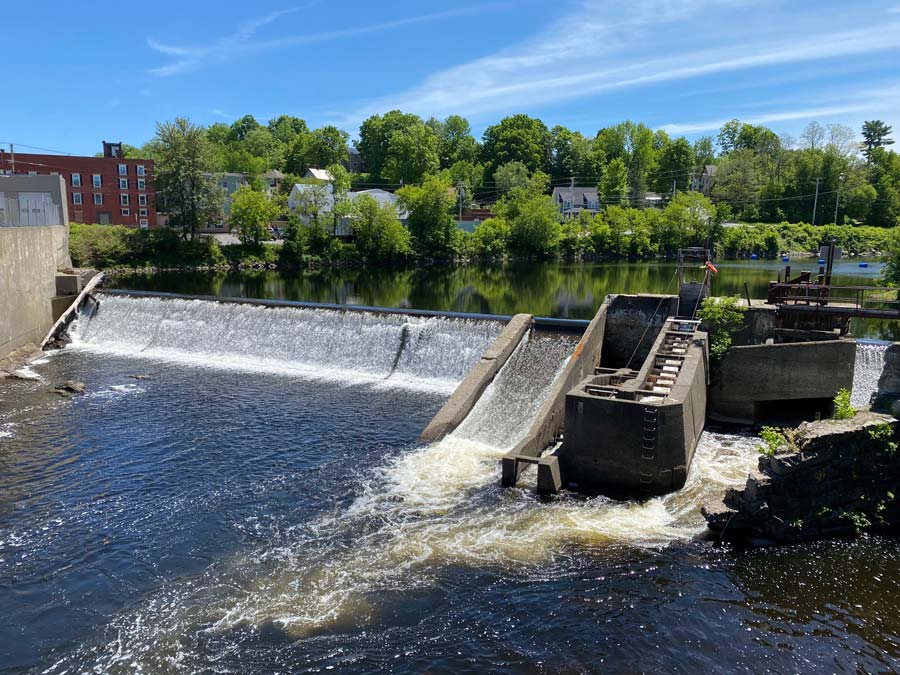
It's a big step in moving towards dam removal, and now we can focus on permits, upland enhancements, and finalizing the design and construction sequence.
We also heard from ASF Habitat Restoration Project Manager Cat Morse about a stocking project on the Pleasant River in Washington County.
Last week, I assisted Maine Department of Marine Resources and US Fish & Wildlife Service with fry stocking in the Pleasant River.
It is still early spring in Northern Maine. Among the emerging fiddleheads, trout lilies, and trillium, the last bits of winter ice still cling to the muddy ground, but that means the tributaries are pumping water and are perfect for accepting juvenile salmon. ASF helped put 72,000 fry into these headwater streams, where they will stay and grow for one to three years before making their way out to sea.
This summer, ASF will open more of the Pleasant River watershed to salmon and sea-run fish by replacing the crossing at Stinking Brook and the Katahdin Iron Works Rail Trail. (Video: USFWS, Photo: Eileen Bader-Hall, TNC)
On Sunday, Jason Valliere, a marine scientist with the Maine Department of Marine Resources, also weighed in with some good news from the Penobscot fish passage:
Just in time for this report, the river herring finally showed up—more than 20,000 in the last 24 hours.
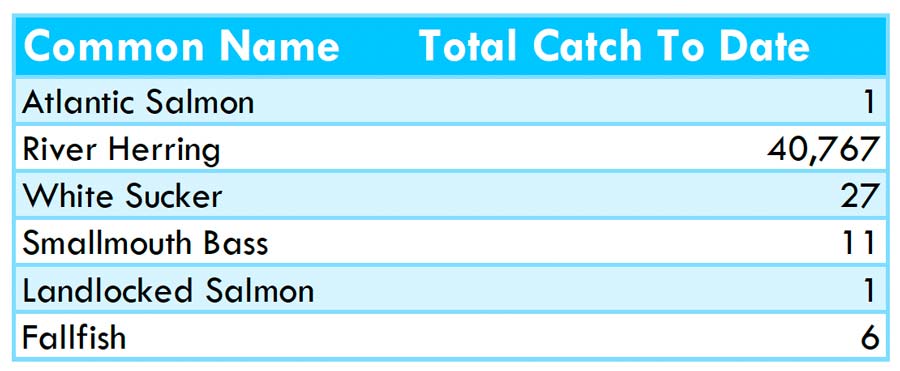
We also got our first salmon for the year, a 71cm fork-length female!
The river has been very high, rising from approximately 10,000 cfs to 32,000 cfs, and the water temperature is currently 12C/53F.
Nova Scotia
Nova Scotia Program Director Matt Russell shares good news from our Halifax fundraiser, as well as an update on smolt-counting efforts on the St. Mary's.
Halifax Dinner
On Wednesday May 6, ASF, in Partnership with the Nova Scotia Salmon Association, hosted our 35th Annual Halifax Dinner at the Halifax Convention Centre, and it was a massive success!
This year, we made the decision to move the dinner from Pier 21 to a larger venue at the Halifax Convention Centre in hopes of having higher attendance, and it worked extremely well. With more than 350 people in attendance and a waiting list for tickets, Nova Scotians and visiting conservationists really showed up in numbers to support Atlantic salmon conservation.
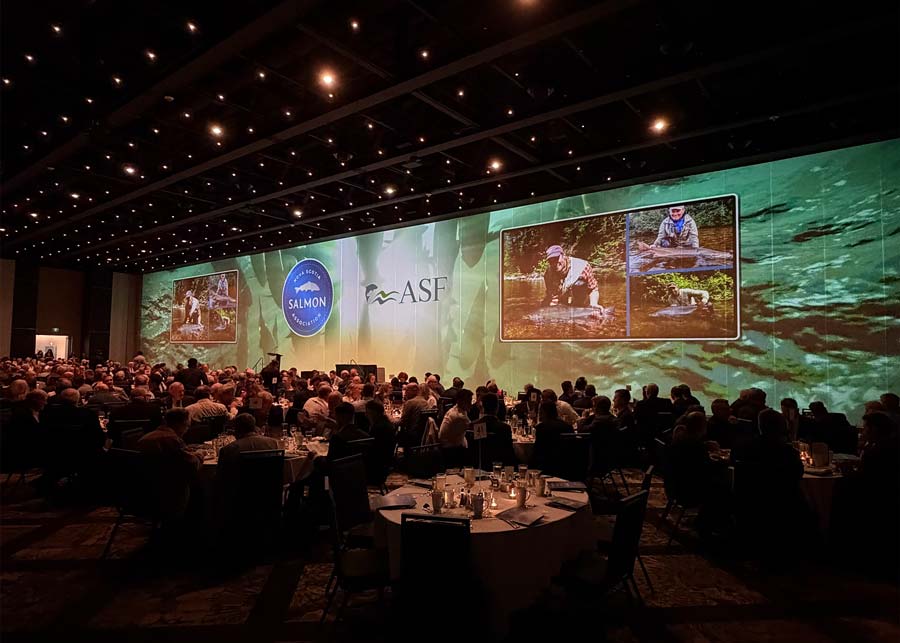
The Halifax dinner not only broke records for attendance, but it also proved to be the most successful fundraising dinner in the province’s history, with generous conservationists pledging money to support our work through silent-auction bidding and paddle raises.
Halifax Board Meeting
This year, our spring board meetings coincided with our Halifax Dinner. ASF had the pleasure of welcoming our board of directors and councils to Halifax for two days of meetings. It seemed Mother Nature was pleased to have so many conservation-minded individuals visiting as well, as we were granted two days of warmth and sunshine, which is rare enough during a Nova Scotia spring.
St Mary’s Smolt Collection
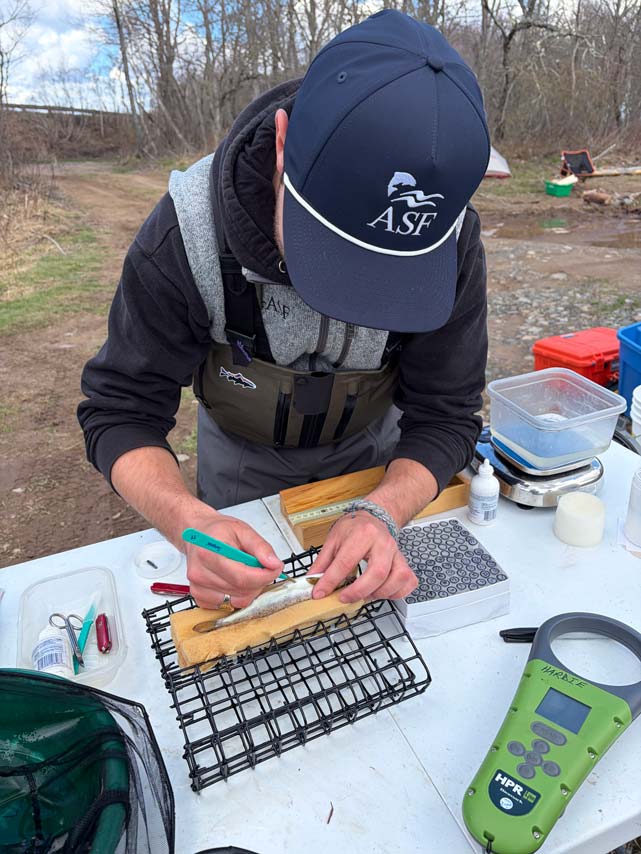
Our work on the St. Mary’s River continues, with the smolt run well underway. Conditions this year have been great for the fish but difficult for the field staff. High water and submerged debris have made smolt tagging a challenge. The river, which was already high, received 70mm of rainfall Sunday night, turning the river valley into a mosaic of rushing rapids, submerged floodplains, and soaked fields.
Nonetheless, our partners at St. Mary’s River Association and DFO have been working tirelessly to maintain and protect our equipment from the storm, tagging smolt when conditions allow.
Research and Environment
Senior biologist Graham Chafe updates us on preparations for data collection on New Brunswick salmon rivers.
Field work is continuing on the Miramichi, and we're getting prepped for the Restigouche and Matapedia fish to start moving and getting tagged. Research scientist Heather Perry, Aquatic Technician Kate Gingles, and I deployed receivers up and down the Miramichi River last week. (Thanks to the folks at Miramichi Marine for helping solve some boat-motor issues and getting us back on the water quickly.)
We didn't see as many striped-bass anglers as usual, and several folks told us that they weren't catching many this year compared to previous efforts. Perhaps the big pulse of bass hasn't come in yet.
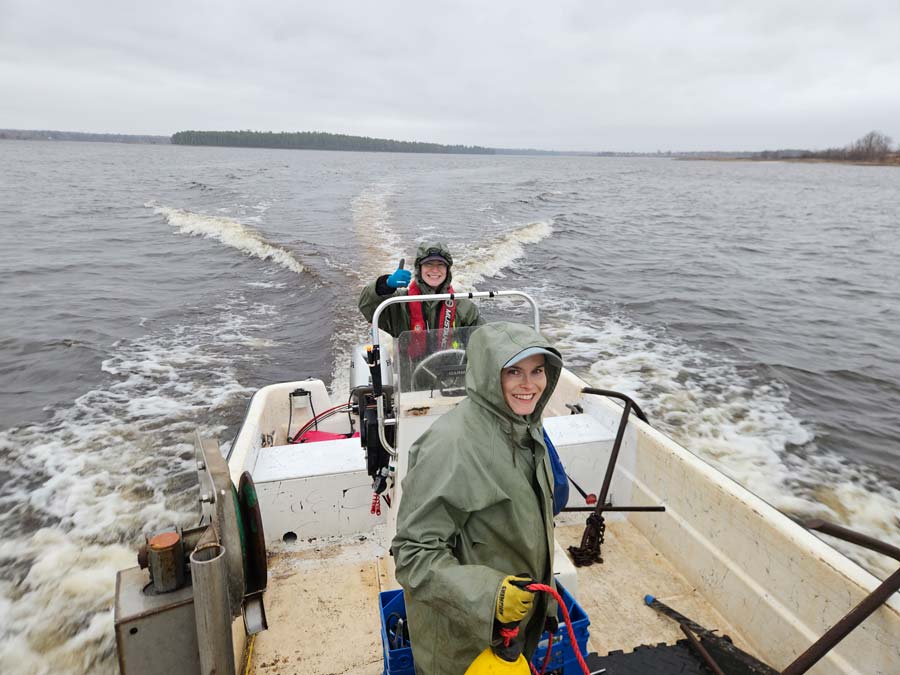
Wild Salmon Watersheds Science Coordinator Jordan Condon and I deployed acoustic-release receivers at Dalhousie, as well. These are similar to our regular receivers, except they sit just off the bottom with no line or buoy on the surface to get tangled by flotsam or boats. When we want them back, we call them up with a hydrophone, and they let go of the anchor and come to the surface. We doubled the line at Dalhousie this year, which will give research scientist Jason Daniels more data to calculate survival at that point.
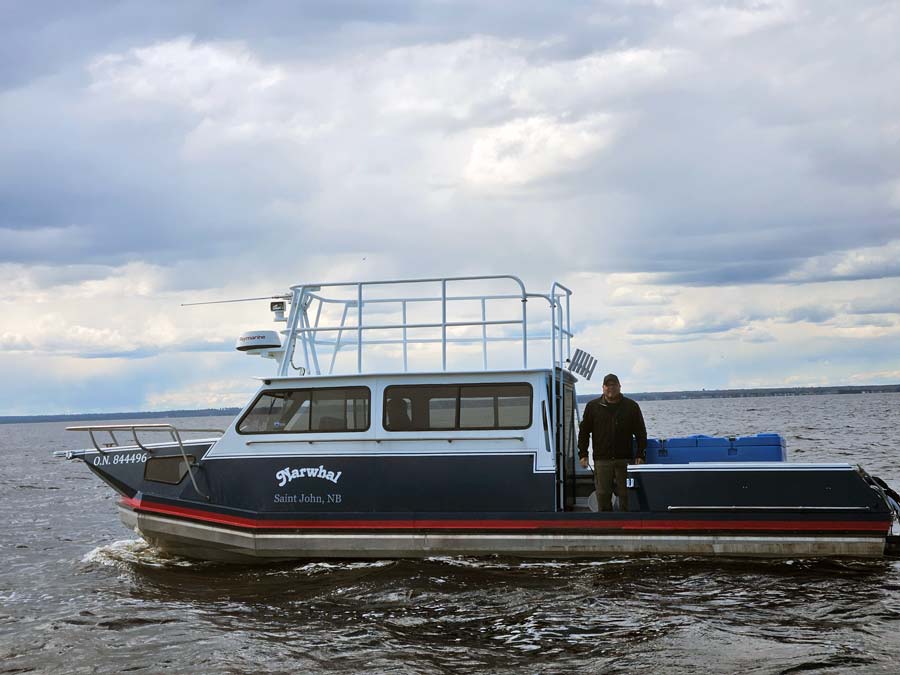
New Brunswick Program Director David Roth and I deployed receivers in Miramichi Bay on Friday. Thursday was launch day for the commercial fishers, so we chose to delay a day to stay out of their way. Out in the middle of Portage Channel, we bumped into Mario Theriault from the Canadian Rivers Institute aboard the Narwhal, the boat that transports smolt from Wayerton around the bass in the estuary, on its way back from another release.
Vice President of Research and Environment Valérie Ouellet shares examples of how ASF’s Research and Environment team is planning for the future.
From Data to Decisions
At ASF’s spring board meeting in Halifax, Environmental Geographer Aaron Clausen and I walked directors through the research architecture underpinning our science conservation programs—from rivers where salmon start their lives to the ocean where they grow. We're collecting baseline data for the models and decision-support tools we're building to make that data actionable. The through line was deliberate: science that doesn't connect to a decision isn't conservation, it's cataloguing.
Our mission is to translate science into action. Each piece feeds into a larger picture of where Atlantic salmon are, why they're struggling, and where intervention is most likely to make a difference.
The board came away with a clearer sense of what a life-cycle approach actually looks like in practice: not a single study, but an integrated program where freshwater, estuarine, and marine science talk to each other, and where outputs are built from the start to support prioritization, not just publication.
The data is in. The tools are built. Now we fish for data where it counts.
Science Doesn't Follow a Road
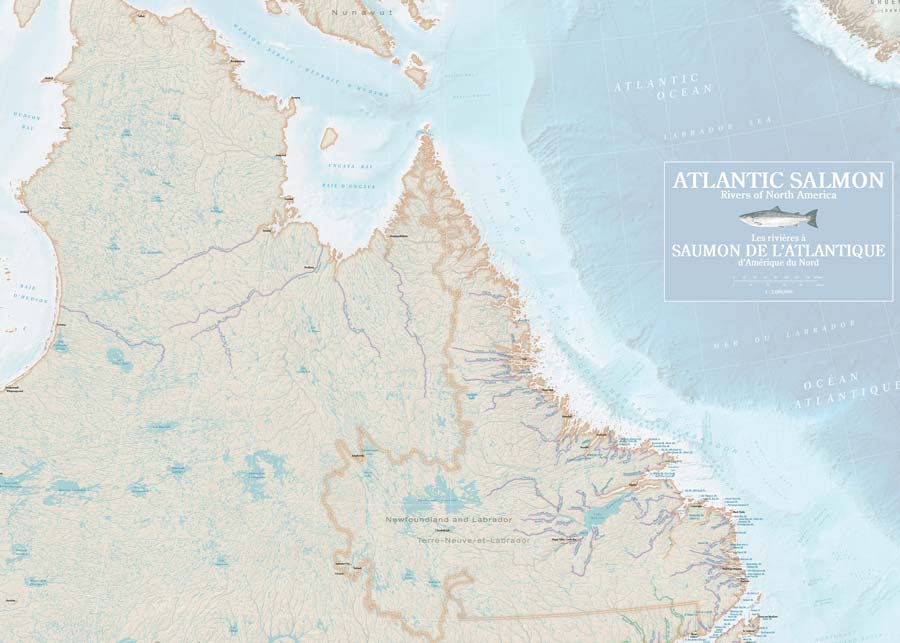
One of the less glamorous realities of expanding conservation science into northern Labrador and Québec is that logistics alone can feel like a full-time job.
As our research portfolio extends into some of the most ecologically important and data-scarce salmon rivers on the continent, we're learning about doing good science in roadless territory. Which means shipping equipment to communities accessible only by air or seasonal barge, coordinating with carriers who don't recognize an address because, officially, there isn't one, and freight that arrives in Goose Bay and still needs a charter flight to get anywhere near the water.
Ellen Mansfield discovered all this over the last few weeks, but managed to solve all the challenges, and our equipment is now waiting for us!
What makes it work is partnership. Community members, Nunatsiavut Government staff, and local knowledge-holders aren't just tolerating our presence in these watersheds; they're helping us navigate them, literally and otherwise. It’s an amazing experience, and the science we're building together in the north will be more robust for it.
The salmon don't care that there's no postal code. Neither do we.
Upcoming Events
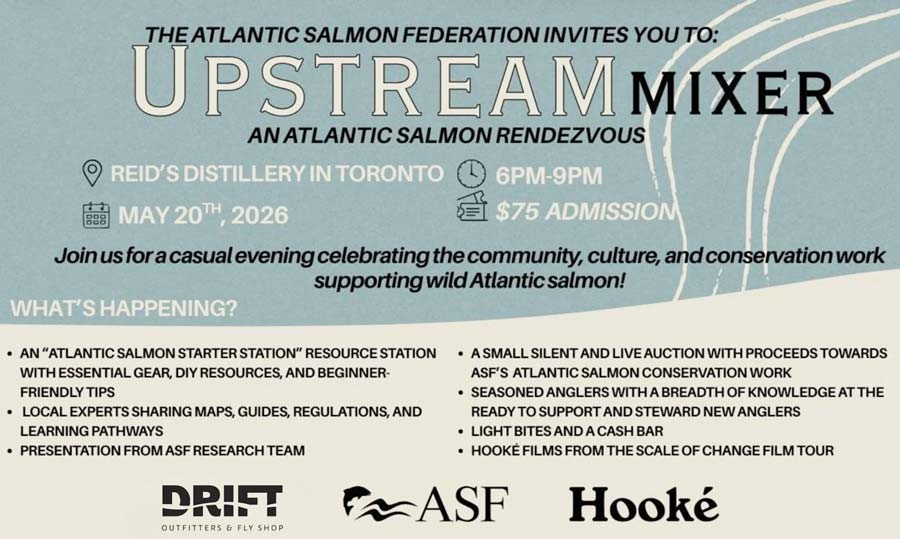
May 20: Toronto Upstream Mixer, An Atlantic Salmon Rendezvous. Join us for a casual evening to welcome a new wave of stewards to the community, culture, and conservation work that supports wild Atlantic salmon. Together with seasoned Atlantic salmon Anglers and Conservationists, we invite you to join us in demystifying Atlantic salmon angling.
Join ASF on a Hosted Trip to the St. Paul’s Salmon Fishing Club
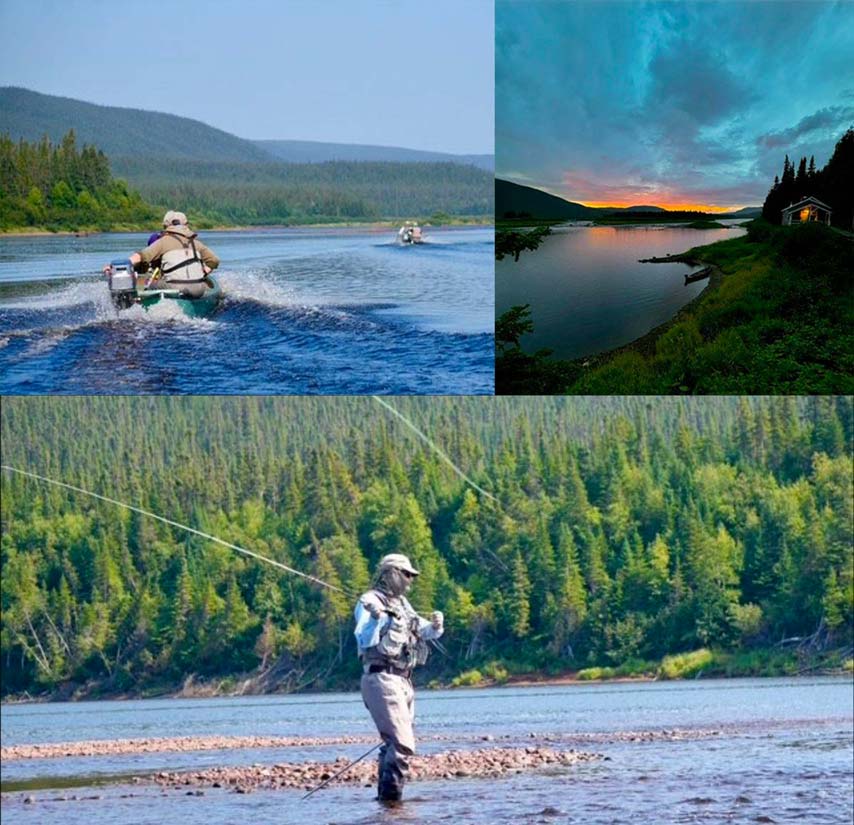
Since 1964, The St Paul’s Salmon Fishing Club—nestled on the St. Paul’s River on the Lower North Shore of Quebec—has been providing clients both some of the world’s best Atlantic salmon fly fishing. The Lodge operates on a 100% catch-and-release policy, with exclusive river rights to more than 30 miles of pristine river, and access to 35+ salmon pools. (Click here for information about the lodge and the fishing.) Join ASF for an exclusive hosted trip to this beautiful, productive river from July 25th to August 1st. The trip includes:
- 7 days of guided fishing
- Private lodging
- Flights to the lodge from Deer Lake, NL
For more information, contact Andy Goode at agoode@asfmaine.org