





RiverNotes
ASF Rivernotes 16 July 2021
asf
juillet 16, 2021
COMPILED BY TOM MOFFATT ~ TMOFFATT@ASF.CA
ATLANTIC SALMON INTO THE UNDERWORLD
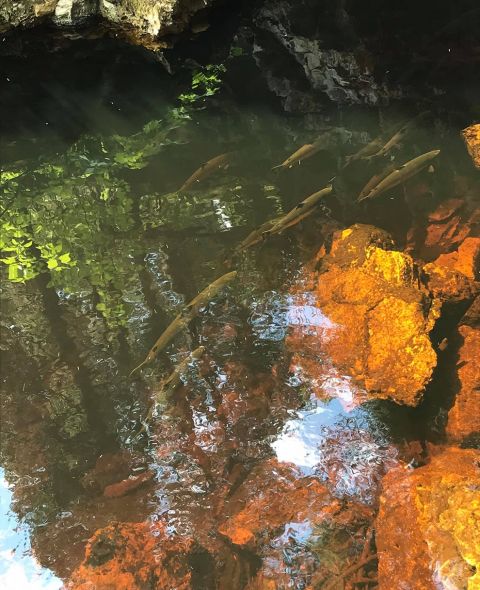
It is an incredible sight that if it was in Ireland, Scotland, Wales, or Norway would generate myths and legends. But instead it is one of the most remarkable experiences to witness in Newfoundland: Atlantic salmon congregating and preparing to make a journey through a cavern, in utter darkness, on their way upstream on Beaver Brook.
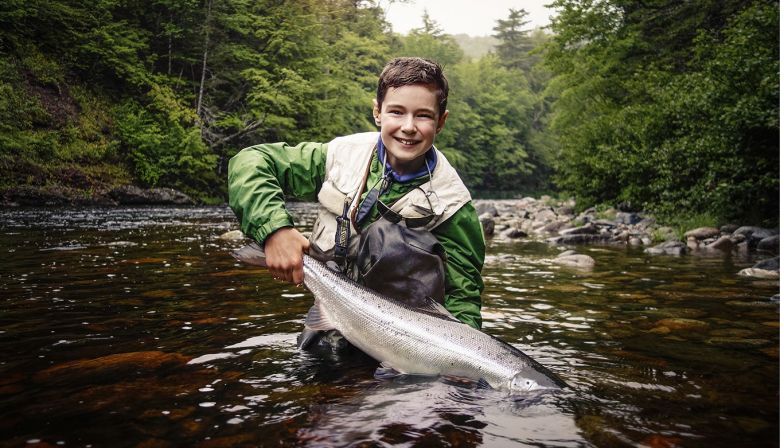
John Fillier, of Hopewell, NS.., saw this firsthand as part of a very successful salmon angling expedition to northern Newfoundland.
“The water level was somewhat low, and that likely helped us see the salmon there,” he said. It was an exciting moment, unlike anything one can see anywhere else in the North Atlantic world of the Atlantic salmon.
Do the salmon feel any sense of anxiety? Or are they so focused on the sense of smell taking them upstream that it is just another challenge in order to spawn. In the dark of the cavern do they just use their sense of current direction registering on their lateral line, or do they search ahead for a glimmer of light?
For those watching, many questions come to mind, but the fact is that it is the only place in the world to watch this.
John Fillier remarked on some other aspects of the trip with salmon angling friends to the region.
“There were a lot of salmon when we were there. We fished the Main (alias Salmon) River and there were amazing numbers coming in. And the Castor River was great.
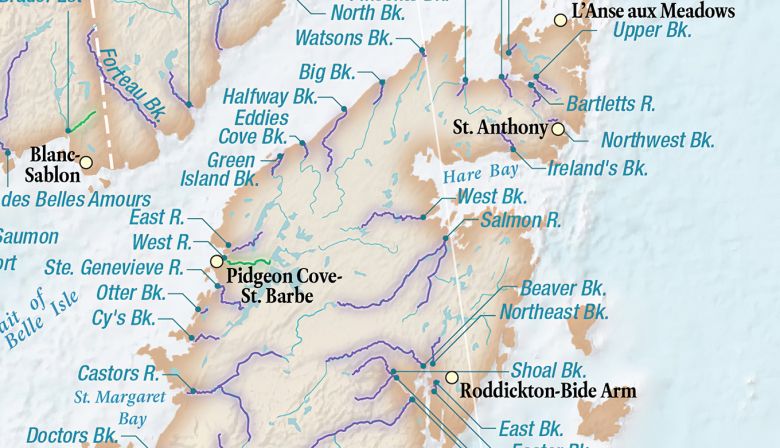
“We stayed at Tuckamore Lodge, and that was wonderful. Barb Genge does a great job, and with the salmon plentiful this year, it added to the experience,” said John Filler. “And we certainly fell in love with the Castor River as well. Lots of salmon.”
How much better can it be for an Atlantic salmon angler when the rivers have fish, but there is also a sense of the unusual and of a special experience related to observing the King of Fish as well.
There are other mysteries yet to be solved in this part of the salmon world. Just a few miles north is L’Anse aux Meadows, where Norse explorers had an outpost before AD 1000. Right next to it is a small stream that was likely their water supply, and also has a small salmon run. Did these Vikings take Atlantic salmon from this stream? No one knows.
NEWFOUNDLAND AND LABRADOR
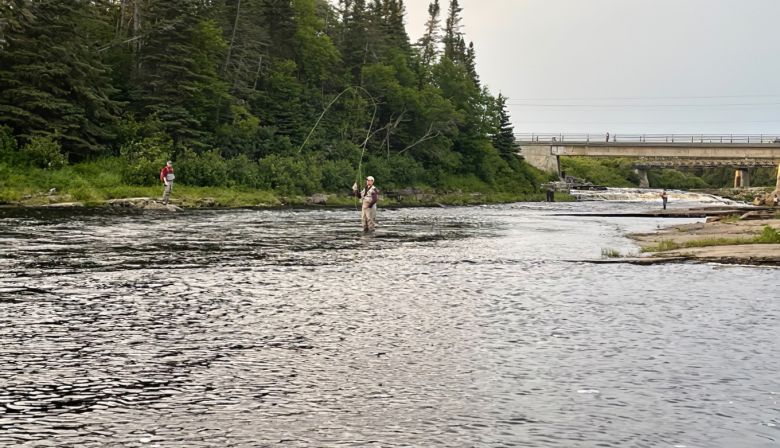
Ralph Hiscock reports from up the Northern Peninsula:
The Torrent, Big East and River of Ponds have plenty of Atlantic salmon entering. Water levels are presently extremely high and water temperatures around 15 C. This is ideal for the grilse to head upstream to spawning grounds.
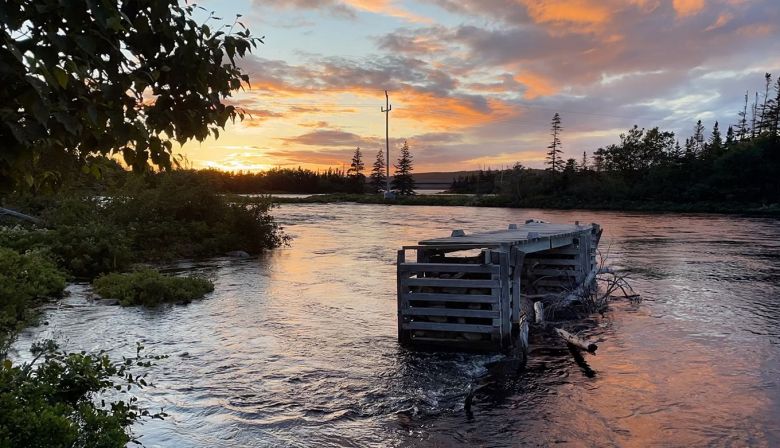
Overall, the returns have improved in 2021, with some exceptions such as the Terra Nova.
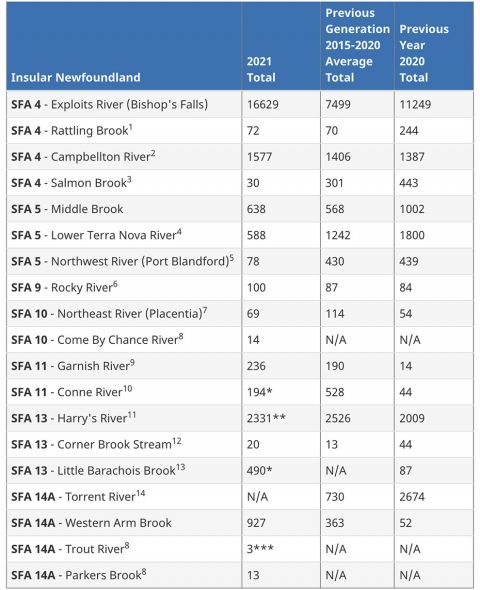
Some like Little Barachois Brook in western Newfoundland are doing amazingly well this year, as is Western Arm Brook. Harry’s River is holding its own with 2,331 so far. One might wish for a count number for the Torrent River up the Northern Peninsula, as a gauge of returns mentioned by John Filler.
In central Newfoundland the Exploits is back in better shape with 16,629 counted to July 11.
Labrador
Dwight Lethbridge of Pratt Falls Lodge on the Eagle River:
We have not seen this many fish, this early in July for many years. Perhaps not since around 2013-2014, we figure. We had many fish in the 34-36″ range hooked this week, and there are now plenty of maxi-grilse in the river. The ratio of large salmon to grilse has tipped the 50/50 mark, and is now about 35-40% large in the mix.
He also says:
The river is now in great fishing condition. The water level is close to the 2.2m level, and still dropping fast. Water temperatures have been great, thanks to cold nights. The weather has been all about wood stoves in the morning and air conditioners in the afternoon!
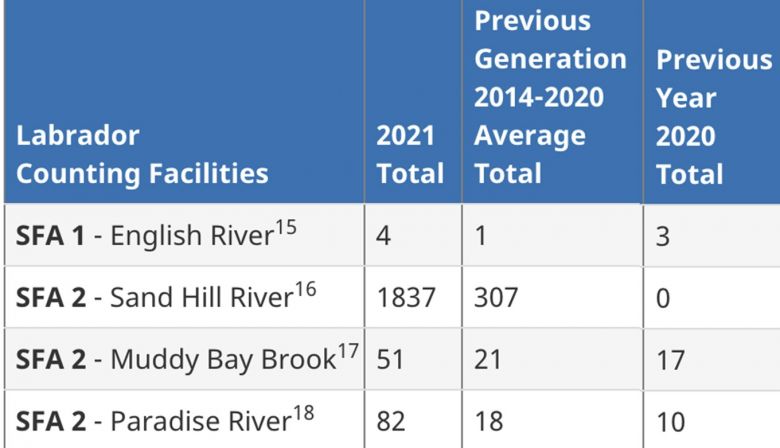
It is still early days to make predictions. But while there is always a concern for the heat of summer affecting both adult fish and the survival of parr, there are good signs for 2021. Mind you, we are comparing it with several recent years of very low returns and ultra-hot river conditions.
NOVA SCOTIA
Margaree
Patrick Poirier made some notes, following the passage of Tropical Storm Elsa that mostly hit NB:
Elsa didn’t hit the Margaree with any force. There was enough rain to keep levels prime and keep the run of Atlantic salmon heavy, with this past week boosting great numbers of fish hooked.
This included amazing large salmon weighing more than 20 lb., and some even pushing 30 lb.
With water levels well above that of the last few previous years, we can hope the salmon run will stay strong for the next while.
It’s been great this past week helping and watching experienced anglers helping young ,and first-time anglers get their first salmon. Seeing the excitement and joy, and knowing these new salmon folks are now hooked – probably for the rest of their lives.
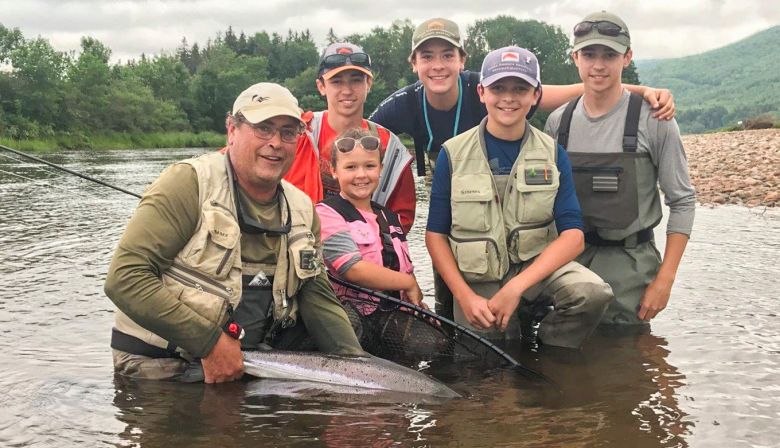
My brother Rob, his youngest son Tait, along with my sister Tami and her husband Chris, joined my family and me on a trip last week to the Margaree Valley.
We booked the cottages a couple of months ago to simply have some time away in the beautiful Margaree, but were treated to ideal fishing conditions for a few days and a few fresh fish coming into the system.
The kids were able to take advantage of the good conditions and managed to hook several fish during our stay.
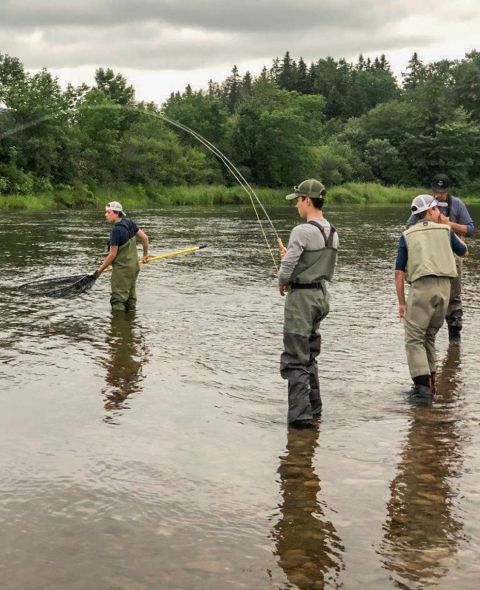
Alan Harlow continues:
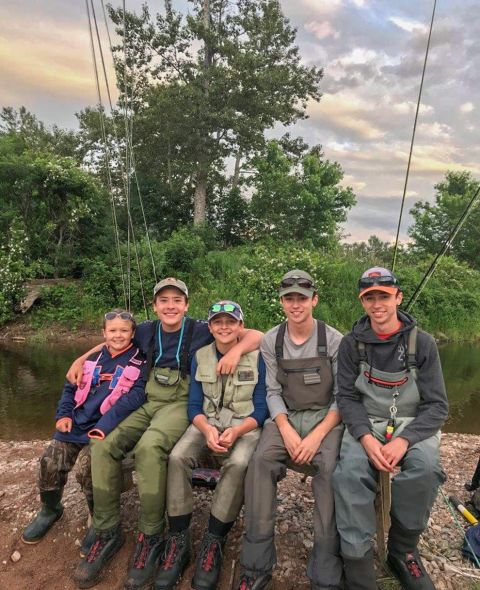
As always, we met many nice people and several of the fishermen went out of their way to ensure that the kids had a good experience on the river – that’s what salmon fishing should be all about.
I would encourage any experienced anglers to try and go out of their way to help any young or even simply inexperienced anglers to learn the ropes – show them how to properly/safely access the pools, where and when to cross the river, how to rotate through the pools, how to properly/safely handle a fish, and most importantly, to simply enjoy the experience of sharing time on the river with others that share the same passion.
Thanks to all those anglers out there that do this… the impression that you make is an important one in order to encourage the next generation of anglers to stay involved in the sport and to continue to look out for this fantastic fish!
NEW BRUNSWICK
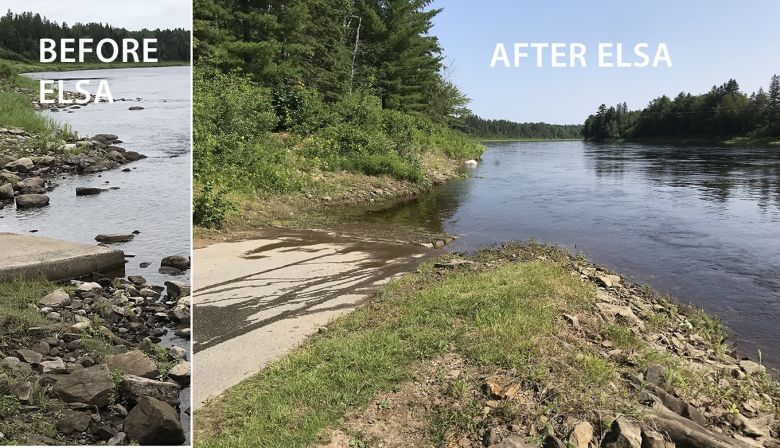
Brock Curtis of Curtis Miramichi Outfitters in Blackville says:
Prior to Friday, and Friday night’s storm we were getting quite a few reports from people spotting salmon jumping from down at Miramichi City on up to Derby.
Angling was quite good with some pools producing some large numbers of salmon and grilse.
By Saturday the results of the storm were unreal.
The river was running brown from silt and the trees and debris made the currents very dangerous. Even though these conditions existed, the salmon were still showing but were staying close to shore.
By Sunday the river crested and was starting to drop. Even today it would be a bit high for some of the high water pools.
To add to the sightings of salmon on the lower section of the river below Blackville into Miramichi City, we are hearing of large numbers of salmon in the Bay.
One report from a couple fishing striped bass was quite impressive. While fishing they saw a good size number of salmon going by their boat but a short time later they noticed a very large area turn black. He checked his fishfinder and saw it was fish. As they watched they noticed these fish were salmon and they were moving further up into the estuary.
We have had a consistent run of salmon coming into the Miramichi for approximately four weeks now and by the sound of things this will continue for some time. River temperature yesterday was 67 F.
A few salmon were hooked Sunday but I expect hookups to improve quite a bit this weekend.
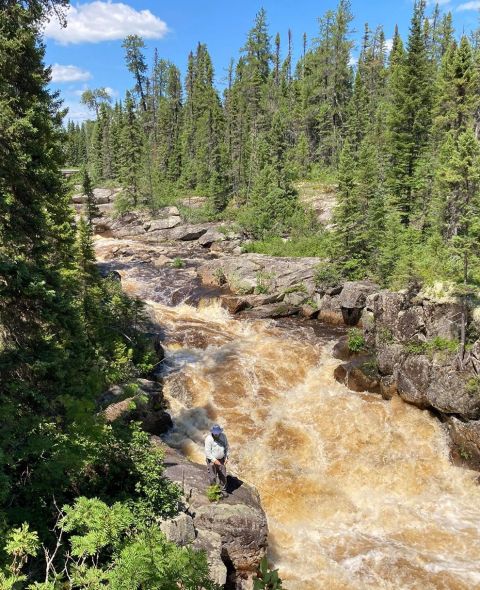
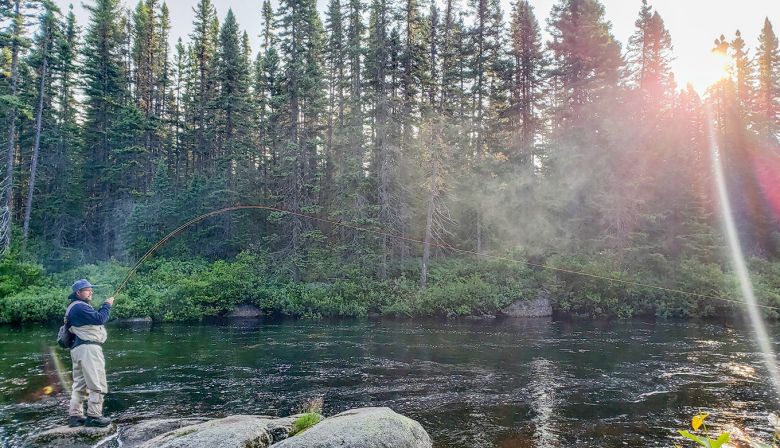
We spent the weekend on Crown Reserve at the Palisades. Not a lot if fish…30 maybe in the Camp Pool, and none anywhere else.
Water came up about 10 inches and was into the grass/bushes on Saturday due to Tropical Storm Elsa. Every pool was pretty much unfishable except the Camp Pool. We hooked four fish and saw a bunch of others, mostly Sunday morning when the water was dropping.
A small run of fish plowed through on Sunday, and the water got quiet by 10 am again.
With the Canada-U.S. border now open to fully vaccinated people with a compelling reason to enter, this week Brian Finlayson flew from California to Fredericton, arriving Sunday.
Brian is a consultant and the project supervisor for the effort to eradicate invasive smallmouth bass from Miramichi Lake, Lake Brook, and a short stretch of the Southwest Miramichi River this summer. (To learn more about the project check out Elements of Eradication) [add link]
Brian has lead dozens of invasive fish eradications using rotenone around the world. He has visited Miramichi Lake and Lake Brook, but this was his first time on the river – something that would have taken place last summer, but for Covid.
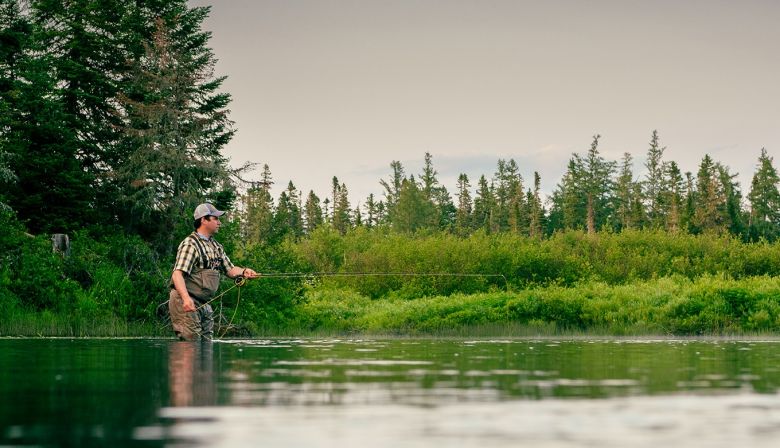
The goal was to nail down precise locations for the rotenone drip stations and explore challenging areas like McKeil Bogan. Water levels were what ASF’s Nathan Wilbur called “perfect for fishing” after heavy rains late last week. We tried a few casts at Big Louey and Little Louey pools over lunch, but fishing was not the focus.
At the end of the day, Brian indicated that he saw nothing overly complicated, certainly no red flags, and after an extensive debrief this huge project has taken another significant step ahead.

Southwest Miramichi Salmon Count
The salmon count to July 11 for the Dungarvon River has 37 grilse and 63 large salmon this year. Last year’s tally was 46 grilse and 38 large salmon to the same date.
Northwest Miramichi Barrier Count
The count to July 11 has 116 grilse and 77 large salmon, compared with 47 grilse and 106 large salmon in 2020.
Interesting the difference between years for both these counting facilities.

Restigouche
Rob Johnson of Nova Scotia has some comments on salmon and the Restigouche:
My dad and I travelled up to the Restigouche from Nova Scotia we were guided by Denis Boudreau and his son Jaxon tagged along.
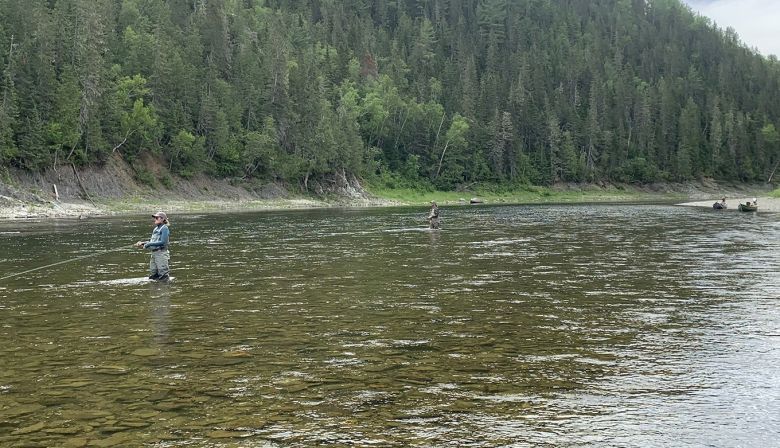
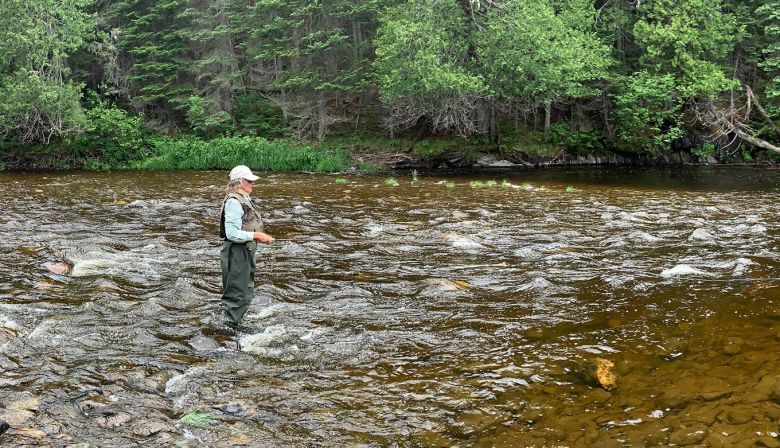
We managed to hook into a couple of fish, and saw lots of salmon rolling or jumping over the course of four days. The water levels and temperatures stayed at a good level while we were there, with air temperatures below 10C most nights. We could notice a drop in the water level by the time we left.
One thing we noticed was that there was very brown, silty water coming out of the Matapedia River even four days after the last rain prior to Elsa. You could very clearly see the divide in water colours where two rivers met near the bridges close to the Matapedia/QC border.

Very, very low water and few fresh grisle in our pools. Tropical Storm Elsa didn’t reach Kedgwick to any degree, maybe bringing only a two inch raise of water.
Morning fishing is better than evening fishing at this time. Morning water temperature is 63 F and up to 73F in the evening.
QUEBEC

Le coup d’eau qui était attendu la semaine dernière en provenance de l’ouragan Elsa n’a pas modifié les débits des rivières du Québec. Cependant, il y a une augmentation marquée du nombre de madeleineaux jusqu’à ce jour d’après les statistiques de plusieurs rivières.
Les gestionnaires des rivières vous demandent votre coopération pour la déclaration de vos prises et vos remises à l’eau. Les données sont très importantes pour le calcul du succès de pêche ajusté et réel.
** Les données utilisées dans ce rapport proviennent de divers sites Web, médias sociaux et des sources du gouvernement du Québec.
Rivière Mitis
La montaison de saumon dans la rivière Mitis se maintient avec un dénombrement phénoménal jusqu’à ce jour.
Au 13 juillet, 1 420 poissons ont cumulativement franchi le piège de capture, dont 699 saumons et 721 madeleineaux. Les pêcheurs sportifs de la Mitis et Mistigougèche ont capturé un total de 226 poissons comprenant 120 saumons remis à l’eau et 106 madeleineaux récoltés.
En date du 13 juillet 2020, 936 poissons avaient franchi le piège (545 saumons et 391 madeleineaux). Les pêcheurs sportifs avaient rapporté la capture de 99 poissons, dont 60 saumons remis à l’eau et 39 madeleineaux récoltés.
Rivière Trinité
En date du 9 juillet, au-delà de 300 saumons ont cumulativement (toutes grandeurs confondues) ont franchi la passe migratoire en plus de 1 000 truites de mer. Au 11 juillet 2020, 76 saumons et 127 madeleineaux avaient franchi la passe migratoire.
Bill Taylor, président de la FSA:
« J’ai pêché quelques jours sur la rivière Cascapédia récemment. Les conditions au niveau du débit et la température de l’eau était bonne. Nous avons observé moins de saumons dans les fosses par rapport aux saisons récentes. Une bonne montaison de saumon de 12 à 16 livres avait lieu et a livré de bons combats. Nous avons piqué quelques saumons de plus grosse taille, mais il est évident que les 3 ans de mer avaient déjà franchi les extrémités des branches de la rivière.
La Société Cascapédia est depuis plusieurs années un partenaire important dans nos projets de pistage des saumoneaux et les saumons noirs qui va aider à élucider les mystères des migrations et la survie en mer. Les données en provenance de ces projets aideront à mieux gérer et conserver les populations particulières de la Cascapédia. La Société Cascapédia gère également un musée très intéressant et riche en patrimoines historiques de cette région et de cette rivière spectaculaire ».
À ce jour, au 10 juillet, la Zec de la rivière Bonaventure fait rapport que 489 saumons ont été pêchés dont 330 remises à l’eau et 159 madeleineaux ont été récoltés. Cumulativement au 11 juillet 2020, 457 poissons, dont 308 saumons relâchés et 149 madeleineaux récoltés avaient été inscrits aux statistiques de la Zec.
Rivière Causapscal
Cumulativement au 13 juillet, la capture de 76 saumons a été déclarée dont 28 relâchés. En 2020 à pareille date, 138 saumons étaient inscrits dans les statistiques de la CGRMP dont 55 remises à l’eau.
Rivière Matapédia
Au 13 juillet, 253 saumons ont été déclarés capturés dont 183 remises à l’eau à ce jour et la récolte de 70 madeleineaux.
Les statistiques de la CGRMP à ce jour en 2020 indiquaient que les pêcheurs avaient capturé 433 poissons, dont 355 saumons graciés et 78 madeleineaux récoltés pour un total de 433.
Le nombre de jours-pêche continue d’afficher une augmentation marquée par rapport à l’an dernier, soit 3 133 en 2021 comparativement aux 2 515 jours-pêche vendus au 13 juillet.
Les résultats affichés au 11 juillet sur le site de la Zec Gaspé présentent un bon succès de pêche jusqu’à ce jour en 2021.
York 307 captures (incluant les remises à l’eau) 2 846 jours-pêche
Dartmouth 168 captures (incluant les remises à l’eau) 841 jours-pêche
Saint-Jean 114 captures (incluant es remises à l’eau) 363 jours pêche
Visiter
https://saumongaspe.com/riviere-york/declaration-de-remise-a-leau.html
afin d’enregistrer une remise à l’eau.
Rivière Matane
Au 13 juillet, 1 319 poissons (613 saumons et 706 madeleineaux) ont franchi la passe migratoire depuis son ouverture le 15 juin. Les pêcheurs sportifs ont rapporté un total de 99 remises à l’eau (70 saumons et 29 madeleineaux).
En date du 13 juillet, cumulativement pour la saison 2020, 1 276 poissons (943 saumons et 333 madeleineaux) avaient franchi la passe migratoire. Également, 113 remises à l’eau avaient été enregistrées.
Au 13 juillet, les pêcheurs sportifs de la rivière Rimouski connaissent du succès dans les fosses en aval de la chute jusqu’à ce jour cette saison, 353 poissons (153 saumons et 155 madeleineaux) ont franchi le piège de capture. Cumulativement à la même date, 112 poissons ont été capturés comprenant 48 saumons graciés et 64 madeleineaux récoltés.
Rivière aux Rochers
Au 13 juillet, les pêcheurs de la rivière aux Rochers ont capturé cumulativement 145 poissons comprenant 79 saumons et 29 madeleineaux relâchés et 45 madeleineaux conservés. Les captures ont été effectuées dans les secteurs 1 et 2 qui sont en aval du piège de comptage.
Également au 13 juillet à ce jour, 240 poissons ont franchi le piège de capture dont 107 saumons et 133 madeleineaux.
Saumonier de la côte nord, Jocelyn Leblanc passe en entrevue dans le cadre de sa chronique pêche à l’antenne d’Ici Radio-Canada chaque mercredi matin. Voici l’émission du 14 juillet où il vante les mérites de la rivière aux Rochers.
« Les précipitations récentes ont grandement amélioré l’état de la rivière. Les saumons et les madeleineaux semble bien se comporté grâce a la température idéale de l’eau et ils sont présents en grand nombre et les pêcheurs sont contents » a déclaré Garland Nadeau.
Unfortunately, the recharging of Quebec rivers with the passage of Tropical Storm Elsa did not materialize last week. The good news presently is the remarkable increase in the number of grilse being reported by many rivers.
River managers continue to ask anglers to report the fish they release to calculate an accurate angling success rate.
** Data used in this report are sourced from various river websites, social media and Quebec government sources.
Mitis River
To date on July 13th, the Mitis is being blessed with an impressive migration. 1,420 fish (699 salmon and 721 grilse) have migrated through to the fish trap. For the season to date, sport anglers have landed 226 fish (120 salmon released and 106 grilse harvested).
As of July 13th, 2020, 936 fish had been counted (545 salmon and 391 grilse) and 99 fish were declared landed made up of 60 salmon released and 39 grilse harvested.
Trinité River
To July 9th, this Quebec north shore index river continues to surpass last season’s numbers. More than 300 fish have been cumulatively counted through the fishway. Also, more than 1,000 sea trout have been counted!
In 2020, as of July 11th, 76 salmon and 127 grilse had been counted for a total of 203.
Bonaventure River
The Bonaventure Zec has published statistics to July 10th reporting that anglers have landed 489 fish (330 salmon released and 159 grilse harvested. At the same date in 2020, 457 fish had been reported landed (308 salmon released and 149 grilse harvested.
Cascapedia
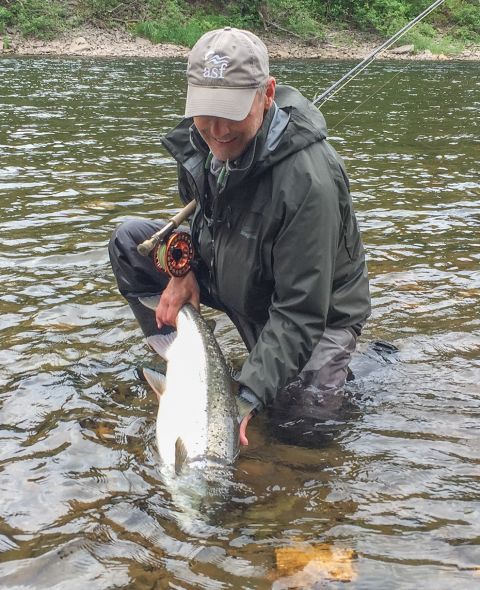
ASF President Bill Taylor:
“I was recently on the Cascapedia for a few days. The river level and temperatures were ideal. We had good fishing, though there were fewer salmon showing in the pools than most years. There appeared to be a strong run of superbly fit 12-16 pounders that fought extremely well. We hooked a few larger fish but it felt as though the early run of three sea winter salmon had already gone through to the upper branches.
The Societé Cascapedia is doing important research and conservation work on the river and is a key partner with ASF in our smolt and kelt tracking research which is helping shed new light on salmon migrations and survival at sea. The data collected will help us better manage and conserve the Cascapedia’s unique population of large salmon. The Societé Cascapedia also operates an informative museum that tells the very interesting story and history of this great river. “
Causapscal River
For the season to July 13th, 76 salmon have been reported landed by the CGRMP which includes 28 releases. 138 salmon had been reported landed which included 55 releases at the same date in 2020.
Matapedia River
To July 13th, 253 salmon have been reported landed including 183 released and the harvest of 70 grilse. The number of rod-days has dramatically increased (3,133 to date in 2021) compared to the 2,515 sold cumulatively at the same date in 2020.
During the 2020 season at the same date, 433 fish had been reported landed which included 355 releases and 78 grilse harvested.
Gaspé Rivers (York, Dartmouth, and Saint-Jean)
For the 2021 season to July 11th, the Gaspé Zec is reporting the following results:
York 307 captures (includes releases) 2 846 rod days
Dartmouth 168 captures (includes releases) 841 rod days
Saint-Jean 114 captures (includes releases) 363 rod days
To register the release of a fish please visit
https://saumongaspe.com/riviere-york/declaration-de-remise-a-leau.html
To July 13th, 1,319 fish (613 salmon and 706 grilse) have been counted since June 15th. Sport anglers have registered releasing 70 salmon and 29 grilse for a total of 99.
Comparatively in 2020 on July 13th, a total 1,276 fish (943 salmon and 333 grilse) had been counted through the fishway. 113 releases had also been reported.
Rimouski River
To date on July 13th, Rimouski anglers have had some success in the pools below the waterfall. Cumulatively, 353 fish (153 salmon and 155 grilse) have been counted. Since the start of the season, 112 fish have been reported landed which includes 48 salmon released and 64 grilse harvested.
Rivière aux Rochers
For the season to July 13th, 145 fish have been landed by sport fisherman which includes 79 salmon and 29 grilse released plus 45 grilse harvested. To date, all fish landings have taken place in sectors 1 and 2.
At the same date for this season, 240 fish (107 salmon and 133 grilse) have been counted via the fish trap.

Saint-Paul River
Garland Nadeau is reporting “The river is in great condition due to recent rains. The salmon and grilse are enjoying the nice cool water temperature. The salmon are plentiful and blessing anglers with great fishing”.

MAINE

Penobscot
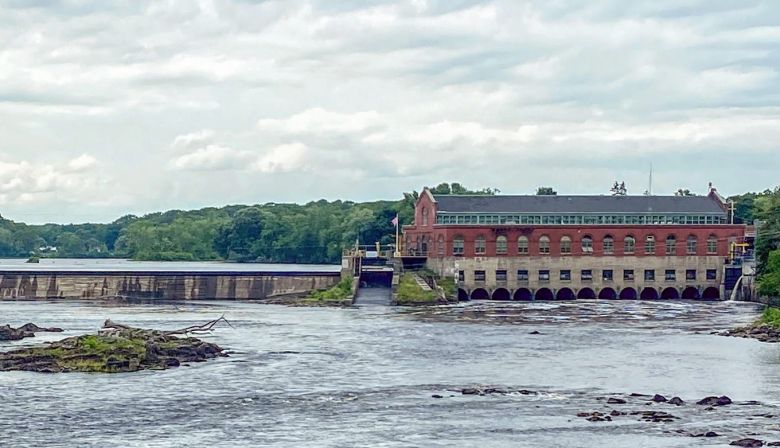
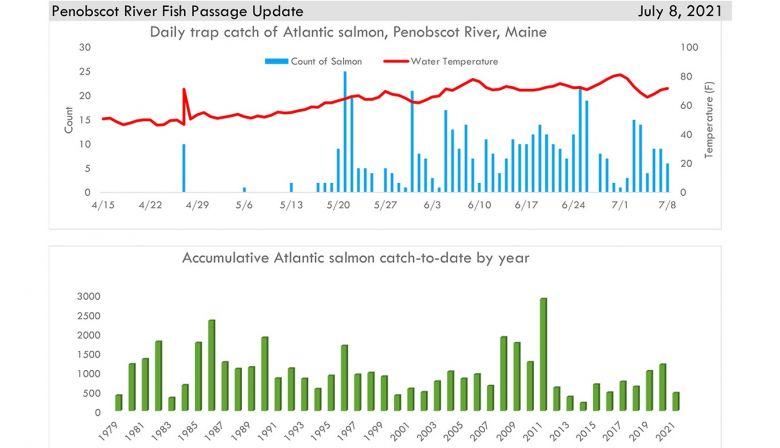
There have been 461 Atlantic salmon as of July 8, considerably fewer than in 2020. Water levels had been low, and there may be improvement with the higher flows this week.
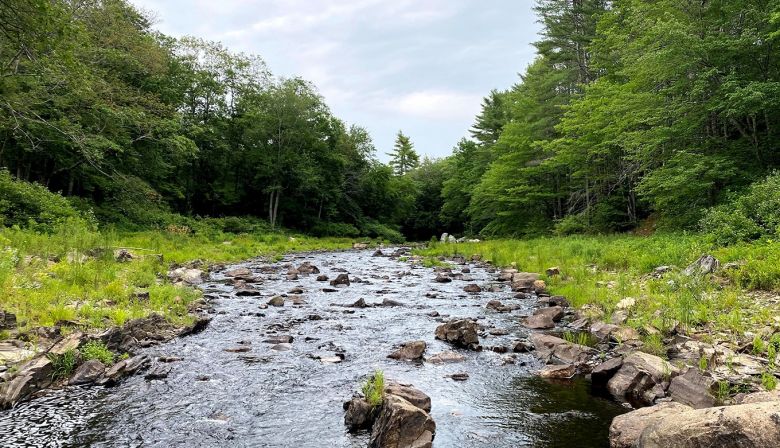
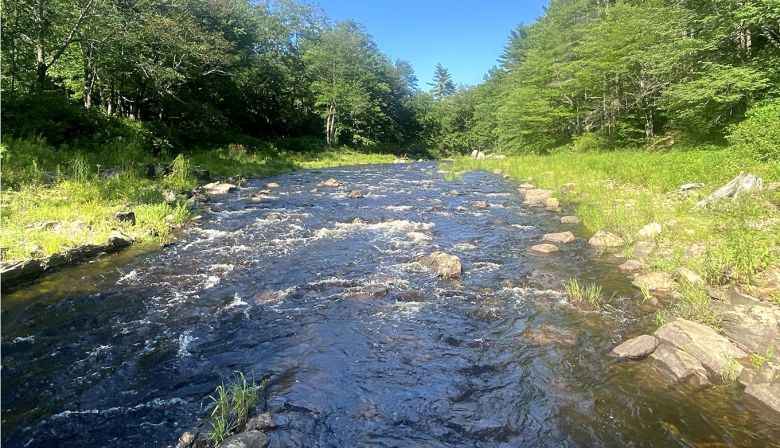
Tropical Storm Elsa did bring some much needed rainfall across much of Maine, generally two or three inches in total. The flows have since declined, but it had both an immediate effect and continues to help these rivers have closer to normal flows.
Jennifer Noll of Maine DMR says:
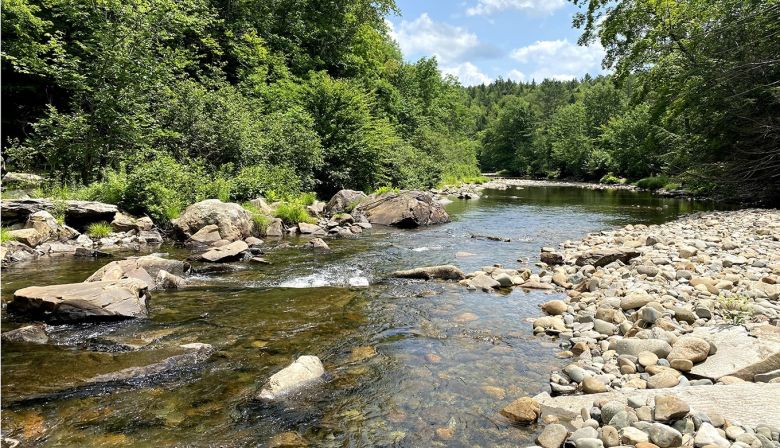
Rain, rain and more rain – finally!!! Friday’s rain event got the Kennebec up to 5,240 cfs which is right around the mean discharge rate for this time of the year. Unfortunately that didn’t last long, because the river is now back down to 2,390 cfs, which is a historical low for today’s date. Temperatures at Lockwood fishlift have been around 20°C all week. Three grilse and 1 multi-sea winter salmon were caught this week in the Lockwood fish lift.
Lockwood Dam: Atlantic Salmon: 21 (1 additional was caught in ledges during stranding rescue and transported to the Sandy River)

WILL THE U.S. AND CANADA BORDER OPEN IN MID-AUGUST?
For those involved in the Atlantic salmon world, whether as anglers, guides, lodge owners, friends of anglers or anyone else, this indeed would be a wonderful thing.
FINAL WORD
If anyone, adult or child, is wearing chest waders, always wear a belt that keeps the legs from filling fast if someone goes for a dunking. It can happen.
Alas, a 70-year old trout angler had just this tragic event happen to him in this past week in Idaho. His wife tried to save him and she drowned as well. Just a reminder that safety concerns need to be taken seriously.