





Rivernotes
Rivernotes June 18, 2026
Phil Monahan
June 18, 2026
Editor's Note
by Phil Monahan
Welcome back to Rivernotes, our weekly roundup of news and information from around the world of Atlantic salmon—Québec, Atlantic Canada, and Maine. Thanks to my colleague, Director of Communications and Publications Kristen Noel, for taking over last week while I was away.
Reminder: The row of buttons you see above will help you find exactly what you're looking for. Simply click a button and you'll be whisked directly to the section you want to read.
Beautiful Blanda
On Monday morning, I had the opportunity to fish the famed Beat 1 on the Blanda River in northern Iceland. Although it was very early in the run—the first fish of the year on the river had been landed just two days earlier—I was hopeful that the overnight high tide had brought some fish in.
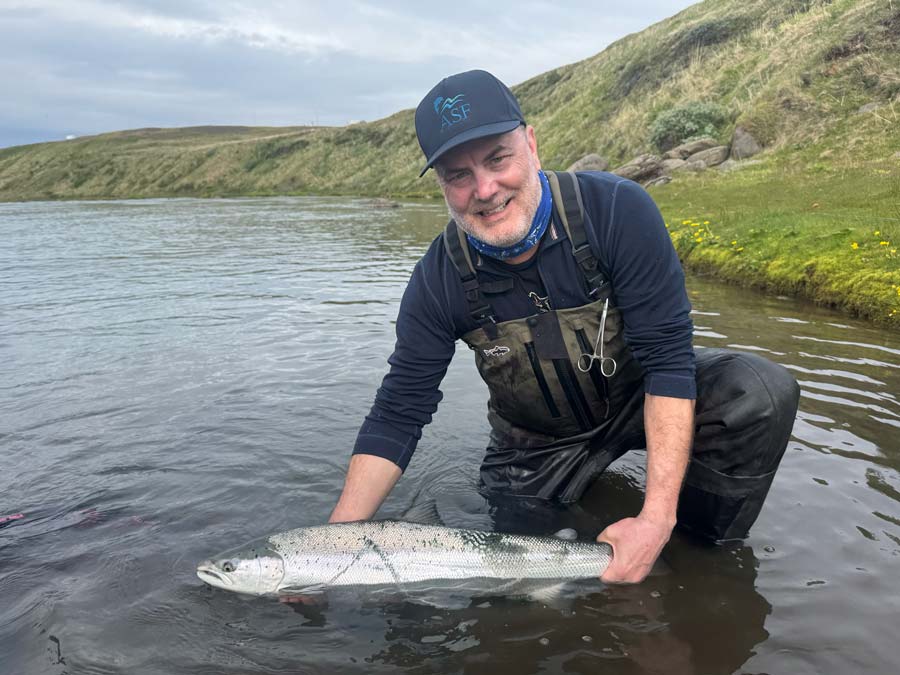
While swinging a black tube fly that featured some blue flash—tied by my guide, David Lambert—I felt a solid grab, and the fight was on. After a prolonged back-and-forth, which included the line wrapping around a midriver rock, we got the battle-scarred beauty in the net.
Later in the morning, I hooked another, but it came unstuck after just 30 seconds or so. My fishing companion, Ken Beatty, also lost one and landed one. A remarkable morning, indeed.
Restigouche Brace
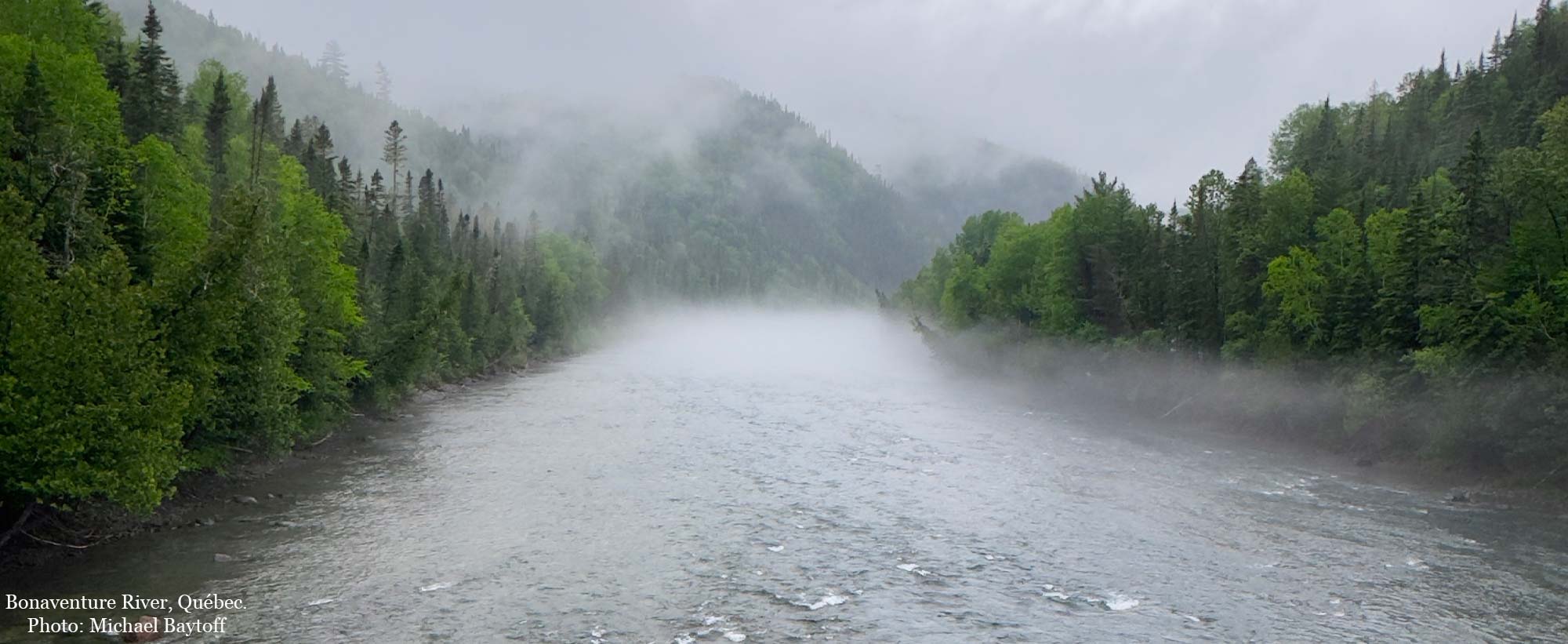
Photographer Michael Baytoff—whose gorgeous image graces the top of this page—sent in a photo of a salmon that took a Green Highlander in Sector C of the Restigouche River on Tuesday morning.
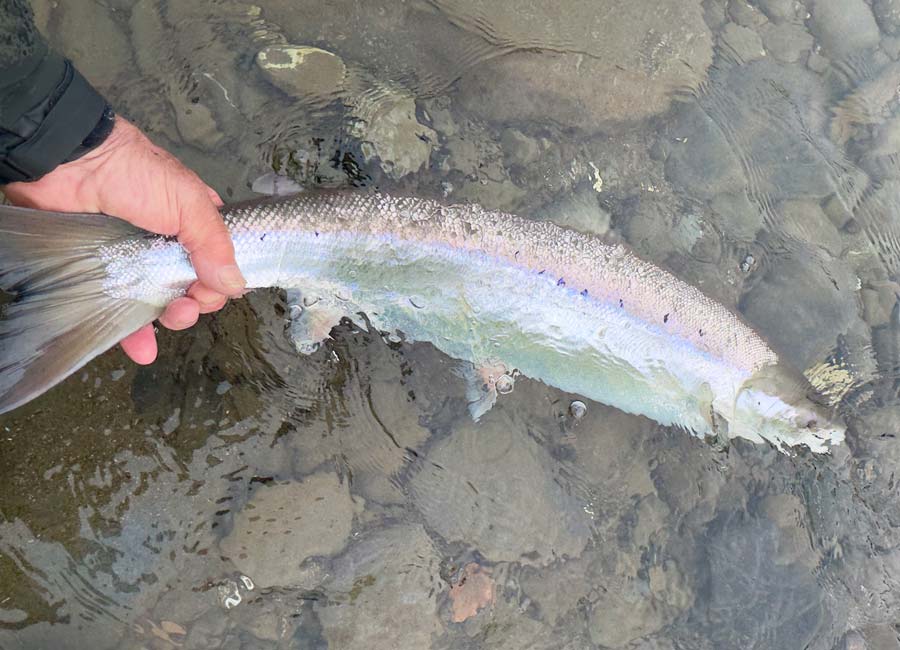
He reported that temperatures have been on the cool side, with good amounts of rain. The river level is between 25 and 29 m3/s, which is great for wading, and the water is cold. The above fish was one of two he landed that morning.
Advocating for the Miramichi
Last week, ASF President Nathan Wilbur and Vice President of Communications and Special Projects Neville Crabbe travelled to Ottawa to present to the Parliamentary Fisheries Committee. The committee comprises Members of Parliament and is doing a study on what action can be taken specifically on salmon predation with respect to striped bass and seals, and trying to understand other bottlenecks in the marine environment.
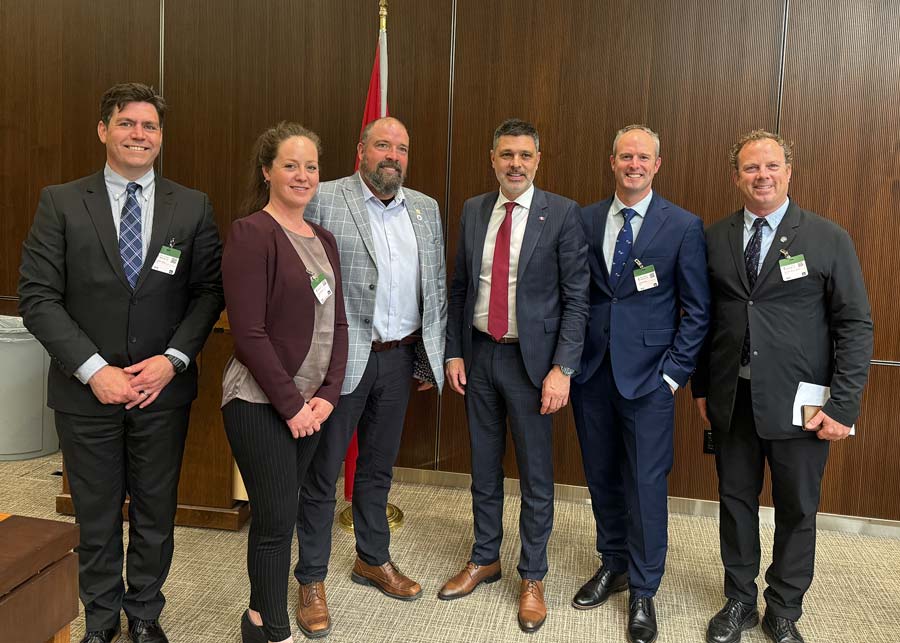
ASF's presentation for the Fisheries Committee focused on striped-bass management, with some clear and strong recommendations consistent with our recent advocacy. These include establishing an ecosystem-based management target and reducing striped bass spawners to 100,000 by expanding the Indigenous commercial fishery and allowing by-catch in the gaspereau fishery throughout the Gulf of St. Lawrence.
Join Our Watershed Movement
In the summer edition of the Atlantic Salmon Journal, ASF announced the launch of The Watershed Movement, a campaign to bring one million wild Atlantic salmon home to North American Rivers. This would be a return to overall population levels last seen in 1988.
The Watershed Movement is our blueprint for the future: a comprehensive, long-term strategy to build resilient rivers, healthy ecosystems, and abundant wild Atlantic salmon populations for generations to come. Your support powers solutions across the entire salmon life cycle, helping restore rivers, protect critical habitat, advance science, and address the threats limiting salmon recovery.
Québec
Cette semaine, Sébastien Lavoie, directeur général de la Société de gestion de la rivière Matane et membre de longue date de l'ASF, nous partage les dernières nouvelles de la rivière Matane.
La saison de pêche y est ouverte depuis le 1er juin et se poursuivra jusqu'au 30 septembre. Comme ailleurs au Québec en ce début de saison, la remise à l'eau de tous les saumons est actuellement obligatoire.
Les premiers saumons de la saison
Le 10 juin, la Direction générale des barrages du Québec a mis en fonction le barrage et la passe migratoire du barrage Mathieu-D'Amours au centre-ville de Matane, ce qui permet à la Société de gestion de la rivière Matane d'effectuer avec précision le décompte des saumons en montaison dans la rivière. Depuis, quelques dizaines de saumons ont franchi la passe migratoire, majoritairement des saumons de deux ans de mer, vigoureux et en bonne condition physique. Le premier madeleineau a été recensé dès le 11 juin.
Premier saumon de la saison dans la passe migratoire le 10 juin.
Crédit : Société de gestion de la rivière Matane
« Avec l'excellente montaison de madeleineaux enregistrée en 2025 et la bonne condition physique des premiers grands saumons observés en 2026, les indicateurs nous permettent d'être optimistes pour le retour des dibermarins cette saison. » — Sébastien Lavoie
La première remise à l'eau d'un saumon frais a eu lieu le 11 juin au centre-ville de Matane, ce qui a permis de raviver la flamme et l'excitation des saumoniers qui attendent les premiers signes d'activité avant de lancer leur ligne à l'eau. De plus, quelques saumons ont déjà été observés plus en amont sur la rivière. Ces derniers ont remonté librement au début juin avant que le barrage soit mis en fonction.
Mouches à partager
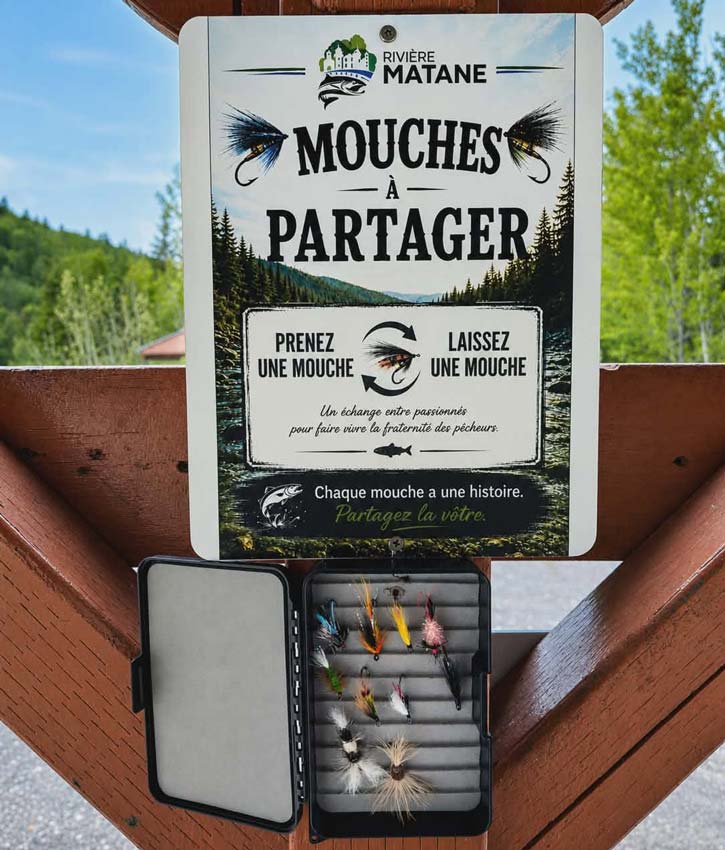
Inspirés par le Projet Flybrary Québec, des saumoniers ont suggéré de mettre en place cette initiative sur la rivière Matane. La Société de gestion de la rivière Matane a donc installé deux boîtes de mouches à partager à la fosse Petite Matane (Métropole) et à la fosse Castor.
Le principe est simple : vous prenez une mouche et, en échange, vous en laissez une.
Des montaisons encourageantes et des projets de restauration qui donnent des résultats concrets : des nouvelles positives de la Matane et de ses partenaires, qui contribuent à l'objectif commun de conserver le saumon atlantique pour les générations futures.
Québec (English)
This week, Sébastien Lavoie, General Manager of the Matane River Management Society and a long-time ASF member, shares the latest news from the Matane River.
The angling season opened on June 1 and runs through September 30. As is currently the case on many Québec rivers early in the season, all Atlantic salmon must be released.
The First Salmon of the Season
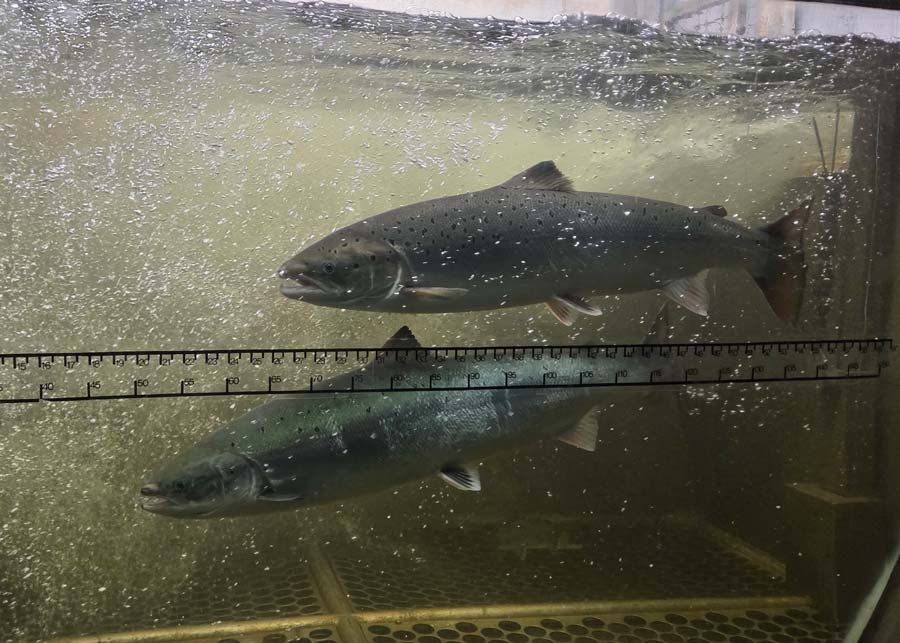
On June 10, Québec's Dam Management Division activated the Mathieu-D'Amours Dam and fishway in downtown Matane, allowing the Matane River Management Society to accurately count salmon returning to the river. Since then, several dozen salmon have passed through the fishway, the majority being vigorous and healthy two-sea-winter salmon. The first grilse was recorded on June 11.
"With the excellent grilse run recorded in 2025 and the strong condition of the first large salmon observed in 2026, the indicators give us reason to be optimistic about the return of maiden two-sea-winter salmon this season," says Lavoie.
The first fresh catch-and-release salmon of the season took place on June 11 in downtown Matane, helping rekindle the excitement of anglers who had been eagerly awaiting the first signs of activity on the river. A few salmon had already been observed farther upstream before the dam was put into operation, having migrated freely earlier in June.
Share-a-Fly Boxes
Inspired by the Flybrary Québec project, local anglers suggested bringing this initiative to the Matane River. The Matane River Management Society subsequently installed two share-a-fly boxes at the Petite Matane (Métropole) and Castor pools.
The concept is simple: take a fly and leave a fly.
Encouraging salmon returns and restoration projects producing tangible results are positive signs for the future of Atlantic salmon and the rivers that support them.
Newfoundland and Labrador
Newfoundland and Labrador Program Director Kim Thompson shares news from the beginning of salmon season and highlights an important educational festival.
Angling Season Update
Labrador's recreational salmon-angling season opened on Monday, June 15. According to Pratt Falls Salmon Lodge, with the Eagle River running low and cold, expectations are that the early fishing season will be one of the best in recent years.
Anglers are reminded that some individual rivers may have different opening and closing dates. Check the DFO Anglers' Guide 2026-2027 - Salmon - Watershed Management Plans and Closed Areas by Salmon Fishing Area (SFA) for more details.
Dave Hennessey reports from a recent group trip to the west coast of Newfoundland:
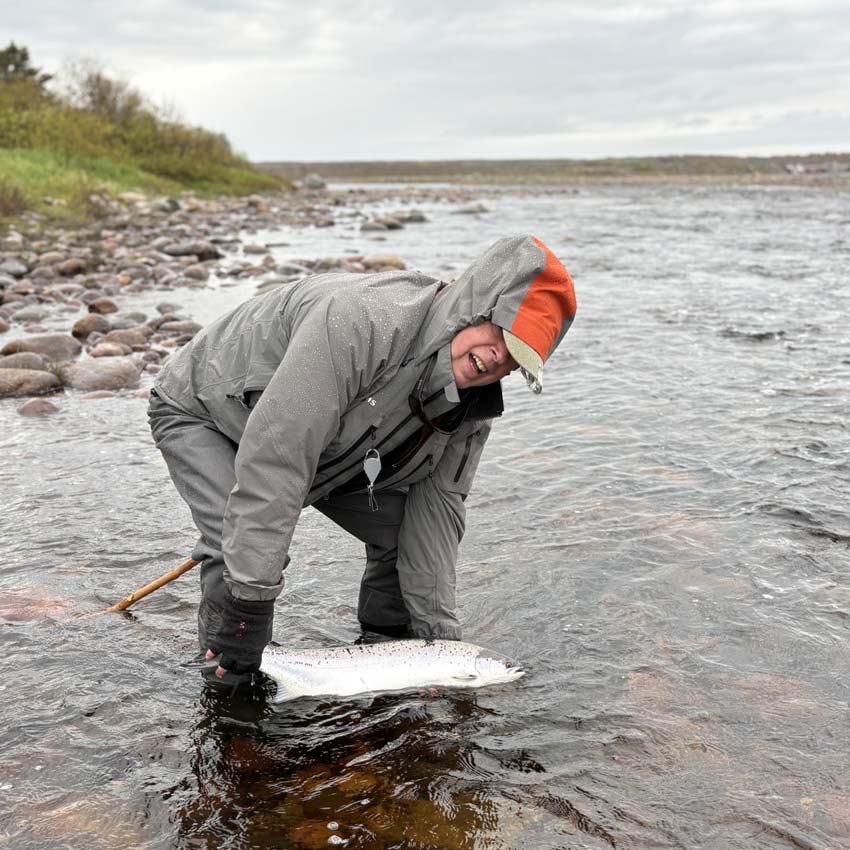
Photo: Dave Hennessey
“Last Friday, our group of Salmonid Association of Eastern Newfoundland
(SAEN) members and friends completed one week of salmon fishing in Bay St. George rivers. The rain started on our first morning on the river, and within five minutes Bob Bishop hooked, landed, and released a big fish of around 10 pounds. It was a good start to our week. The heavy rains, which swelled the rivers last Sunday and Monday, had largely run off by mid-week, and the rivers were at a nice level for fishing.”
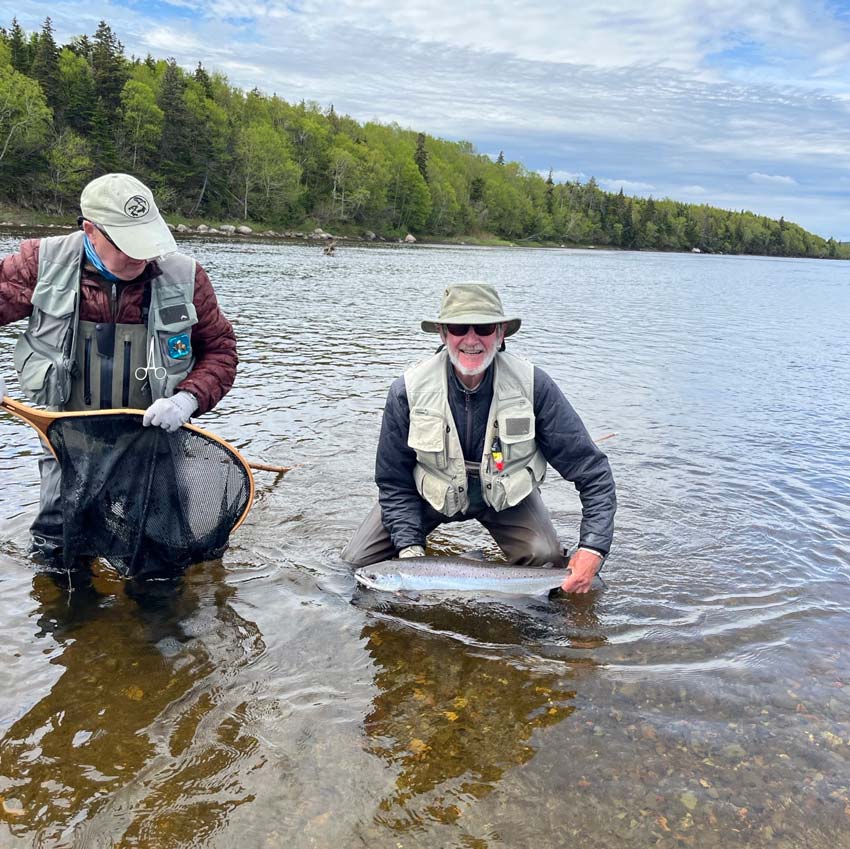
“Our hook-ups were sporadic, but included several big fish, including this one estimated to be around 14 or 15 pounds—hooked and played nicely and released by Dave Downton, with an assist by Bob Bishop—on the Codroy river on June 12th. Water was cold, around 10 or 11 degrees Celsius.”
Community Celebration of Atlantic Salmon
"Celebrate the Salmon," a weeklong festival in Trout River, took place at the beginning of June. The event included a beach clean-up, art, games celebrating the ocean, honoring salmon, and building a stronger community.
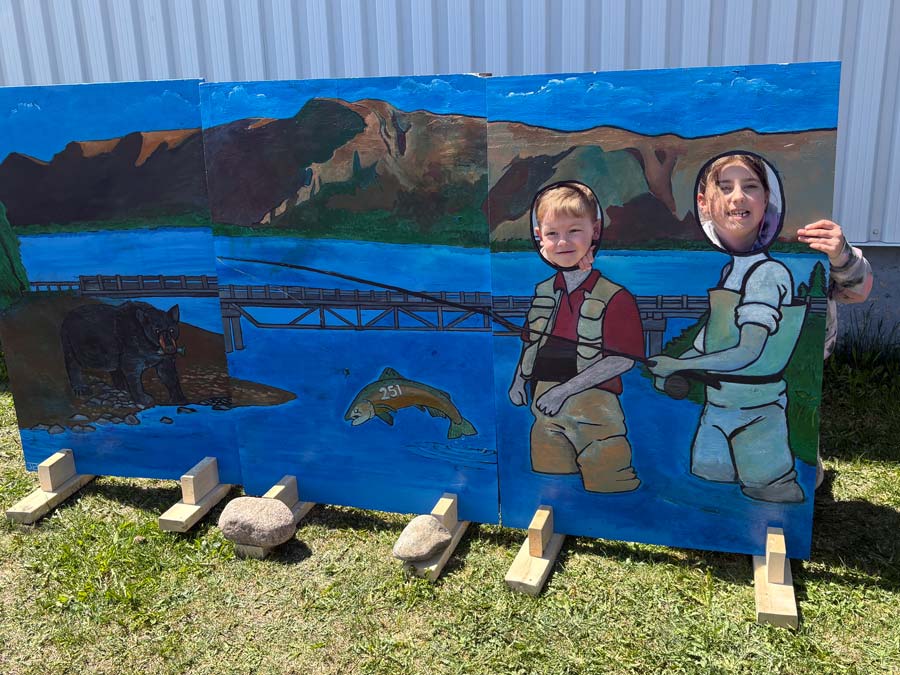
The photo above is of panels created by local artist Jesse Swift in collaboration with June Farnsworth. The number 251 on the salmon represents the minimum number of small salmon/fry needed to reopen Trout River to recreational salmon angling.
New Brunswick
New Brunswick Program Director David Roth reports on his first fishing trip of the season, on a famous Crown Reserve stretch of the Restigouche.
First Casts
After several weeks spent in the field and catching up on office work, I finally had the opportunity to take some time off and get out for my first salmon fishing trip of the season. I was fortunate enough to draw one of the renowned main-stem Restigouche stretches—the Three Sisters. Adding to the excitement was the opportunity to share the experience with anglers whose knowledge of the river spans decades.
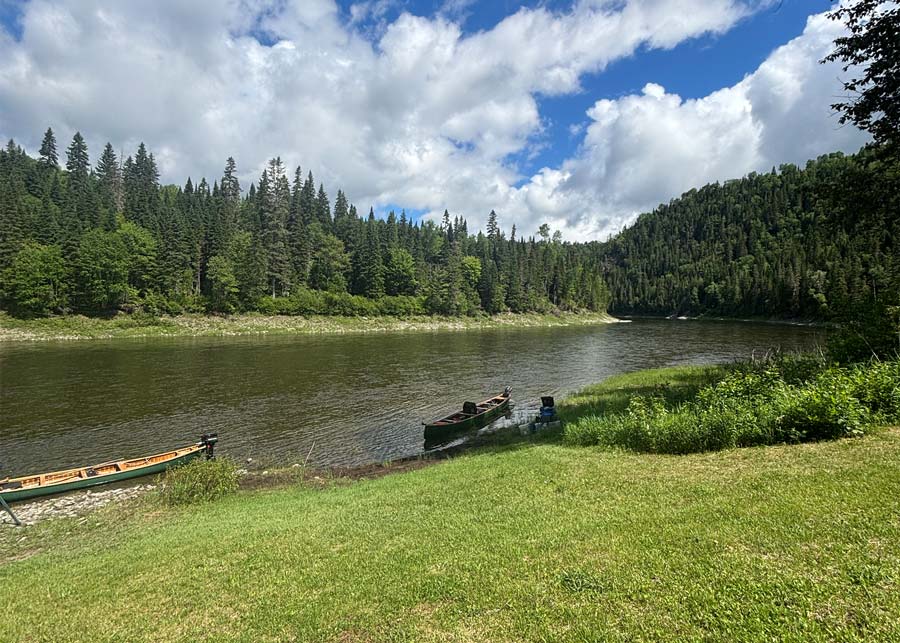
Photo: David Roth
One of the canoes was steered by Butch Dalton, President of the Miramichi Salmon Association, while the second canoe was in the hands of his longtime friend, Philip Lee, author of Restigouche: The Long Run of the Wild River. Spending time on the water with individuals who know the river so intimately was a privilege in itself.
Conditions looked promising. Reports of salmon catches were becoming more frequent, rain in the forecast was expected to provide a welcome rise in water levels, and cloud cover offered what many anglers consider ideal fishing weather. With these factors lining up, hopes were high that we might encounter one of the early-running multi-sea-winter salmon for which the Restigouche is famous around the world.
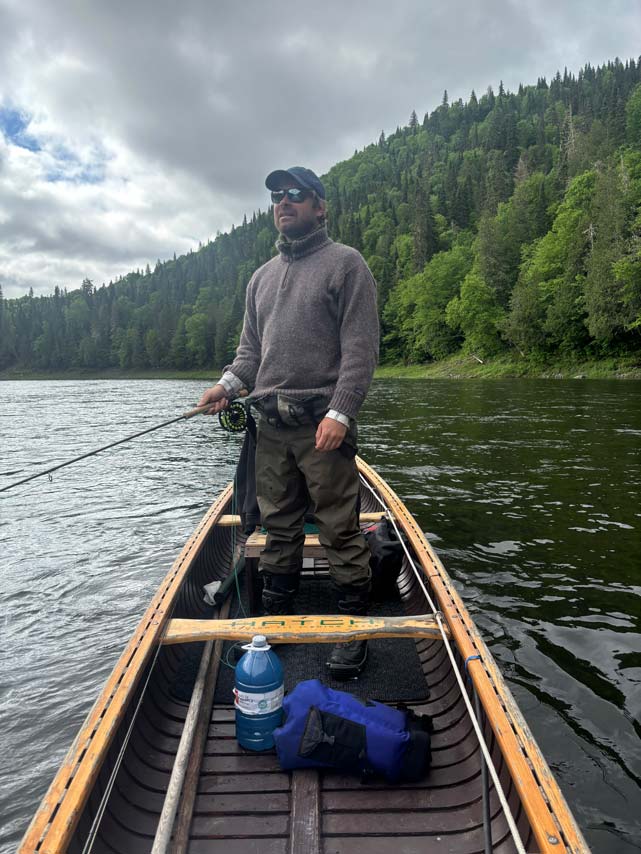
As is often the case in salmon fishing, however, success is never guaranteed. Over the course of a beautiful trip, we saw two fish but were unable to connect with either of them. While travelling upriver and speaking with anglers from neighboring stretches, we learned that the section below us experienced excellent fishing during the latter half of their trip, with several salmon landed, while anglers on the stretch above us were successful in bringing one fish to hand.
Although I returned home without connecting to a salmon, I certainly did not return empty-handed. The trip proved to be one of the most educational outings I have enjoyed in a long time. Listening to stories, learning about the river's history, and gaining insights from anglers who have spent many outings on these waters provided an experience every bit as memorable as landing a fish.
Maine
Jason Valliere, a marine scientist with the Maine Department of Marine Resources, is excited by the number of fish returning to the Penobscot.
Big Numbers of Multiple Species
Lots of salmon and shad returned this week! We had two days exceeding 1,000 shad, with four days surpassing 3,800 shad.
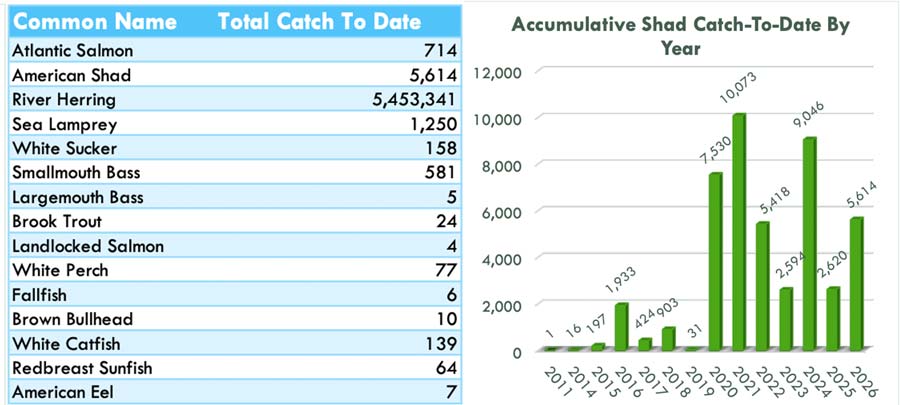
From Thursday to Sunday, we exceeded 100 salmon a day twice, passing over 370 salmon. We have already exceeded last years total run.
The river herring run is quickly tailing off, as we approach 5.5million.
Nova Scotia
Nova Scotia Program Director Matt Russell reports on an important cultural-exchange opportunity, featuring salmon experts from Finland and Norway.
Forging Connections
As referenced in last week's Rivernotes, ASF and our partners at the Margaree Salmon Association and the Chéticamp River Salmon Association recently had the pleasure of welcoming Thorra Hermann of the University of Oulu in Finland and Jan Erik Henriksen, Sámi professor and Director of the Indigenous Voices Research Group at The Arctic University of Norway.
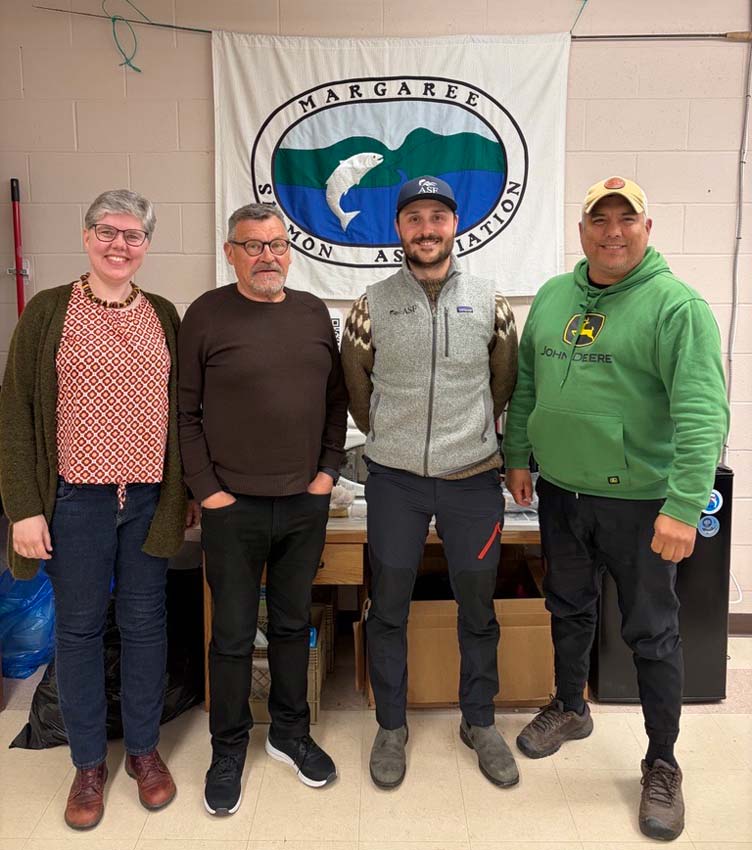
This was part of a North-to-North learning exchange through the European Union Horizon Initiative under the BIRGEJUPMI project. This project aims to strengthen community engagement, Indigenous knowledge and environmental decision-making in Arctic coastal regions of Sápmi and Kalaallit Nunaat that is based on the interconnected relationships between coastal people and the sea.
Our visitors have since published a blog post reflecting on their time in Nova Scotia and the connections they made while here. It is a thoughtful and worthwhile piece.
ASF Executive Director of Regional Programs Deirdre Green describes a fruitful public event in Halifax and shares a tribute to a conservation hero.
What If We Listened to the Salmon?
Last Thursday, I had the opportunity to attend a screening of What If We Listened to the Salmon? at the Bus Stop Theatre in Halifax.
Produced by the Fédération Québécoise pour le Saumon Atlantique (FQSA) in partnership with Groupe North Shore, the documentary takes viewers to the hearts of rivers, communities, and knowledge connected to Atlantic salmon. The film explores the challenges facing wild Atlantic salmon while encouraging dialogue and action to protect both salmon and the environments on which they depend.
Following the screening, a panel discussion, led by FQSA President Normand Fiset, featured Fred Whoriskey of the Ocean Tracking Network, Amy Weston of the Nova Scotia Salmon Association, Kirk Havercroft of Sustainable Blue, and me representing ASF. Discussion focused on what it truly means to "listen to the salmon" in management and conservation decisions, the importance of collaboration among governments, Indigenous communities, scientists, industry, and citizens, and the practical actions that can be taken today to protect and restore Atlantic salmon populations.
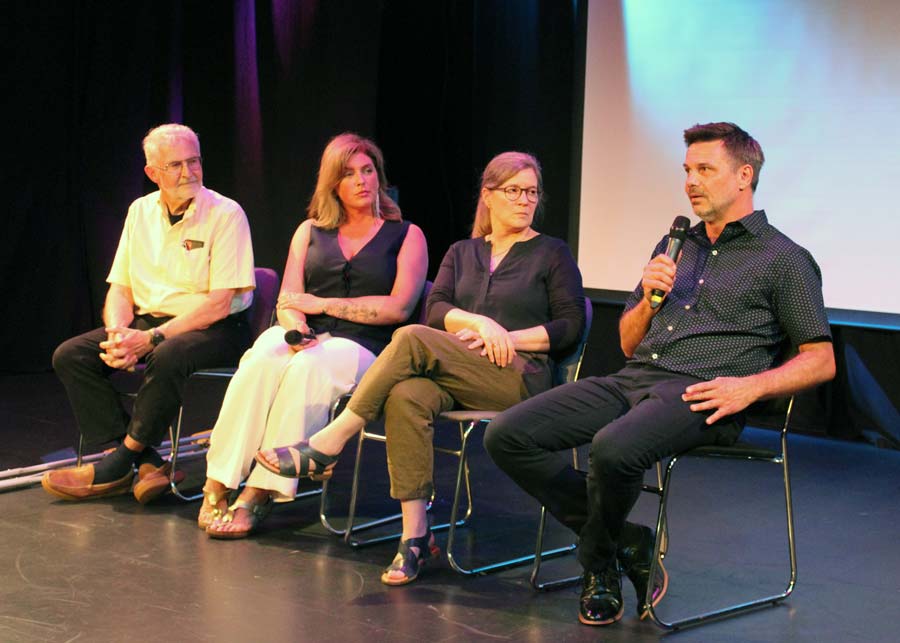
Events like this are valuable not only because they raise awareness, but because they bring together people from different backgrounds who share a common goal. It was wonderful to reconnect with partners, meet new faces, and see FQSA’s leadership showcased here in Atlantic Canada.
Thank you to Patricia Lacasse and Normand Fiset, for organizing and hosting the event, and to Amanda Leslie of the Ocean Tracking Network for capturing the evening through photography.
Additional screenings are planned throughout June and July. We encourage readers to learn more about the documentary and to support FQSA's ongoing work on behalf of Atlantic salmon.
One Last Fly for a Friend
Last week, I attended the celebration of life for a friend of the salmon, James “Jimmy” Lerikos. I first met Jimmy in 2016 in Gerry Doucet’s garage, which many of us affectionately dubbed "Salmon Central," following an Antigonish Rivers Association (ARA) biennial fundraising dinner. Since then, I have had the privilege of volunteering alongside him on the dinner committee, spending time with him on the river and at friends' homes, and sharing in countless conversations, laughs, and stories that seemed to naturally revolve around family and salmon.
Jimmy was a founding member and former director of the ARA, which is celebrating its 20th anniversary this year. In 2022, he received the ARA Special Recognition Award for years of leadership on the fundraising dinner committee and for his contributions to river restoration and conservation efforts in the region. He was also actively involved with Ducks Unlimited, a member of ASF since the early 1990s, and a dedicated supporter of the Nova Scotia Salmon Association. Jimmy believed strongly in giving back to the rivers, organizations, and communities he loved.
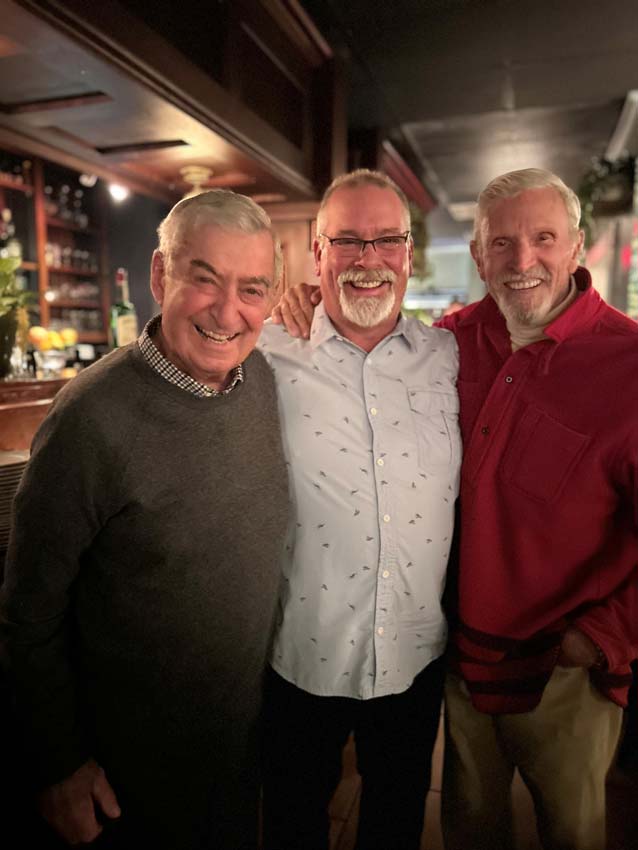
One moment in particular from last week will always stay with me: During Gerry’s remarks, he invited those connected to Jimmy through a shared passion for salmon to come forward and place a fly on his urn. A long line formed as friends offered one final gesture of respect. For those of us who shared time with Jimmy on the river, the moment felt especially meaningful. The flies represented friendships, memories, time spent on the water, and a deep love for these remarkable fish.
The rivers have a way of holding memories, and some people leave footprints on riverbanks that never wash away. Jimmy was one of those people. His legacy lives on in the rivers he helped protect and in the many people fortunate enough to have called him a friend.
Wild Salmon Watersheds
Kris Hunter, Regional Director for Wild Salmon Watersheds, pens an extensive wrap-up of recent activity, including a fascinating collaboration with ASF's Research team on the Terra Nova River in Newfoundland and Labrador.
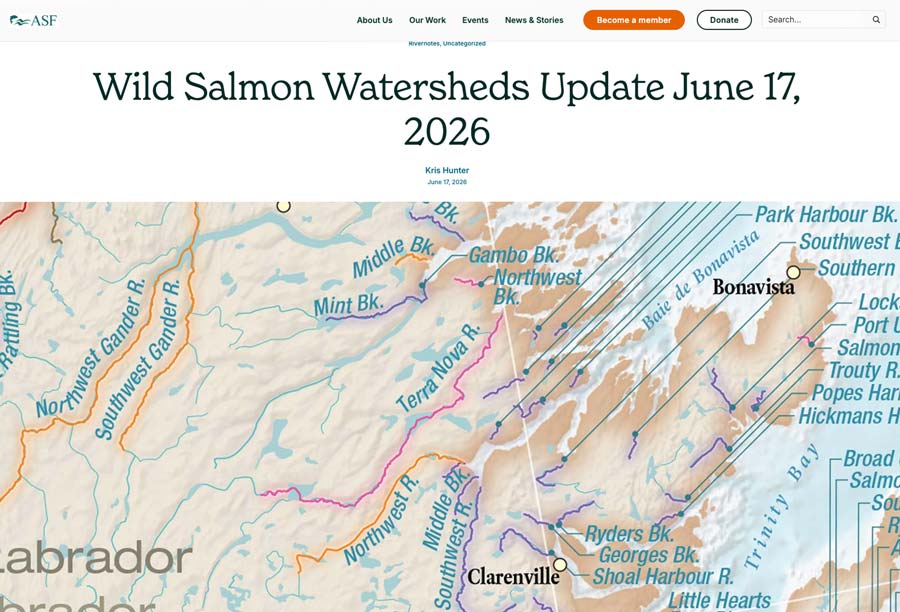
It has been a busy couple of weeks for the Wild Salmon Watersheds (WSW) team. As WSW Science Coordinator Jordan Condon reported last week, our smolt-wheel operations on the Nepisiguit and Chéticamp were wrapping up, so we have been working with our partners to collect the last few fish and get the wheels out of the water and back into storage. The smolt wheel on the Terra Nova continues to operate but had to be significantly readjusted to accommodate the rapidly dropping water. With the adjustment, our catches rose almost fourfold, so with water temperature still in the low teens, we are hopefully that we will continue to catch many more smolt on the Terra Nova. Huge shout out to all those that helped during this challenging . . . . (more)